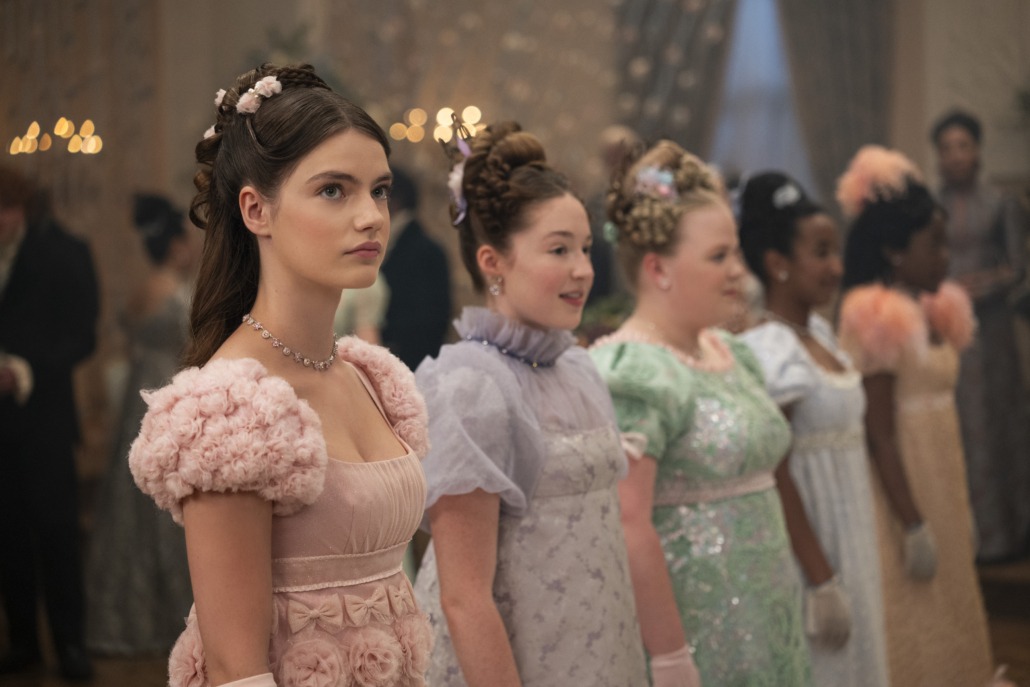
When Netflix released the new central couple for the fifth season of “Bridgerton,” straight women everywhere lost their minds. Instead of the events of the book, with Francesca Bridgerton falling in love with Michael Stirling after she is widowed, Francesca will fall in love with Michaela Stirling.
Fans immediately took to commenting on non-“Bridgerton” related posts from showrunner Shonda Rhimes and on the “Bridgerton” Instagram decrying the decision, with one fan writing that the change “ruined the best series that Netflix had with its forced inclusion.” Most fans were not this outwardly hostile; they instead couched their disappointment in variations of “I’m not homophobic, but…”
Setting aside the fact that “Bridgerton” has been inclusive by design since the beginning, with a racially diverse cast and sexually empowered women, it is strange that a show geared toward women would have fans so opposed to a season with two female leads.
Daily headlines, sent straight to your inbox.
Subscribe to our newsletter to keep up with the latest at and around USC.
Interestingly, these fans did not seem against the inclusion of a bisexual Benedict Bridgerton or a gay male couple in the spinoff “Queen Charlotte.”
To dispense with the obvious, the primary audience of “Bridgerton” seems like straight women — who have notoriously centered their feminism on equalizing heterosexual relationships and not on liberating all women. Their love for the show, especially its straight-ness, makes sense given the line of attractive “rakes” who, generally, sweep the female main character off her feet.
These are the same women who consumed “Heated Rivalry” at record-breaking speeds. Yes, there is the wish fulfillment and potential fetishization of watching two hot hockey players fall in love. But “Heated Rivalry” is also curiously devoid of any fully-realized female characters.
In a truly egalitarian world, the legions of straight women who consumed “Heated Rivalry” would be thrilled about lesbians in “Bridgerton.” Just like they were excited about two dynamic men in leading roles, they should be excited that there are two dynamic women in leading roles on television. But, as illustrated above, they are not.
It’s hard to make any comparative statements about lesbian television romances because there are not really any. “Yellowjackets,” a show about young, queer soccer players stranded after a plane crash had 3 million views of its 2025 finale in its first seven days while “Heated Rivalry” had an average of over 10 million per episode.
Generally, lesbian representation is lacking on American television. Every year, GLAAD puts out a report entitled “Where We Are on TV” chronicling LGBTQ+ representation in the media.
From June 1, 2024 to May 31, 2025, GLAAD’s 2025 report noted that across cable, broadcast and streaming television, gay men were the most represented LGBTQ+ demographic. Meanwhile, for cable television in 2025, the number of lesbian characters dropped 11 percentage points as a share of all LGBTQ+ characters compared to the prior year. For broadcast, the decline was five percentage points as a share of LGBTQ+ characters. Streaming was the only section with an increase, but even this was only five percentage points.
Most of these characters are not primary romances, instead being side characters, sometimes, with already existing relationships. CBS’s “Matlock,” for example, has a side character who enters into a relationship with a woman who has only appeared in four episodes.
Women falling in love with each other is still novel.
This speaks to a larger lack of solidarity between straight and gay women. There is historical precedent for this. During the second-wave feminist movement, lesbians were systematically excluded. Despite Pauli Murray, one of the National Organization of Women’s co-founders, being a lesbian, feminist pioneer Betty Friedan removed lesbians from NOW’s New York chapter. Since a crucial part of feminism’s goal at this time was equality with men, lesbians did not factor into the heteronormativity.
The second-wave feminist movement was highly contingent on relationships with men. This may have seemed necessary at the time, when the movement was begging to be taken seriously by the patriarchal establishment and thus needed to appeal to male sensibilities. Lesbians were seen as too masculine and thus complicated the gender dynamics necessary to Friedan’s version of feminism.
Lesbians were able to exist outside of the heteronormative dynamic and were thus a threat to the movement. Friedan called them the “lavender menace,” as feminism did not want to be associated with “man haters.” Actively purging lesbians from feminist movements ignores the totality of the experience of being a woman. It is possible to exist not just equally to men, but separately from men.
Even today, the idea of feminism as equality between the sexes presupposes that the only dynamic that exists is between men and women. There are relationships beyond heteronormative dynamics. Modern calls for de-centering men seem to stop at consuming media about two women falling in love. De-centering men means taking them out of on-screen romance too.
Just as lesbian women have watched straight couples and gay male couples pervade popular culture, these groups will survive watching two women fall in love. Lesbians deserve to have swoony romances too. If straight women don’t want to watch, their support for women is conditional.