CHRONICALLY ONLINE
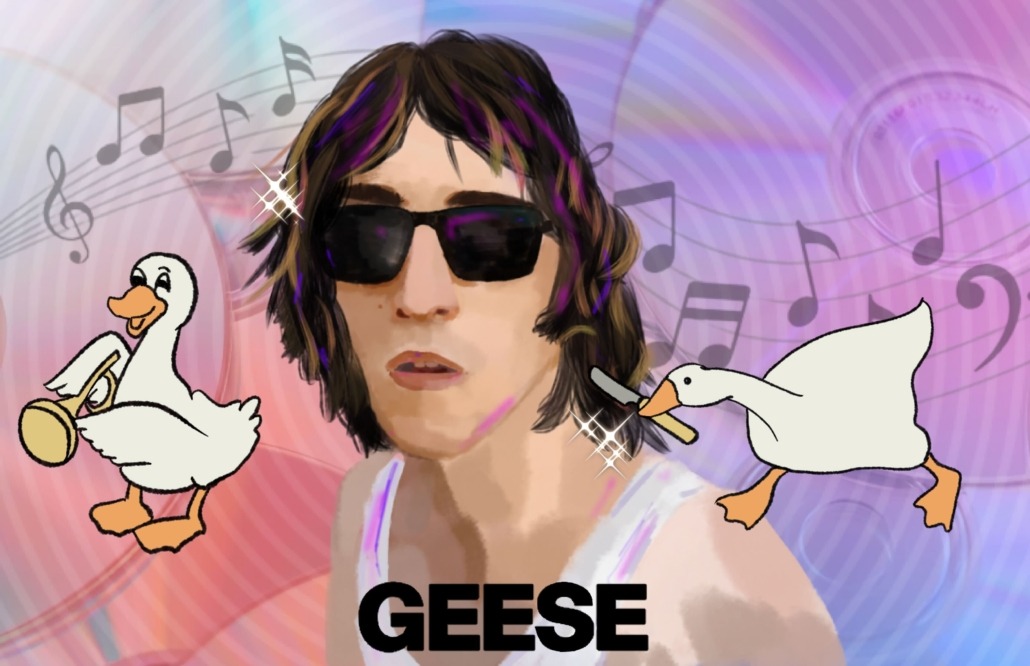
I don’t care that Geese was a psyop
It’s one thing if the industry is shoving an artist down your throat; it’s another if they’re good.
By ANNA JORDAN

It’s one thing if the industry is shoving an artist down your throat; it’s another if they’re good.
On April 14, I thought either someone in my family had died or I had somehow accidentally posted a picture of my bare butt on the internet. Those were the only two reasons I could think of to explain why my phone had been blowing up during my tech-free class. So I girded my loins and checked my phone.
“The Fanfare Around the Band Geese Actually Was a Psyop,” read the headline of WIRED’s freshly posted article from writer John Semley. Knowing I was a fan, several people had sent me the article, like a friend informing another that their favorite celebrity had died or that Trader Joe’s had discontinued their favorite snack.
To be honest, I didn’t really care.
Semley likened the boom of success that Geese had in late 2025 to a psyop, or what is traditionally a military operation with the goal of subliminally or noncombatively influencing an enemy’s state of mind, often via the written word — a clever and genuinely funny use of hyperbole, but one that also poses an interesting question about the reasons we levy to justify listening to the music we choose to.
The psyop Semley reports on is that Chaotic Good Projects, a digital marketing company, ran an internet campaign throughout 2025 to bolster Geese’s public reputation with cultivated impressions and posts. While the group is adamant that they don’t use artificial intelligence or bots to farm engagement, Chaotic Good Projects creates and implements thousands of accounts, aiming to boost the awareness and clout of its clients.
At the time of publication, it remains unclear who at Geese was behind the choice to hire Chaotic Good; nevertheless, this artificial interest doesn’t really bother me that much.
Sure, it’s dystopian that the internet — a place created by and for humans — has become a cesspool of robots or marketing schemes echoing meaningless platitudes at each other, but according to Semley, “It’s an open secret in the music industry that all the numbers — play counts, followers, stats — are fake or at least obfuscated.”
I don’t care because, for a marketing campaign like this to stick, there needs to be talent behind it. And Geese has got it. Their more stylized approach to rock as a genre speaks to me and reads as a fresh approach to an extensive tradition of emotional expression.
As an avid consumer of media, I feel like I am constantly being sold artists as products as opposed to their music being the goods. Personas, perspectives, perfection, all promised in a perfidious attempt at virality and, therefore, profitability.
But when does a psyop just become good marketing? If I believe the marketing to a certain extent and I like the music, I don’t mind that a “psyop” brought Geese to my door. And I know this because others have failed.
An artist whose marketing I don’t believe in, yet whose music I don’t mind, is Addison Rae, seemingly everyone’s favorite rising star. I often feel like I’m the only one who remembers her first single, “Obsessed,” and how desperate for virality it was.
It’s not abnormal for an artist’s persona — or even the artist’s music— to be designed to maximize engagement and profitability. Don’t get me wrong, evolution and change are welcome for all artists in my book: Perhaps she truly changed over time.
But everything about Rae — her production, her fashion, her makeup, her visual aesthetic, her lyrics, her choreography — feels like it was cooked up in a twink laboratory whose sole goal was to get everyone screaming “Mother!” on X.
And yet, I don’t mind Rae’s music. It’s fun, it’s flirty, it’s a little interesting. And she put on a damn good show at Coachella. So, she fulfills one-half of my requirements for a psyop to become good marketing.
An artist who doesn’t fulfill either criterion — whose story I don’t believe and whose music I find disturbingly generic — is KATSEYE. The girl group reminds me that I’m a consumer and that I am making a conscious decision to “buy” a product by listening to their songs.
Their music reminds me that in the virality wars, artists are begging me to slip them some attention under the table until they can pay me back later, itching for their next fix of engagement.
KATSEYE’s existence is a direct product of trying to summit the algorithm: the now five-girl group — notice how I didn’t say band, which is a group of musicians that collaborates to create their songs — was born of “The Debut: Dream Academy,” a competition show in which a slew of incredibly talented young women battle it out for six spots in what will be an elite singing and dancing group that promises exorbitant talent and money-making potential.
The show and KATSEYE itself are all about maximizing the expected value of these women’s immense talent, and it shows in their music: It’s generic, trend-conforming cash grabs that are inoffensive at best and concerning for the culture at worst.
I don’t care if I sound pretentious: Tell me that this group’s label is not reducing these women to vehicles for corporate slop, the fast food of music, when they sang “Hottie, hottie, like a bag of Takis / I’m the shit” in front of Joni Mitchell at the Grammys.
But, as of 2025, both KATSEYE and Rae were nominated for and performed at the Grammys, while Geese wasn’t even in the conversation. Pretentious people like me are saying one thing while the industry is saying another.
All I can ask of you is to trust your ears and your instincts; if you like KATSEYE, don’t let me rain on your parade. If you hate Geese, all power to you. But try to evaluate when and why the art becomes enough for you as both a listener as as a human being, make those connections and analyses whenever possible. Because without some critical thinking, the echo chamber of bots online will promise the world music a lot worse than the likes of Geese.
Anna Jordan is a junior writing about pop culture controversies in her column, “Chronically Online,” which runs every other Thursday. She is also Chief Copy Editor at the Daily Trojan.