Former UK Prime Minister says civic life is in decline
Provost Andrew Guzman and Gordon Brown talked about civic participation.
By RYAN YOUK & ADAM YOUNG
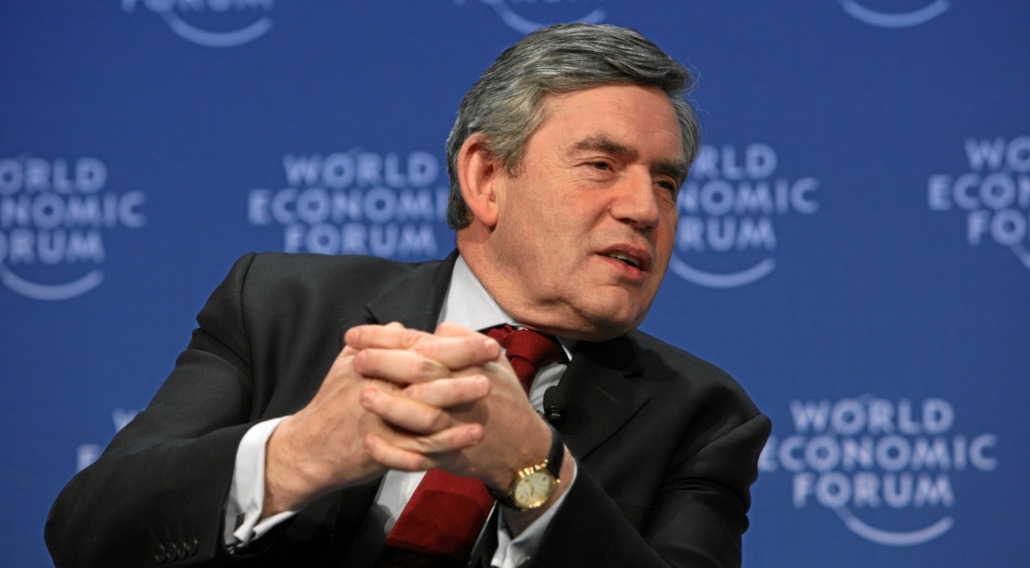

Provost Andrew Guzman and Gordon Brown talked about civic participation.
Former Prime Minister of the United Kingdom Gordon Brown said that universities stand for rationality, impartiality, objectivity, the pursuit of truth and the search for knowledge. The audience laughed when Brown joked that all of these were qualities he abandoned when he entered politics.
The USC Schaeffer Institute for Public Policy & Government Service hosted Brown, a Schaeffer Distinguished Scholar, at Town and Gown on Wednesday for a fireside chat. In a conversation with Provost Andrew Guzman, Brown talked about the decline in civic trust, loneliness and individualism, as well as the global rise of right-wing parties.
Brown served as Britain’s prime minister during the 2008 financial crisis. Bob Shrum, director of the Center for the Political Future, described Brown as a political strategist who brought the Labour Party — a liberal party in the U.K. — back into power and stabilized the globe’s banking and financial system.
“He’s been a leader in the effort to build a rules-based world order that he insists must be both fair and a force for peace, and as the [United Nations] special envoy for global education, he has helped raise billions of dollars to support children in crisis,” Shrum said.
Brown is the chair of the new Center for Civic Society at the Schaeffer Institute, which Guzman said is investigating the causes of widespread dissatisfaction in elections. Through the Schaeffer Institute, Brown said a study with 100,000 people from across 35 countries found that more than half said they were not involved in any civic activity.
In the same study, Brown said they found that people’s informal relationships have also weakened. More than two-thirds of people asked said they have five or fewer friends, and in the United States, Brown said a seventh of the people asked said they had no friends at all. This, Brown said, is one of the many reasons behind civic decline.
Brown said that the decline in interpersonal relationships, as well as a decline in trust, across the world in governments across the world, has resulted in a rise of populist, nationalist politicians.
“In almost every major country in Europe, a right-wing, populist, nationalist party — which is anti-immigration, xenophobic, anti-environment, anti-trade, anti-globalization — is actually in the lead in the polls,” Brown said. “The phenomenon of popular nationalism is not facing one continent, it’s right across, and it’s something that we’ve now got to address.”
Guzman asked Brown what he believes is the cause of civic society’s decline. Brown said for the last 50 years, there has been a rise of individualism, which has made peopleus lose a sense of a strong society. And with the advent of social media, loneliness has intensified.
Brown said reviving civic society is crucial because if not, it could create a “vacuum” that can be filled by an extremist from any side of the political spectrum.
“People will turn to people that offer easy solutions when they don’t find that the existing civic society and the organizations, including political parties, are rooted in the communities in which they live,” Brown said.
In a Q&A portion of the event, Brown answered questions submitted by the audience, one of which asked what investments universities should make to help grow social capital. Brown said that the social benefits of universities are meeting people from different backgrounds.
“People are more likely to be engaged in their community, and at a later stage, more likely to resist the kind of nationalist ‘us versus them’ idea of the world, or a zero-sum view of the world,” Brown said.
William Leach, a teaching professor at the Price School of Public Policy, attended the event and said it was nice to hear someone with a depth of experience.
“One thing that I connected with is [that] one of his sources of hope is young people and college students,” Leach said. “It’s one of the reasons why I work in universities … being connected with young people who are thinking about the future and thinking about ways that they can personally make the world a better place.”
Alashia Jones, a sophomore majoring in public policy, was one of the students who came to the event to reflect on civic engagement. She said she finds stepping into new spaces to be crucial in shaping our decisions.
“It is important to have discussions and debates among the people who you’re around, because I feel like … knowing what elections are coming up and what policies are being passed are important because policy affects every aspect of our lives,” Jones said.