First USC student wins Machtey Award
Professors said that Miryam Huang pushed forward the field of quantum computing.
By ASIANA GUANG
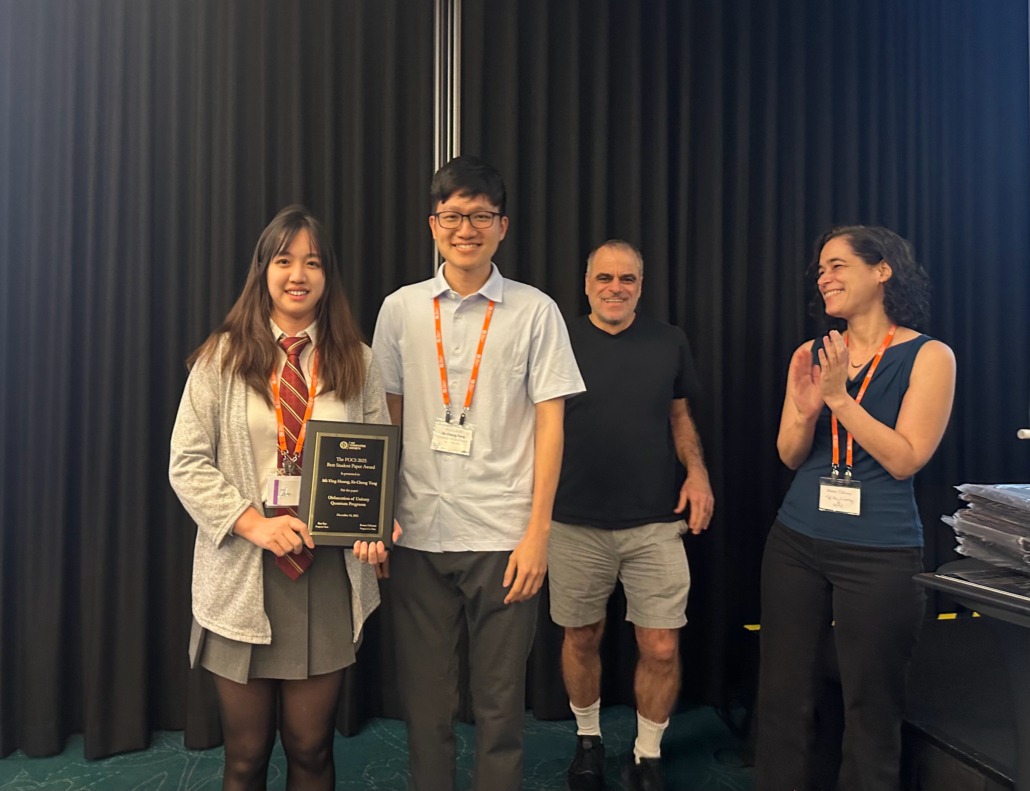

Professors said that Miryam Huang pushed forward the field of quantum computing.
Puzzle pieces, board games and origami scraps once scattered Miryam Huang’s childhood, each a small opportunity for her to solve a problem. Her early love of pattern and play has since transformed into something more complex: the world of math, physics and cryptography.
Huang, a Ph.D. candidate studying computer science, is the first USC student to win the Machtey Award, a prestigious prize given at the annual Institute of Electrical and Electronics Engineers Symposium on Foundations of Computer Science, for Best Student Paper.
After winning the award, though, Huang said she feels pressure to keep up the good work; there’s no time for her to rest on her laurels yet.
“This is like a really good award, and it’s like a really good achievement when I’m a student, but I know that there are more and more people who are better than me,” Huang said. “I feel like I should be more humble and do more great work for this field, and then just don’t let them down.”
The content cryptography paper, co-authored by Huang and Er-Cheng Tang, a Ph.D. candidate at the University of Washington, explores quantum obfuscation — the process of transforming an original program or circuit into an unintelligible version while preserving its functionality. The research builds on earlier work in classical cryptography, including a problem first proposed in 1976.
“People in the quantum cryptography [world], they actually want to see whether a similar, strong notion exists in the quantum world, or for quantum computation,” Huang said. “We define the quantum version of obfuscation for general or unitary transformation.”
This concept can be explained through the context of a video game’s pseudocode, according to Huang. If someone shared the code in a video game with someone else, that person would not be able to view the original code, but its functionality would remain the same.
“[A video game artist] can still execute this game, can still play this game, but they cannot see the internal structure,” Huang said.
Shanghua Teng, a professor of computer science and mathematics who worked closely with Huang through USC’s Computer Science Theory group said her strength as a researcher stemmed from her many curiosities and talents. Huang also served as his teaching assistant three times.
“She’s a remarkable student, and [she] sometimes came to my office just to explain to me what she’s thinking,” Teng said. “Most of the time, I’m just learning from her.”
Teng said Huang’s work is a breakthrough in the quantum computer science field because it is a major modern concept in cryptography.
“[Cryptography is] when you have a program you want to, in some sense, transform into another program so that the people cannot do reverse engineering,” Teng said. “This concept can be used for many modern applications.”
However, her path to answering one of quantum computer science’s complex questions was not a straightforward one, as she faced several obstacles along the way. She initially set out to pursue other research paths before she realized her goal was too ambitious.
“I was not satisfied … I spent … nine months for just that part, and then I got a pretty weak [result],” Huang said. “It’s tough when [I’ve] got nothing.”
Jiapeng Zhang, an assistant professor of computer science and Huang’s Ph.D. advisor, said her strong work ethic helped her stay committed to her research despite setbacks.
“I also studied a long-term problem for a while … for four years, and [had] a lot of collaborators while I was doing that problem,” Zhang said. “A lot of collaborators, they just left after a few months, whenever there’s no progress. So it happens a lot.”
Huang and her co-author Tang’s most recent work in January includes a completed solution to the question posed in their first paper that won the Machtey Award.
“[The first paper] is kind of like the stepping stone for us to get full-fledged content obfuscation,” Huang said. “This year we made it. We got the first content obligation for arbitrary content circuits.”
Teng said Huang’s goal was not to win the award, but to resolve something she was curious about in her mind.
“She has wonderful taste in selecting a problem, because this problem is fundamental and it’s challenging,” Teng said. “She has intuition, she has [the] background and she has [the] interest to push.”
Huang said her grandmother was her biggest supporter for her love for mathematics growing up.
“If I wanted to say ‘Oh, I like math,’ she would be like, ‘Okay, I’ll 100% support you to do math,’” said Huang.