Have the damn fight: Avoidance is not satisfaction
If we continue to escape all conflict, true and authentic intimacy will never be ours.
By MILAN HOANG
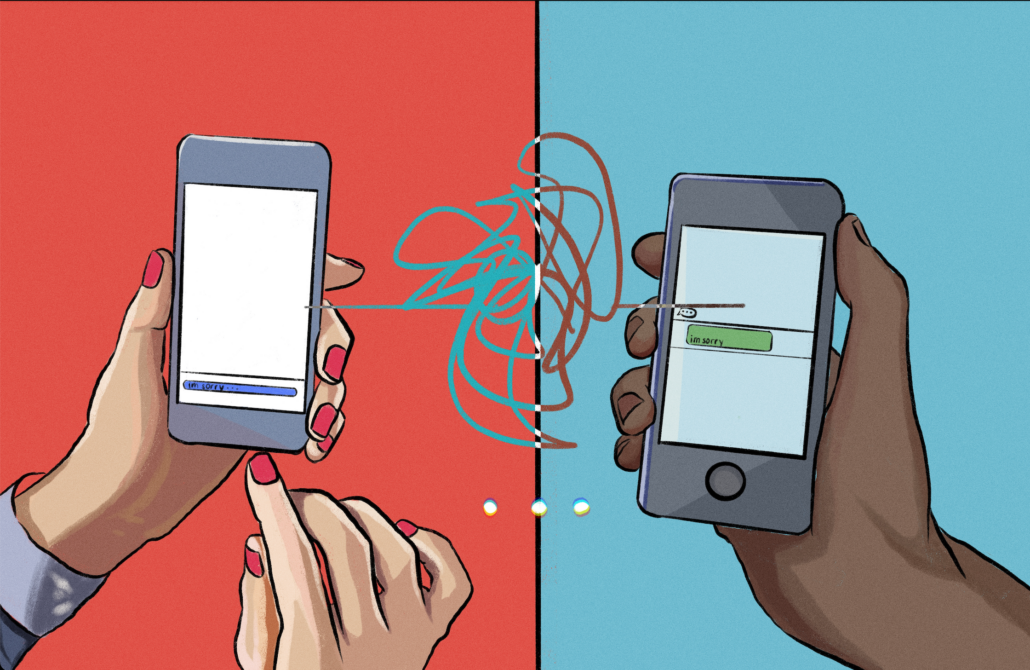

If we continue to escape all conflict, true and authentic intimacy will never be ours.
“Protecting your peace” is an illusion to mask emotional avoidance. We are quick to shame and judge others by labeling them as “emotionally unavailable.” Conflict becomes something we try to avoid, rather than understand.
This pattern is often referred to as modern “cut-off culture,” a tendency to abruptly end relationships — whether it be friendships, romantic partnerships or even family ties — without attempts at communication and repair. Social norms today encourage ending relationships quickly rather than working through conflict. It’s “self-care.”
But self-care has become a common justification, one that blurs the lines between protection and withdrawal. Not every uncomfortable interaction is a violation. Not every disagreement means that the relationship is fundamentally broken. It can be the natural result of two people with different perspectives working to coexist in the same space.
And if love is ever going to mean anything real, it has to be able to withstand that friction. Love is never something you can lose; it’s something you get to live in and move through.
The pressure to appear secure and fulfilled makes people less willing to engage in the uncomfortable, honest conversations that real intimacy requires. Conflict becomes something to hide or bypass. Every disagreement risks being interpreted as a “red flag,” making people default to distancing themselves and keeping their opinions behind closed doors.
As an avoidant person, the urge to withdraw isn’t necessarily the easiest to combat. There’s control in silence, in stepping back before anything escalates at the risk of hurting yourself. You don’t have to risk saying the wrong thing, being misunderstood or confronting the possibility that you might be at fault too.
Avoidance can appear as a strength when you look disengaged and indifferent. More often, it’s fear. A fear of vulnerability, abandonment, confrontation and of what might surface if the conversation actually happens. The overuse of this coping behavior can lead to isolation, unprocessed emotions and a missed chance to grow in relationships.
An avoidant front doesn’t just affect the person who leaves. It shapes the emotional expectations of everyone involved. When relationships end without explanation or an effort to reconcile, it sends the underlying message that connection is conditional.
At the same time, relationships are increasingly performative: gifts, curated social media posts and public validation are used to signal to others that a connection is thriving. These contrived actions are used as indicators of relational success. This creates a paradox: Relationships are optimized to appear healthy rather than to function healthily, ignoring the importance of conflict resolution.
We chase the idea that if something is right, it should feel completely natural at all times. So when conflict pops our little bubble, it feels like proof that something is wrong, rather than evidence that something real is happening. Real connection is about having endurance and choosing to feel instead of shutting down.
We are constantly hearing conversations and experiencing situations of cut-off culture at USC. Someone moving out of their double the day after conflict or a relationship where both parties become blocked on social media. Then the trails of hidden conversations and side comments follow, circulating in shared spaces until resentment builds a stronger wall than the original disagreement ever did.
What’s interesting isn’t just how quickly relationships can end — it’s how rarely they’re given the chance to evolve. Discomfort becomes the endpoint, rather than the starting point of understanding and developing intimacy.
Conflict forces clarity when handled with care. It reveals expectations that were never discussed, boundaries that were never fully defined and emotions that were never acknowledged. It requires people to be accountable.
But this emotional intimacy takes effort, and even worse, risk. You have to be willing to speak rather than suffocate your emotions. You have to accept that the other person might not respond the way you hope. You have to be ready for both discomfort and resolution. You have to stay present long enough for growth to be possible.
That’s the very thing cut-off culture often avoids: the potential growth that comes with conflict. Because to grow in a relationship, you have to feel — fully, honestly and sometimes painfully. In that culture that prioritizes comfort, that feeling can seem like failure. It manifests as rejection.
But it isn’t. It never was. If we treat all of these situations the same, we lose something essential to the human experience: the ability to build relationships that are resilient and beloved.
That’s the shift we need. Not away from boundaries, but away from the idea that cutting people off is always the healthiest and right choice.
As long as you’re willing to feel — to risk your comfort and take down your walls, to remain present even when it’s easier to leave — you are alive through love. So, consider making the harder and more meaningful decision to stay.