Care on wheels: Inside USC’s Mobile Dental Clinic
The clinics offer treatment for a range of dental issues, including cleanings, fillings, extractions and root canals.
By DAHLIA BECK
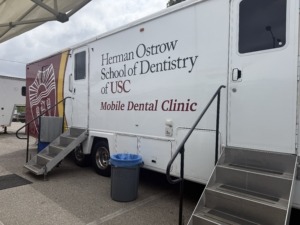

The clinics offer treatment for a range of dental issues, including cleanings, fillings, extractions and root canals.
Scattered throughout the parking lot at the Veterans Affairs Campus in West Los Angeles are USC trailers. The trailers simply say “Mobile Dental Clinic.”
This is one of many stops for the Mobile Dental Clinic of the Herman Ostrow School of Dentistry of USC, the largest fleet in the nation outside of the United States military. Founded in 1968, the Mobile Clinic has been operating for over 50 years in Central and Southern California, offering dental services to the community. Currently, 12 mobile dental clinics are in rotation.
The mobile clinic typically operates once a month at various sites, spanning one week of patient care. Clients are often children or veterans who lack traditional housing or are unhoused. For the latter, the clinic has partnered with Village for Veterans since 2021, a nonprofit organization that assists veterans and their families.
“We have the best patients ever,” said Sunny Fereshteh, the dental director of the mobile clinic and the section chair for mobile programs at USC. “In every clinic we have, they’re the most grateful, they’re the most kind. They are the ones that are worried about their shelter, they’re worried about their food, they’re worried about their safety, their security, yet they come grateful. They come here positive.”
When the clinic was created, its intended patients were farm workers in the Central Valley. Within a year, it changed to the children of farm workers, and since the pandemic, the scope of care has shifted toward “where the need is.”
On Thursdays, Fridays and Saturdays, a large portion of the care is provided by volunteer dental students at Ostrow. Ryan Ordaz, a mobile director of the clinic and a third-year dental student, said that the difference between working in the classroom and doing hands-on dental work is enormous.
“A lot of these patients that we’re seeing today don’t have access to any dental care,” Ordaz said. “Some of the people haven’t had cleanings in over 10 years, [and] a lot of them also come in with [post-traumatic stress disorder] or high anxiety levels, so we really cater to the patient, versus doing what we may normally do in a normal practice or even in a school setting. We’re all here to show up for the patients and get the standard quote, basically, and cater the treatment to what they need and how they need to be treated, or do any treatment modifications for anxiety, like quiet rooms.”
Five to six faculty members oversee the treatment at every stage. One faculty member is Robert Peters, a clinical associate professor in Ostrow, who said he feels engaged with the community through the clinic.
“I’m a veteran,” said Peters. “I served in the Navy for 36 years, and for me, [the clinic] is a great opportunity to help my brothers and sisters who may have come before me who are now retired in the community with significant dental treatment needs. It’s a great opportunity for USC to be involved in the community.”
Fereshteh said that the clinic has felt the impact of federal funding cuts to partner migrant education programs, causing some branches to question whether or not they will be able to continue. U.S. Immigration and Customs Enforcement raids in Los Angeles since 2025 have also driven down clientele rates.
“At least half of our clinic is very consistently serving migrants and those who are newer to this country,” Fereshteh said. “There is definitely a fear to show up. We’ve seen in some of our schools that with the sign-up rate [of patients] who are willing to come and feel safe, there’s definitely a lower registration of patients.”
The clients who do show up, do so in spite of their hardships, Fereshteh said. In her eyes, one of the most rewarding parts of the clinic is observing how invested students become.
“These students are all half my age, and they’re extremely motivated,” Fereshteh said. “I see their connection with patients, and with, let’s say, an unhoused veteran who’s in their 60s who needs just some love, attention and compassion. I see a 25-year-old dental student who comes from a very different background connect with a veteran. If they can connect with someone that is so different from their experiences, they’re going to connect with any patient that they serve and treat, and that is the goal.”

