Cinephiles play hooky at screening club
A variety of genre films are shown at the Movie Hooky Club on an IMAX screen.
By DUNCAN E. GEISSLER
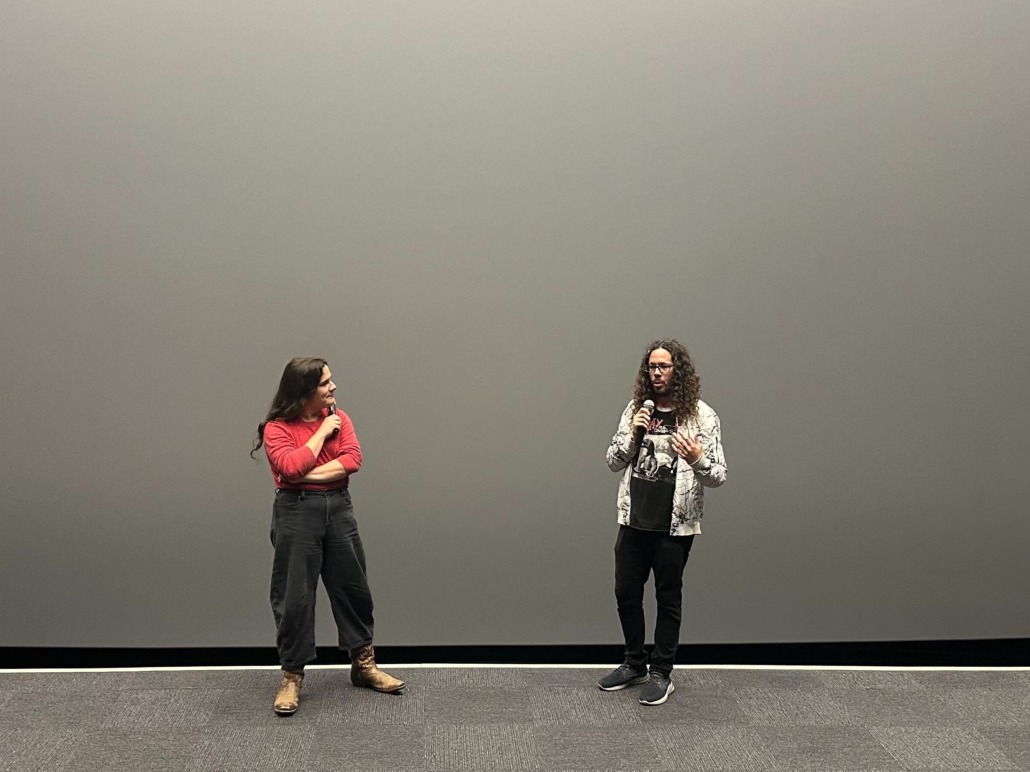

A variety of genre films are shown at the Movie Hooky Club on an IMAX screen.
Each Tuesday at 3 p.m., in the IMAX screening room of the Zemeckis Center for Digital Arts, a film club meets to watch some non-traditional picks.
There’s no “Avengers” or “Star Wars” movies in sight. Instead, the films screened belong to the nebulous title of “genre film,” which often contain graphic violence or moments so strange the audience simply has to laugh. It’s one of the most open, welcoming odes to cinema on campus.
The Movie Hooky Club was officially founded in Fall 2023 by Alex Ago, the assistant dean of programming and special events at the School of Cinematic Arts and graduate of the cinema and media studies masters program, and Bret Berg, the theatrical sales director of the American Genre Film Archive. Ago said he founded the club in order to dedicate time to work through the many films he had purchased, but couldn’t find the time to watch.
“I was just amassing a lot of stuff,” Ago said. “‘I want to see this stuff. I’m not getting to it at home. Let’s put it up on the big screen.’ That was really the genesis of it.”
By working with AGFA, Berg said he coordinates theatrical distribution for a massive index of films, from restoration home media labels like Vinegar Syndrome, Severin, Arrow Video, Shout! Studios, Troma and more. These films are given to repertory cinemas — theaters that prioritize older films rather than first-run releases — to showcase.
Los Angeles has a strong repertory scene, including theaters like the Egyptian Theatre, New Beverly Cinema and Brain Dead Studios, all of which Berg says serve as important third spaces for younger cinephiles. AGFA is a major distributor for repertory cinema, and also the provider for the films screened in the Movie Hooky Club.
“What [the club] is, in addition to being just fun, weird genre films on the big screen, is research and development,” Berg said. “Our catalog is about 2,000 titles. Even though I’m a video store veteran and a big movie fan, I don’t even know what some of them are.”
The Movie Hooky Club will often show related films back to back as a series to highlight certain aspects of the genre. Ago, a scholar of Italian film, created a series dedicated to spaghetti westerns and police action films, two popular Italian genres from the 1960s to the 1980s.
“Genres have a life cycle — the seminal early films, the sort of classic period and then the Baroque decline, where it turns into parody,” Ago said. “A really fun exercise is to watch a bunch of these films in a row, moving forward in time, and you can see the peak and the decline.”
In early 2024, Ev Amaral, a doctoral candidate of the cinema and media studies program, joined the club and curated a series of films centering queer and femme identities.
Amaral’s picks included the drag-themed “Sometimes Aunt Martha Does Dreadful Things” (1971), the psychosexual “The Velvet Vampire” (1971) and the Spanish slasher “The Cannibal Man” (1972). Amaral said these selections don’t dictate her full taste, though.
“For a visibly transgender film scholar like me, people do tend to expect you to always be centering that in your programming or your scholarship,” Amaral said. “The way I see it, my interests are much more vast than that, and it’s important to challenge that assumption.”
The club shows a wide variety of films during its meetings, including the J-horror classic “One Missed Call” (2003), the French arthouse “Duelle” (1976) and the underground Brazilian crime film “The Red Light Bandit” (1968).
“It’s the expectation that, when you walk into these screenings, you’re never going to see a normal movie,” Amaral said.
Although all the films could be described as interesting, Berg said it may be difficult to describe them as actually good. Rather, Berg said his motivation for screening these films is to see if they play well to an audience — he isn’t interested in the film’s quality per se, but rather the entertainment level present in them.
For his job, he must determine which films in the AGFA catalog are worth recommending to repertory theaters, with the club members as his test subjects.
“It’s kind of a mad scientist experiment,” Berg said. “I don’t need to know who’s in it or who directed it. I just need to know, is it gonna make the audience excited?”
Amaral said the audience is another valuable asset for the club, having created a vibrant community that truly cares about these films.
“It’s given me a lot of hope that film culture is alive and well,” Amaral said. “What I’ve always wanted out of life is to live somewhere where that kind of scene exists, and to be an engaged part of it, and that’s been one of the most fulfilling things for me about being at USC.”
Correction: A previous version of this article used the incorrect name for one interviewee. The article was updated on April 29 at 11:07 a.m. to use the correct name. The Daily Trojan regrets this error.