Visions and Voices celebrates 20th anniversary with ‘An Evening with Natasha Lyonne’
The actress and “Russian Doll” creator reflected on her lifelong career.
By MARINA YAZBEK
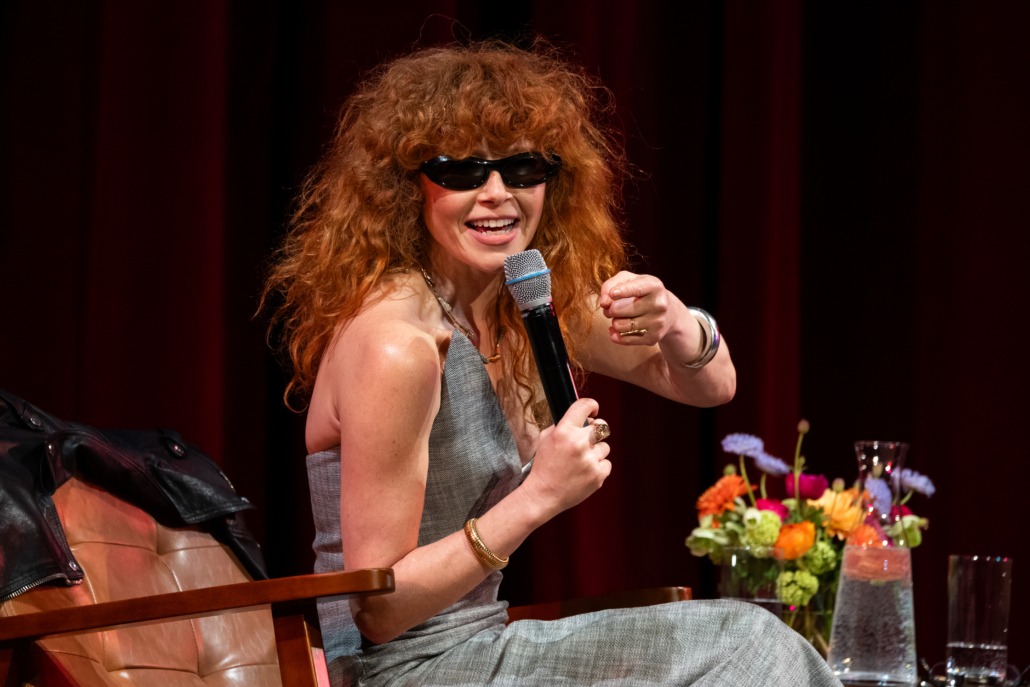

The actress and “Russian Doll” creator reflected on her lifelong career.
Donning sleek, cat-eye sunglasses, a black leather jacket already propped on her chair, Natasha Lyonne walked onto Bovard Auditorium’s stage with moderator Tara McPherson, a professor of cinema and media studies, to speak on her extensive career as an actress, writer, director and producer for Vision and Voices’ “An Evening with Natasha Lyonne.”
The event was the closer for the 20th anniversary celebration of Visions and Voices. It also marked the last event directed by Daria Yudacufski, who has been executive director of the organization since its creation in 2006. The evening opened with remarks from Vice Provost of the Arts Josh Kun and a surprise video from President Beong-Soo Kim, both thanking Yudacufski for her contributions to USC’s arts community.
After the video, Yudacufski took over to introduce Lyonne and McPherson to the stage.
“What I love most about my work is bringing the USC and larger community together for transformative and inspiring experiences in the arts,” Yudacufski said. “I can’t think of a better way to do that than with our special guest this evening, an artist that I admire immensely, and whose work epitomizes innovation and creativity and defies categorization.”
To open the event, McPherson asked Lyonne about her career, which spans almost her entire lifetime — over four decades, during which she rarely took a break.
Lyonne began acting at six years old, playing Opal on “Pee-wee’s Playhouse,” which she claims made her “alert from the age of four,” and went on to star in “Slums of Beverly Hills” (1998) and “But I’m a Cheerleader” (1999). She also created, starred in and co-wrote the series “Russian Doll” alongside Amy Poehler and Leslye Headland.
McPherson’s questions followed the trajectory of Lyonne’s work in chronological order, prompting Lyonne to joke that it felt like a “This is Your Life” moment, referencing the 1950s documentary show. Ad-libs and jokes were not uncommon throughout the panel, as Lyonne shared her honest commentary throughout the night, much to her fans’ delight.
“I like the way [Lyonne] speaks, she’s kind of like a beatnik free association, like splattering paint on the canvas, where it’s kind of going all over the place, but then it all connects, very much like a ‘Seinfeld’ episode or something,” said Johnee Engle, a fan who flew in from Las Vegas to hand-deliver his artwork to Lyonne. “It’s all these jokes that are kind of random, but then it’s like, ‘Oh yeah, I see, I see the big picture here.’”
With sprinkles of humor throughout, Lyonne and McPherson touched on serious topics, such as Lyonne’s messaging and intention behind each of her projects, and the impact they’ve had on her audience. After watching a clip of “But I’m a Cheerleader” (1999), Lyonne said that, as much as she loves that the film is adored by fans to this day, she hates that the film’s relevance stems from the pervasiveness of homophobia.
“It’s like how disturbing it is that this movie stays so ahead of the time… it recently came up again, this idea of conversion therapy,” Lyonne said. “[The movie is] beautiful but it’s also a heartbreaker, that’s what’s hard for me about this one … the reason that we all love the movie is because it’s still fucking happening.”
The second clip shown was a compilation of every time the line “sweet birthday baby” was said in the first season of “Russian Doll,” which McPherson compared to “Groundhog Day” (1993). Lyonne made it clear that in the first season of the show, the repetition served a purpose of exploring the “definition of insanities,” how different reactions to the same thing can render “different results,” and how making connections are going to “get [you] through the night.”
Apart from discussing specific projects, Lyonne and McPherson also talked about the artist’s distinct style and personality: Her self-description as the child of “Lou Reed and Nora Ephron,” her frequent gender-bending throughout her projects, something Lyonne “can’t believe we’re still on” but sees as necessary “to get that push” for women in the industry, and her absolute frankness when it comes to addressing the humanitarian and political climate of the world.
“I don’t know why we’re not supposed to say genocide or Apartheid,” Lyonne said. “You can’t ban a book we’ve already read … You can’t say gay people don’t fucking exist, that’s jibber-jabber, it just doesn’t work … Name things as they are, and remind us that certain facts were always facts.”
Following the discussion with McPherson, the floor opened up to audience questions. The night concluded with an audience member’s request for advice to young people on how to live life.
“Trust the things that you like. It doesn’t matter if those things are fucking, bubble gum Juicy Couture suits, or fucking, Tchaikovsky, let your freak flag fly in whatever direction,” Lyonne said. “Follow that sort of aesthetic, of what you’re into.”