DEIA survey expands scope on student status, sexuality
Data showed an increase in LGBTQIA+-identifying staff members for Spring 2026.
By ANDREW CARDENAS
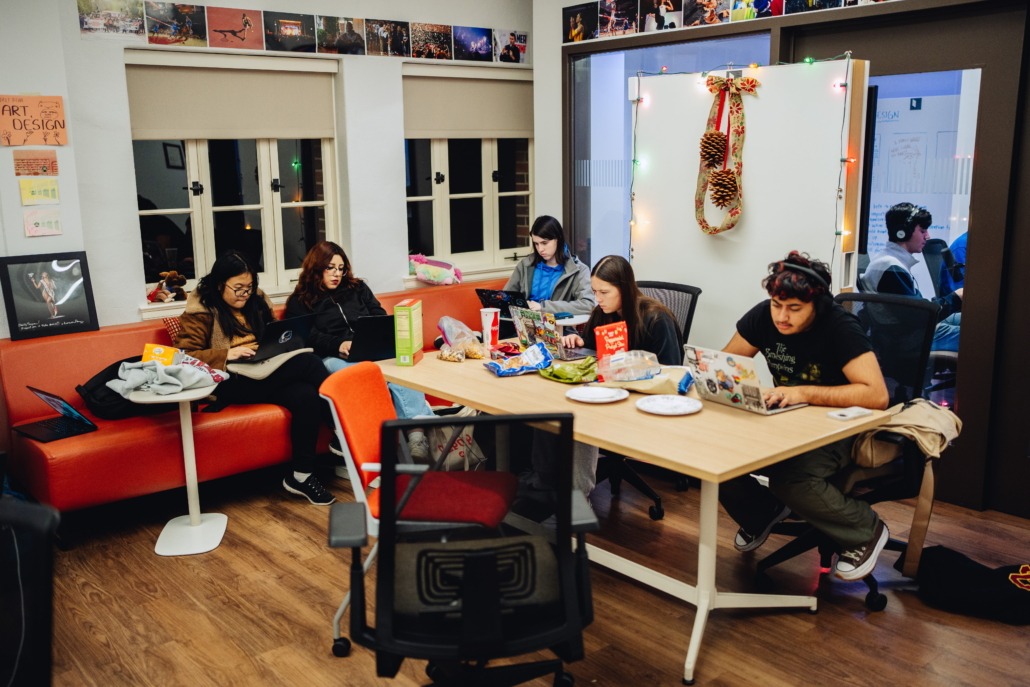

Data showed an increase in LGBTQIA+-identifying staff members for Spring 2026.
Since Fall 2020, the Diversity, Equity, Inclusion and Accessibility director has administered an end-of-semester survey to assess the demographics and identities of the student journalists in the Daily Trojan’s newsroom.
The findings help us identify how we can better reflect and represent our community within our leadership and overall team, strengthening a collaborative work environment grounded in DEIA principles.
Additionally, the survey data was used to track representation and satisfaction trends, identify areas for improvement, and guide policy, recruitment, and newsroom culture.
This report remains an evolving tool, growing alongside the Daily Trojan as it continues to reflect and improve.
Methodology
In the last week of March — several weeks into the Spring 2026 semester — the DEIA form was distributed to staff. This timing ensured the survey reflected active members only, excluding those who had left the DT staff during the semester. Out of 240 staff members, 144 responded, resulting in a 60% response rate, a slight decrease from last semester’s 62.8% response rate.
The survey covered race and ethnicity, gender identity, sexual orientation, religious affiliation, class standing, financial aid status, disability status, and student background. Respondents could select multiple options where applicable, and all identity-based questions included a “Prefer not to state” choice.
Participants also indicated which section they worked for, including the highest position they served on staff. This allows us to assess how representative leadership at the Daily Trojan is of its overall staff.
For the purposes of this report, the masthead refers to the 34 members of the newsroom’s senior leadership team — including 28 section editors, three associate managing editors, two managing editors and the editor-in-chief — who are responsible for shaping editorial direction and newsroom operations.
Race and ethnicity
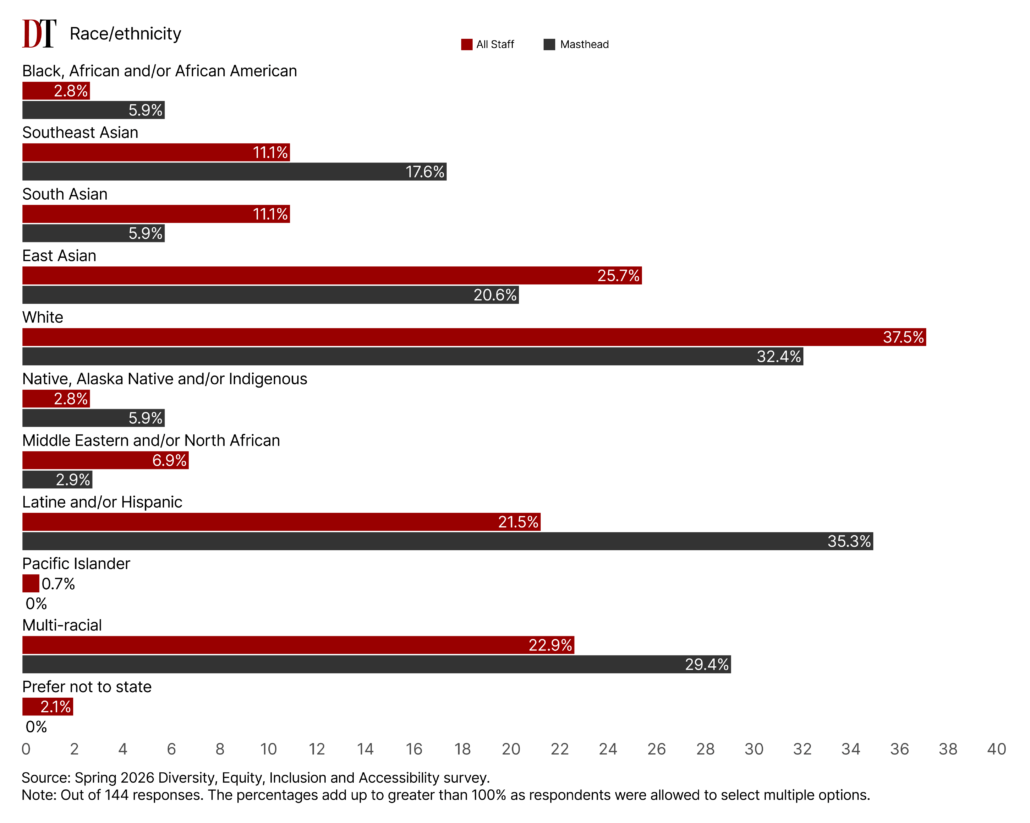
This spring, 33 respondents, accounting for 22.9% of respondents, identified with more than one racial or ethnic background. This is an increase from the 28 respondents, 18.1% of those surveyed, reported in the previous survey, representing an increase of 4.8 percentage points. Multi-racial staffers are represented in each of their respective racial identities.
Only 2.8% of respondents identified as Black, African and/or African American, a slight increase from the previous survey’s 1.9% — on the masthead, Black respondents make up 5.9% of leadership.
South Asian representation stood at 11.1%, continuing a downward trend from the previous survey’s 13.5% — South Asian respondents account for 5.9% of the masthead.
East Asian representation has reversed its decline. Last semester’s survey reported 21.3%, but now 25.7% of respondents identify as East Asian — on the masthead, East Asian staffers make up 20.6% of leadership.
Similarly, Southeast Asian representation now comprises 11.1% — a 2.7 percentage point increase from the previous semester. On the masthead, they represent 17.6%.
No respondents identified as Pacific Islander last semester, down from 1.4% the semester prior. Now, 0.7% of respondents identify as Pacific Islander — a slight return, though still well below previous highs. No masthead members identify as Pacific Islander.
Native, Alaska Native or Indigenous representation increased to 2.8%, continuing an upward trend from the previous survey’s 1.9%. On the masthead, Native, Alaska Native or Indigenous respondents account for 5.9% of leadership.
White respondents made up 37.5% of respondents, a decrease from the previous survey’s 40%. On the masthead, white respondents comprise 32.4% of leadership.
Last semester, Latine and/or Hispanic representation reached an all-time high of 29% among respondents. Now, 21.5% of respondents identify as Latine and/or Hispanic. On the masthead, Latine and/or Hispanic respondents make up 35.3% of leadership. Among staff who identify as Latine and/or Hispanic, 8.3 percentage points are masthead members — meaning over one-third of Latine and/or Hispanic respondents hold leadership positions.
Middle Eastern and/or North African respondents now make up 6.9%, continuing an increase from the previous survey’s 5.2% — a total of 2.9% of the masthead identified as Middle Eastern and/or North African in the survey.
Religious affiliation
The Spring 2026 DEIA survey found a continuing trend of atheists and agnostics making up the largest group of respondents. In Fall 2025, the survey found that atheists and agnostics represented at 21.3% and 17.4%, respectively. At that time, Christian staffers composed 27.7% of respondents, with Catholics representing the largest denomination at 16.1%.
Current data shows a slight reorganization of these trends. Atheist identification dropped to 15.3%, while agnostic identification rose to 19.4% this semester. The total Christian population remained relatively stable at approximately 28.5%, when combining those who identified simply as Catholic, 14.6%; Christian, 11.8%; Orthodox Christian, 1.4%; and Protestant Christian, 0.7%. Catholic representation has decreased slightly, from 16.1% to 14.6% of respondents.
The form also found a shift in other religious identities, with respondents identifying as Hindu decreasing from 7.7% to 4.9%, and Jewish respondents falling from 7.7% to 4.2%.
Conversely, Muslim representation among respondents has grown from “at least one” respondent in Fall 2025 to 3.5% currently, with 2.1% identifying as Sunni Muslim and 1.4% Muslim not otherwise specified. Buddhist and Sikh identification also increased, now at 4.9% and 1.4% respectively, compared to only “at least one” staffer in each category previously. The large increase in respondents identifying as “spiritual” noted in the Fall 2025 survey has been quantified at 4.2% in the current data.
At 13.2%, people who chose not to disclose their identity make up the fourth-largest belief category among respondents.
Gender identity
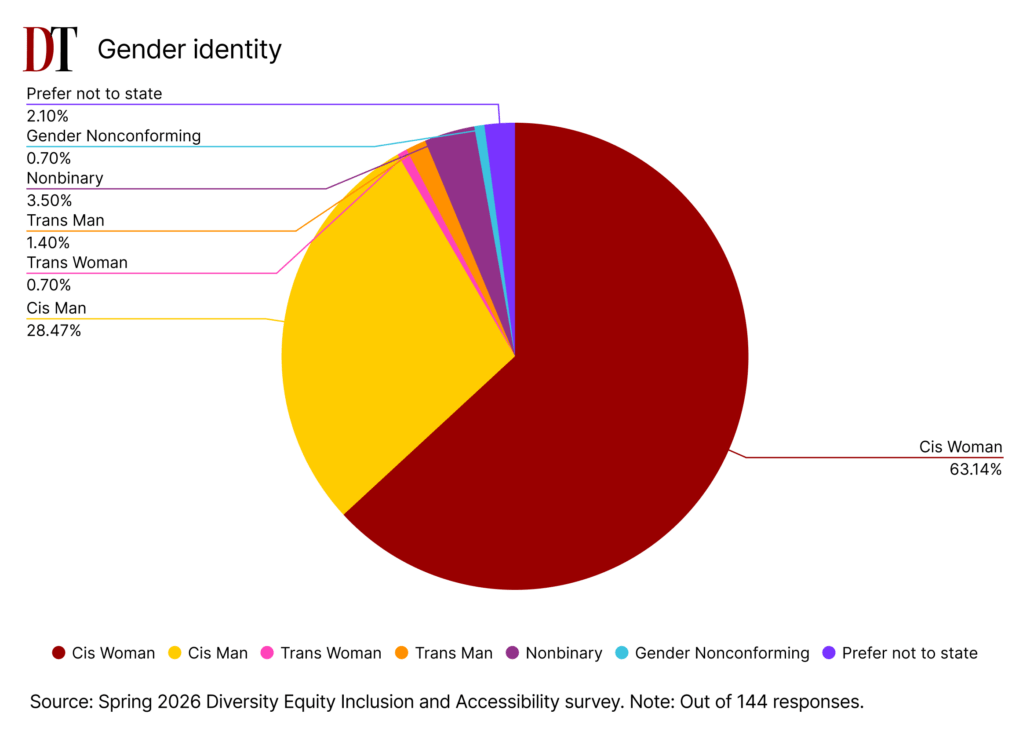
The Spring 2026 DEIA survey found a relatively constant trend of cisgender respondents and non-cis respondents. In Fall 2025, cisgender students made up 92.3% of respondents, with cis women at 63.2% and cis men at approximately 29.0%. Non-cis individuals — including trans men, trans women, agender, gender nonconforming and nonbinary people — composed 5.2% of respondents.
Current data shows remarkable stability in cisgender women’s representation, now at 63.2% of respondents — nearly identical to the previous value. On the masthead, cis women make up 52.9% of leadership.
The share of cis men has decreased slightly to 28.5%. On the masthead, cis men comprise 35.3% of leadership.
However, non-cis representation increased modestly among respondents from 5.2% to approximately 6.3% when combining current categories: nonbinary, 3.5%; trans men, 1.4%; trans women, 0.7%; and gender nonconforming, 0.7%. An additional 2.1% of respondents preferred not to state their gender identity. On the masthead, non-cis individuals collectively account for 8.8% of leadership.
Sexual and romantic orientation
The Fall 2025 survey reported that 58.7% of respondents identified as heterosexual, heteroromantic and/or straight. Respondents identifying outside these categories stood at 36.6%. Bisexual respondents comprised the largest non-straight group at 18.7%, followed by gay, 5.8%; queer, 4.5%; and lesbian, 3.2%. On the masthead, only 39.3% identified as straight — far lower than the general respondents.
Current data shows a continued shift away from exclusive straight identification. Straight/heterosexual respondents now make up 51.4% of the survey, and 41.2% of the masthead identified as straight. Conversely, the percentage of those identifying with a sexual or romantic orientation that falls within the LGBTQIA+ community has risen to approximately 39.6%. On the masthead, such staffers collectively make up half of leadership when combining all non-heterosexual identities.
Bisexual representation has grown substantially among respondents from 18.7% to 23.6%, making bisexuals the largest non-straight/heterosexual group by a wide margin. On the masthead, bisexual staffers account for 26.5%, slightly exceeding their proportion of the overall staff.
Queer and gay identification rose slightly to 7.6% and 6.9%, respectively. Conversely, asexual representation decreased to 0.7% from last semester’s survey 1.9%. On the masthead, queer respondents make up 14.7% of leadership, while gay respondents account for 8.8%.
Meanwhile, lesbian representation held steady at approximately 3.5% — none of the masthead identified as lesbian. Pansexual identification nearly doubled to 3.5% — on the masthead, pansexual respondents make up 5.9%.
New categories in the current data include biromantic, 2.8%; aromantic, 0.7%; and questioning, 1.4%. Those who preferred not to state their orientation were quantified at 9.7%.
Disability
The Spring 2026 DEIA survey found that disability representation has declined since the Fall 2025 survey. At the time, 14.8% of respondents reported having a disability or a record of one, and disability representation on the masthead was reported at 18.2%.
Current data shows a reversal: Only 11.8% of respondents now report having a disability, a drop of three percentage points. Among masthead members, 17.6% identified as having a disability.
Class standing
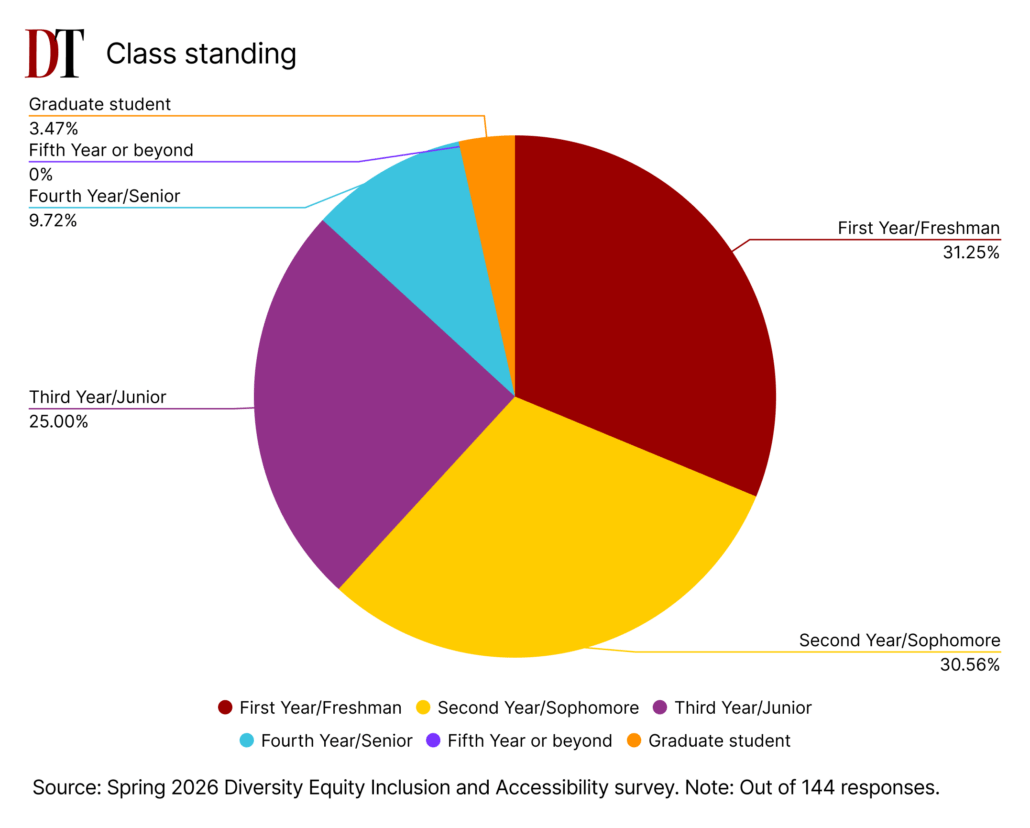
Respondents have grown significantly younger since the Fall 2025 survey. Previously, second-year students were the largest group at 31.6%, followed by first-year students at 25.8% and third-year students at 23.9%. Fourth-year and graduate students made up 11.6% and 6.5% of respondents, respectively.
In the current data, the number of first-year students increased to 31.3%. At the same time, the proportions for second-year and third-year respondents remained relatively stable at 30.6% and 25%, respectively. Fourth-year and graduate students saw slight declines, falling to 9.7% and 3.5%.
Semesters at the Daily Trojan
First-semester staff remain the largest group, though their dominance has lessened slightly. In Fall 2025, first-semester staff made up an overwhelming 53.5% of respondents.
Current data shows first-semester staff at 39.6%, while second-semester staff represented 26.4% — meaning staff in their first two semesters make up 66.0% of respondents. Longer-tenured staffers have held steady: those with five or more semesters now comprise 15.3% of respondents, comparable to the previous semester’s 14.2%.
Student status
The Fall 2025 survey reported that traditional applicants made up 59.4% of respondents. First-generation students composed 17.4% of respondents. International students declined to 12.9%. Transfer students saw a significant uptick to 16.8%, while the share of spring admits decreased to 11.6%.
Current data shows several reversals and continuations. First-generation college students have increased to 21.5%, reversing the previous decline. International students also rose sharply to 18.1%. Spring admits increased even more dramatically to 18.8% of staff.
Transfer student representation has decreased slightly to 15.3%. Traditional applicants increased sharply to 73.6%.
New data points in the current survey include Legacy/SCion students, 6.9%; commuter students, 4.9%; students from low-income backgrounds, 16.7%; United States veteran or military-affiliated students, 1.4%; and students enrolled in a progressive degree program, 0.7%.
Semester recap
The DEIA committee met weekly throughout the semester to discuss and implement strategies for fostering diversity, equity, inclusion and accessibility within the newsroom. Among its initiatives, the committee collaborated with other sections to host educational workshops, cultivated an implicit bias and sensitivity training program for the masthead, and worked to create topic style guides for various cultural celebrations.
The Daily Trojan DEIA committee remains committed to continuous improvement, recognizing that change is the only constant. As staff demographics shift and new challenges emerge, the committee will continue to evolve its approach, refine its resources and adapt its programming to meet the needs of an ever-changing newsroom.