DUGOUT DIARIES
The Dedeaux Field effect
USC baseball has been nearly unbeatable at home this season — but why?

By BENNETT CHRISTOFFERSON
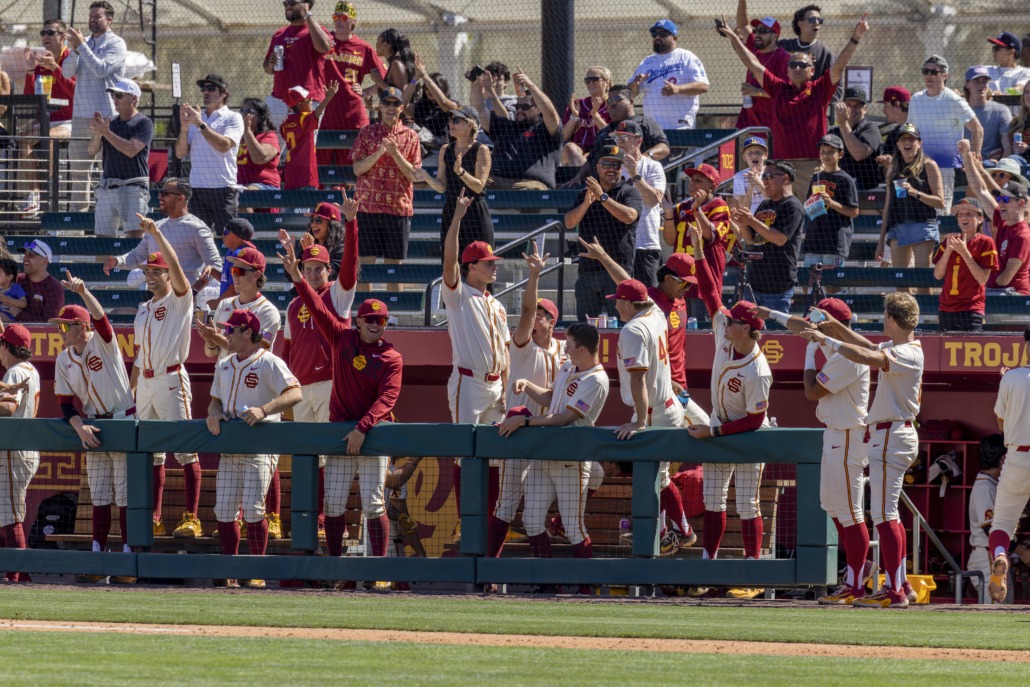

USC baseball has been nearly unbeatable at home this season — but why?
Long before the college baseball season even began, it was clear that one storyline would define USC’s 2026: the new Dedeaux Field. After playing “home games” off-campus at Great Park in Irvine for two years, the Trojans’ home stadium had finally completed a major renovation — well, most of it, at least — and would host baseball for the first time since 2023.
Indeed, when I covered USC’s season-opening series against Pepperdine back in February, there was a palpable feeling of excitement in the air. Frat guys and families alike packed the stands, overjoyed to finally watch their beloved Trojans play in person. Players stopped to take everything in before taking the field — one they could truly call home.
And yet, I don’t think anybody in attendance could’ve predicted just how impactful the new stadium would end up being.
Following USC’s sweep of Purdue last weekend, the Trojans are a staggering 25-1 at home this season. Twenty-five and one. Even UCLA, which has been the consensus No. 1 team in the country all year, can’t claim a home record that lopsided.
For comparison, USC sits at just 9-11 on the road; that’s not terrible considering the level of competition the Trojans have faced, but it’s nowhere in the same ballpark as their performance at Dedeaux. Additionally, of the three teams USC has faced in both situations — UC Irvine, Long Beach State and UC Santa Barbara — the Trojans are 3-0 at home … and 0-3 away.
Home-field advantage may not be that noteworthy for the average baseball team, but it’s sure as hell been a factor for USC.
Now, admittedly, part of this trend could be chalked up to the distribution of where the Trojans have played their opponents. Of the seven games USC has played against currently ranked teams — all losses, mind you — six of them were on the road, while only one was played at Dedeaux: the only game the Trojans lost at home.
In fact, before the series against Purdue, every Big Ten opponent USC had hosted was below .500 in conference play. A cynic would argue that the Trojans simply got a cupcake schedule at home, and road series against UCLA and Nebraska have exposed them as frauds.
Dear reader, I’m no cynic — ignoring the general tone with which I’ve written most editions of this column — especially when it comes to USC baseball. I believe the Trojans’ home dominance is the real deal, and regardless of whether the construction team infused Dedeaux Field with some sort of devil magic, I think the stadium has been a genuine, tangible reason for their success.
After USC’s first of three wins against the Boilermakers, Head Coach Andy Stankiewicz told me the most important aspect of the new stadium was simply “having a home.”
“[We love] having a place that we can call home, for real, on campus,” Stankiewicz said. “They built this beautiful stadium, and we want to protect it.”
Junior outfielder Kevin Takeuchi echoed that sentiment, saying the team takes pride in “protecting the home.”
The Trojans have certainly done a phenomenal job of protecting their home field; they understand how meaningful it is to finally have a stadium of their own, and they’ll do whatever it takes to keep it safe. As much as I love my little statistics, I don’t think there’s a number that can quantify that feeling of responsibility.
That being said, you’re not getting a column from Bennett Christofferson, a junior majoring in applied and computational mathematics, without some good number-crunching. Sorry, copy staff.
My first instinct was to check the number of runs USC has scored and allowed on the road and at home. On offense, the Trojans have been stronger at Dedeaux, but it’s not a major gap: They’re averaging 6.7 runs per game at home, compared to 6.3 runs per game away. Probably a negligible difference.
The pitching, however … a completely different story.
On the road, USC has given up an average of 5.7 runs per game, slightly less than the number they’ve scored. At home, that number drops to 2.8.
What?
Maybe I’m overreacting, but I couldn’t believe the numbers when I saw them. The Trojan pitching staff allows half as many runs when playing at Dedeaux. In 20 road games, they’ve given up five or more runs 11 times; in 26 home games, they’ve done so just four times.
And in a way, that makes sense. USC’s mantra of “protecting the home” inherently feels like it’s putting the onus on the pitching: “Protect this field. Don’t let anybody score on it but us.”
Perhaps the best example of this is sophomore pitcher Grant Govel, who has earned the win in all seven of his starts at home. On April 18, he suffered his worst outing to date at Nebraska, giving up seven earned runs in just three innings. A week later, he returned home and proceeded to throw seven perfect innings against one of the Big Ten’s best offenses in Purdue.
However, when I talked to Govel about his long-term goals after the game, his sights were set on somewhere other than Dedeaux Field.
“Make it to Omaha,” Govel said. “Simple.”
Indeed, as incredible as the Trojans have been at home, they’ll have to follow their dreams all the way to the College World Series’ host city of Omaha, Nebraska, if they wish to make the program’s first appearance in 25 years.
Can they do it? … Maybe. I’m going to need a bit more proof that they can compete with the nation’s best before I make any predictions of grandeur. But the fact that they’re even in the conversation speaks volumes about how important USC’s new stadium has been.
Aside from all the winning, an on-campus stadium has granted the Trojans a level of stability and comfort they haven’t had in years. No longer do they need to drive an hour south just to practice on a field that isn’t theirs — they have a home right here, and it’s one that the fans can appreciate just as much as the players.
Regardless of how the rest of the season plays out, it’s clear to me that Dedeaux Field has been instrumental to USC’s success; there simply isn’t a world in which the team does this well while playing in Irvine. I’m not sure how far the Trojans will make it in the playoffs, but wherever they end up, their new stadium certainly will have helped them get there.
Speaking of which — let’s break into that top 16 before the season ends, boys. I have a feeling you’d much rather be playing your NCAA Regional games at home.
Bennett Christofferson is a junior writing about baseball’s biggest stories and controversies in his column, “Dugout Diaries,” which typically runs every other Thursday. He is also a Sports editor at the Daily Trojan.