‘I Love Boosters’ proves there is such a thing as too much camp
Director Boots Riley dresses up his newest social satire under layers of humor.
3
For fans of:
“Sorry to Bother You” (2018), “Parasite” (2019)
By MARINA YAZBEK
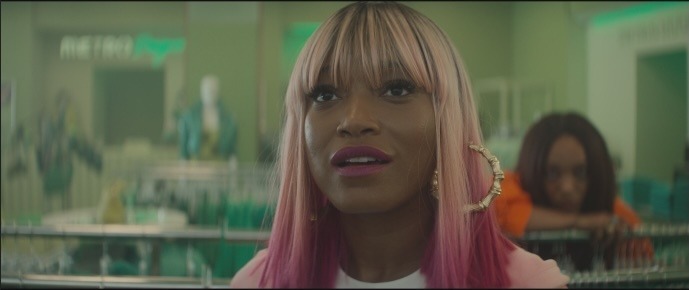

Director Boots Riley dresses up his newest social satire under layers of humor.
3
“Sorry to Bother You” (2018), “Parasite” (2019)
“Boosters” waddle out of retail stores looking like pink marshmallows, donning neon sweatsuits stuffed to the brim with couture and vibrant wigs that could be spotted from the opposite end of the strip mall parking lot. In “I Love Boosters,” this outfit is the result of a perfectly executed heist.
In director Boots Riley’s world, camp is back and more boisterous than ever. After his 2018 debut, the anti-capitalist sci-fi “Sorry to Bother You,” Riley returns with his sophomore film, “I Love Boosters,” this time focusing on ethical abuses within the fashion industry. He employs the same surrealist lens as his debut, but this time, due to an overwhelming focus on absurd imagery and humor, the film fails to develop any of its characters in a meaningful way.
Riley’s latest film is a colorful, surrealist heist-comedy that centers around aspiring designer Corvette (Keke Palmer) and her friends, who together form the Velvet Gang, a group of women “boosters” who steal from high-end department stores and sell the clothes at a lower price. The film relies heavily on Palmer’s witty personality and comedic timing, but doesn’t give her — or any of the Velvet Gang, for that matter — much depth to work with.
Initially, the Velvet Gang only does this to get by and as a charitable initiative for their community, which they call “Triple F: Fashion-Forward Philanthropy.” However, their motivations quickly become more vindictive when Christie Smith (Demi Moore), the owner of the retail empire Metro Designer and Corvette’s biggest fashion inspiration, labels the Velvet Gang “low-class urban bitches” while simultaneously stealing one of Corvette’s designs.
Spurred by this insult, the Velvet Gang embarks on a journey not just to steal from Smith but to ruin her completely. In their pursuit of revenge, they join forces with employees who have been abused under the dictatorial structure of Metro Designer.
Violeta (Eiza Gonzáles), one store worker, protests their lengthy, underpaid shifts and 30-second lunch breaks, and Jianhu (Poppy Liu), a factory worker from China, explains that health violations have become so dire that her aunt died and her mother developed lung cancer.
However, the anti-capitalist core of the plot is glazed over by the film’s surrealism and comedy. Though the comedic tone is amusing, the film neglects the chance to deliver a story with depth on the abuses within the fashion industry, instead concluding with rather basic messaging on working together as a community to fight against abusers of the industry.
Certain aspects of the film’s exaggerated absurdism land; each member of the Velvet Gang wears a new bold wig in nearly every scene, which works to enhance the mesmerizing neon color scheme of the society Riley has created.
With the prevalence of exaggerated streetwear and neon explosions just about everywhere on the screen, the film builds a vibrant aesthetic that conveys the fashion industry’s excess and the absurdity of our consumerist tendencies.
This world is surreal, accentuated by the huge mountain of anxieties — debt, unpaid bills and eviction notices — that follow Corvette throughout the film in the form of a physical ball that rolls toward her every time she struggles to find her footing. The ball is one of the film’s best uses of surrealism, as it employs a clearly hyperbolized object to portray Corvette’s internal struggle through an interesting visual.
The campy style of the film at times feels unintentional. For example, Smith’s headquarters building is slanted, which makes for a comical scene where Corvette struggles to run out of her office after sneaking in, but the purpose of the slant is never explained, seemingly only in the picture for slapstick-esque physical comedy.
Although the loud, excessive cinematic style of “I Love Boosters” makes it a hilarious watch, the film sacrifices the potential for intentional character depth and undercuts the seriousness of the characters’ revolt against exploitative business practices.
While dedicating tons of screentime to details, such as Smith’s skinless minions and Corvette’s demonic, stalkerish love interest, the protagonist’s backstory and motivation remain severely underexplored. The audience is told she’s squatting in an abandoned fried chicken shop and living with extreme anxiety, impending doom and loneliness, but we never receive an explanation for the events that led to these conditions and emotions.
The lack of development of Corvette’s character — and the rest of the Velvet Gang — makes scenes that are supposed to have emotional charge, such as arguments over why Corvette feels lonely and a reconciliation between her and another member of the gang, somewhat underwhelming. Because we aren’t familiar enough with these characters, it’s difficult to understand what fuels their arguments in the first place.
Although the film redeems itself with its inspiring message, that we must work as a community to effectively fight against exploitative capitalism, it falls flat due to poor character development. Ultimately, “I Love Boosters” is a hilarious social satire, but in lathering the plot with excessive humor, it undermines its attempt to deliver a truly impactful message.