Non-tenure faculty move to unionize amid University pushback
In a recent election, 70% of faculty voted in favor of the United Faculty-UAW union.
By ANYA MOTWANI
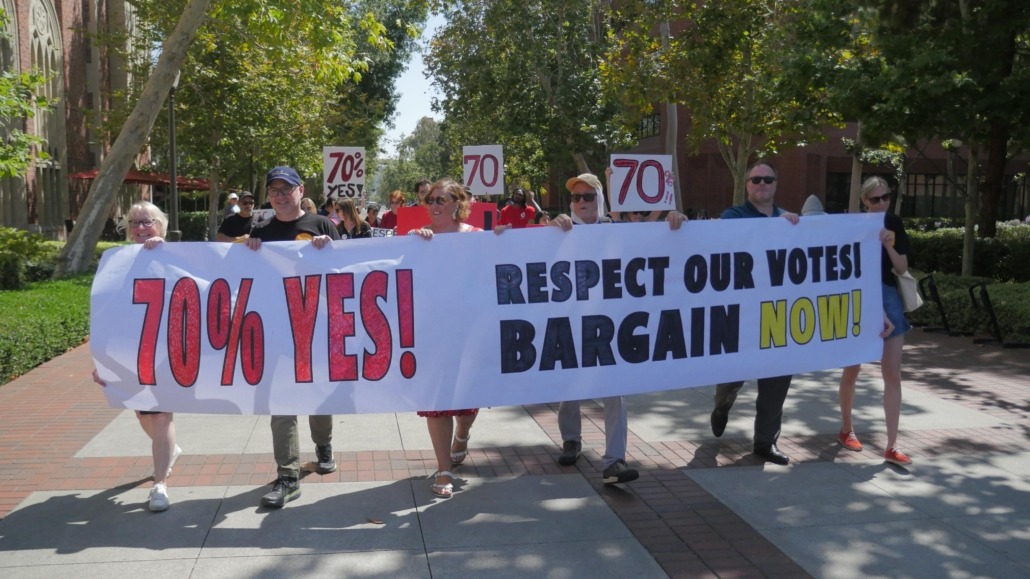

In a recent election, 70% of faculty voted in favor of the United Faculty-UAW union.
A year and a half into unionization efforts by non-tenure track faculty, 70% voted in favor of organizing in an election that closed June 1, according to a post by United Faculty-UAW, the union that will represent them. A day later, before the results were announced, the University filed a review of the election with the National Labor Relations Board.
In a statement to the Daily Trojan, the University reiterated its concerns with the UF-UAW election.
“We are grateful to our faculty for all they do for our students and as partners in our academic mission. This election has presented not just important substantive issues but important legal issues as well,” the statement read. “The University has asked the National Labor Relations Board (NLRB) to quickly review the validity of this result as the first step toward obtaining much-needed legal clarity over these issues.”
The union would represent research, training, practitioner and clinical-track faculty — which accounts for more than 2,500 faculty members. Adjunct faculty at the School of Cinematic Arts unionized under Adjunct Faculty Alliance-UAW in 2025 and would not be represented by UF-UAW.
Some groups of non-tenure-track faculty previously moved to unionize in 2016 but were unsuccessful. In February 2016, adjunct faculty at the Roski School of Art and Design and the USC International Academy voted to join Service Employees International Union Local 721, but Dornsife’s election rejected the measure. The NLRB ruled the vote was invalid after faculty appealed the results, citing emails sent out by then-Provost Michael Quick that urged voters to side against the union.
In 2019, a D.C. appeals court ruled that non-tenure track faculty at USC could not unionize, despite a contrary decision by the NLRB. The SEIU dropped its petition to unionize Roski faculty, and union efforts seemed to be put on pause.
Despite facing similar pushback, the UF-UAW’s election went through and was a “thrilling victory” for Kate Levin, an associate professor of writing, with over 1,200 people voting in favor of the union.
“This is a very high turnout election, which shows that faculty were really invested in making their voices heard,” Levin said. “We’re excited that this can usher in a bright and positive new chapter for the University, which many of us feel is really necessary — not just for faculty, but for students and for patients. … It’s up to USC now to do the right thing and bargain in good faith with us.”
Both Levin and Sanjay Madhav, an associate professor of technology and applied computing practice, said they received emails from the University, including from the Office of the Provost, for weeks leading up to the election.
“Without a union, RTPC faculty take home more of their paycheck,” read a May 16 text sent to RTPC faculty by the University. “The United Auto Workers may charge 1.44% of your gross salary in union dues each year, which could offset an annual salary increase that the union may be promising. There is also no guarantee they will deliver on this promise. Make the choice that lets you keep what you earn. Make the choice that protects your voice. Vote.”
Some faculty said they felt the messages were anti-union.
“The provost kept sending out emails saying that ‘Our votes matter,’ and ‘Don’t let a few decide for the many,’ and ‘Make sure you vote’ with a very clear anti-union tilt. … They’re trying to convince people to vote no,” Madhav said.
Since union efforts in 2016, the University has said that non-tenure track faculty hold managerial positions and, more recently, that they encompass too great a variety of roles to justify organizing under one union.
“Given the important issues raised by the petition — notably, the status of USC’s faculty as managerial employees, and the appropriateness of including in the same unit more than 2,500 faculty who teach and provide services under completely different terms and conditions — the hearing will require thoughtful preparation and witness participation,” the University wrote in a statement to the NLRB requesting special appeal of the 2024 union petition.
The petition resulted in NLRB hearings, which concluded this March and ultimately resulted in the approval of UF-UAW’s election.
Specifically, the University said the RTPC faculty cannot unionize because of the Academic Senate and other faculty bodies, which represent USC faculty and are intended to help address their concerns at an administrative level.
“[The] Former President of the Academic Senate explained that the Senate’s resolution-making ability has no force of authority and that there is no instance where USC has implemented a request made by the Academic Senate through resolution or otherwise,” the NLRB wrote in a March decision document from the election hearings. “The Academic Senate has made several recommendations and requests in the past five years that have all been rejected or ignored by USC.”
Pamela Conley Ulich, an adjunct lecturer in the Gould School of Law, pointed to Tuition Assistance Benefit cuts as an example of the kind of say non-tenure track faculty have in high-level changes.
“[Faculty are] really not managerial, because if they were, the Tuition Assistance Benefit wouldn’t have been reduced,” Ulich said. “[The University is] trying to make these arguments that they’re managers, but in reality, when push comes to shove, the managers are the Board of Trustees and the President’s Office, and the faculty do not have that power.”
In October 2024, USC announced that Tuition Assistance Benefit for employees would be cut in the following summer. The program was to remain unchanged for those enrolled at the time of the announcement. The changes meant spouses and domestic partners would be eligible for 25% of tuition to be covered for up to one degree program, dependent children could be covered until the age of 26, and graduate certificates or studies would no longer be covered for faculty, staff or their dependents.
“As managers, would we do that? Would we ever decide to cut our own benefits or freeze our merit pay increases? Of course not,” Levin said. “It’s a pretty laughable argument on its face, but of course it’s a legally opportunistic argument that the University is going to make, because they want to suppress the union drive. Their goal is to keep the union from forming, keep us from getting to the bargaining table.”
On Thursday, a delegation from UF-UAW walked to President Beong-Soo Kim’s office to deliver a letter with over 256 signatures asking him to respect the election results, according to Madhav.
Madhav said this effort is vital because over 70% of faculty are non-tenure track who teach the majority of undergraduate courses, do research and provide almost all the patient care.
“I would hope that [President Kim] takes a hard look and thinks about what kind of legacy he [wants] as a president,” Madhav said. “Does he want to be the president that went out of his way to silence the votes of [almost] 1,300 faculty that voted in favor of the union, or does he want to be known as the president that collaboratively worked with non-tenure faculty on solving these very real issues that we have?”