USC researchers find communication gap between AI and humans
The team concluded artificial intelligence interprets words like “maybe” or “probably” differently than us.
By JACK FARRINGER
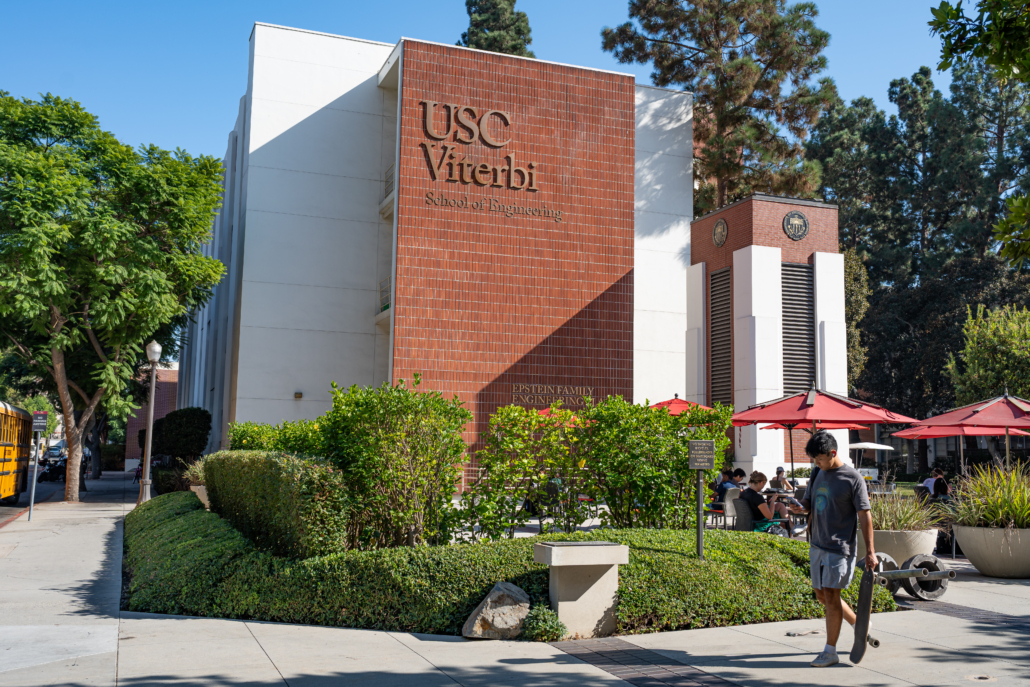

The team concluded artificial intelligence interprets words like “maybe” or “probably” differently than us.
As a growing number of students incorporate artificial intelligence into their daily lives — asking it to do their homework, plan trips or simply answer their questions — new research from the Viterbi School of Engineering found that they may need to double-check those AI-generated results.
Mayank Kejriwal, a research associate professor of industrial and systems engineering, and his research team set out to determine whether AI models use words the same way we commonly understand them.
Kejriwal and his team of Zhisheng Tang, a doctoral student in industrial and systems engineering, and Ke Shen, who has a doctorate in industrial and systems engineering, looked specifically at words that express uncertainty — such as “maybe,” “likely” or “probably.”
“We wanted to try to understand how large language models like ChatGPT — [or] pick your favorite model — understand these words,” Kejriwal said. “Do they interpret these words in the same way as humans interpret these words? And if not, then how? Why is it different?”
Kejriwal and his team found that humans and AI models were not on the same page when interpreting what common words of uncertainty meant in practice.
In their paper “An evaluation of estimative uncertainty in large language models,” published in npj Complexity, a peer-reviewed journal, the research team concluded that humans and AI models saw the most disagreement with intermediate words such as “likely” or “probably.” The AI associated these words with stronger probabilities than humans commonly would.
At a time when students increasingly rely on AI for answers — 90% of students have used AI academically before, according to a 2025 survey by Copyleaks, a plagiarism detector company — these results highlight challenges of an overreliance on AI responses.
“You don’t necessarily accept these [AI results] as a source of truth,” said Jonathan May, a research associate professor of computer science in Viterbi. “It’s helpful to understand that you’re not actually talking to a human, even if it seems to be a human.”
Given these findings, Tang said that students should ask AI models like ChatGPT for more clarification on important questions to make sure they don’t miscommunicate results.
As researchers try to implement AI into science, Kejriwal and Tang both said that it is vital to ensure AI isn’t hurting research by converting data into findings that convey the wrong meaning. Kejriwal said that scientific papers frequently include words of uncertainty to communicate the paper’s message, using terms such as “the association is low” or “the evidence moderately supports [the findings].”
“This problem arises a lot in science, which is, how do you go from numbers and data to everyday language without miscommunicating or without giving the wrong impression to the user about a theory or some kind of finding?” Kejriwal said.
Since Kejriwal and his team started this research in late 2024, he said that there has been significant progress in developing and enhancing AI agents — an improvement he hopes can make them effective communicators of scientific findings.
“We are really trying to figure out how far we can actually take these agents,” Kejriwal said. “The bigger question, especially in science, [is] how far can these agents become the equivalent of scientists?”
The results from this study could extend beyond science as well. May said that further study could explore whether AI’s language could be adapted to match certain cultural language practices.
“How British people think of Americans is that we’re overly positive about everything, so if I’m saying, ‘Oh, wow, that was great,’ that means ‘It was okay,’ and if a British person says, ‘Yeah, that was good,’ that means, ‘Oh, it’s fantastic,’” May said.
For humans to understand the information that AI is giving them, May said they need to be aware of hidden meanings — like the example above — that mean different things to different cultures. May said that although adopting AI to our cultural terms would be helpful, he cautioned against seeing models as fellow members of society.
“It’s always good to realize that you’re not talking to a native English speaker … and this is a computer program,” May said. “It’s very well tuned to try to get you to be comfortable and think it’s a human, and in a way we’re trying to push that, because it potentially makes it more useful.”