Higher education is not ready for the future
Facing uncertainty, skepticism and financial woes, universities must adapt.
By JACOB STRAND
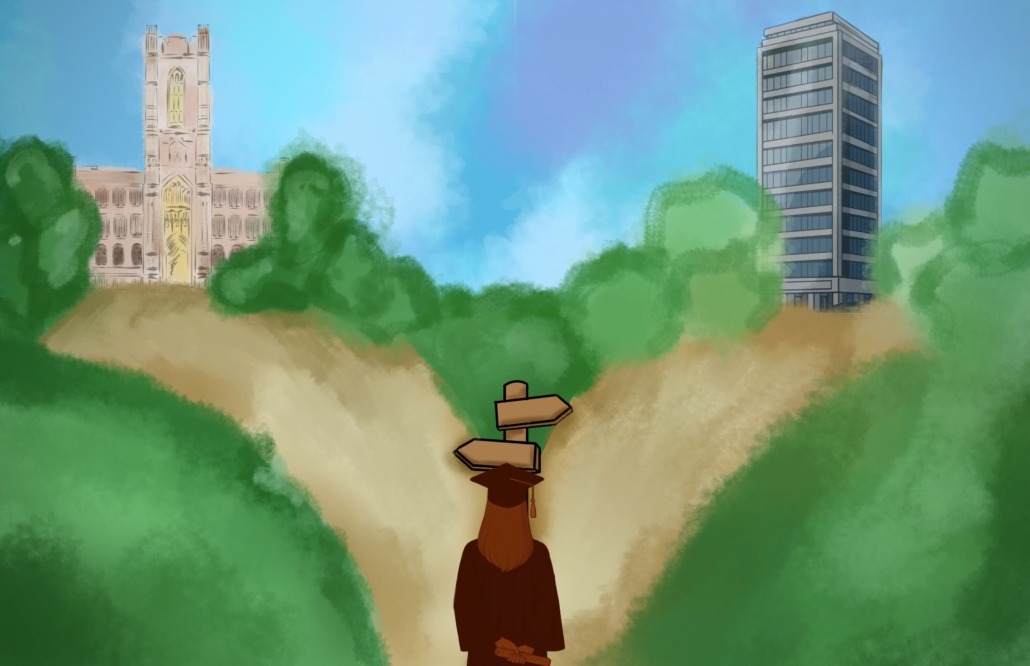

Facing uncertainty, skepticism and financial woes, universities must adapt.
The University of Southern California first opened its doors in 1880, with a modest 53 students in attendance. Today, the University boasts an active student population of 48,000 students and over half a million living alumni.
USC, alongside other higher-learning institutions in this country, has been at the forefront of research; it pushed the boundaries of innovation, brought talent to industry and created communities and leaders. Young people flock to higher education to foster knowledge, develop character and find opportunity.
But in recent years, the role of higher education has been put into question as young people face increasing job uncertainty and feel that universities are becoming unequipped to deliver on the promises of education.
Data compiled by the Federal Reserve Bank of New York from the U.S. Census Bureau and U.S. Bureau of Labor Statistics’s Current Population Survey shows that as of June 2026, 42.0% of recent college graduates and 33.7% of all college graduates are considered to be underemployed.
In addition, the unemployment rate among all young workers aged 22 through 27 has been somewhat rocky in recent years falling from 22.0% in June 2020 to 5.9% by June 2023; by December 2025, 7.8% of young workers were unemployed, and as of June, the rate is 7.2%. The most recent U.S. jobs report revealed that roughly 720,000 Americans, mostly young workers, opted out of the workforce entirely.
The shaky U.S. job market, under pressure at all angles, has been particularly hard on the young and the recently graduated. Entry-level jobs, which many recent grads rely on, are scarce, and options are dissipating as artificial intelligence and mechanization revolutionize markets.
Correspondingly, universities have tried to adapt to rising volatility, but administrative responses from colleges across the nation feel insufficient — subversive, at worst — in helping the plight of their graduates.
General dissatisfaction with and distrust in higher education has been fomenting for decades. Growing numbers of students are being faced with fewer opportunities accessible by their education and swelling costs to top it off.
In an October 2025 Pew Research poll, 70% of Americans believed that higher education was going in the wrong direction. With only 34% of U.S. adults confident in higher education’s ability to prepare students for well-paying jobs, and only 12% feeling that tuition costs were affordable, it brought into question the role of higher education.
For many California colleges, to ease doubt and boost confidence, the strategy has been to invest in AI partnerships. This year, USC launched a $200 million initiative to invest in and increase usage of AI in its research labs and classrooms. This came on top of existing AI initiatives within the University, and increasing spending on AI across the state’s CSU and UC systems.
These expensive AI partnerships come at a time when these universities are facing financial strains: USC ran an over $200 million spending deficit in fiscal year 2025, while the CSU system has a $2.3 billion deficit of its own.
The strain on these colleges’ balance sheets has forced trade-offs which have, more often than not, only hurt students more. Tuition hikes, faculty layoffs and department cuts have been a consistent pattern across California colleges. Universities have also been knocked off balance from declining enrollment and federal funding cuts.
The benefits of recent administrative decisions at universities like USC and the CSUs have yet to be seen, while the consequences are transparent: fiscal deficiency, increased costs and gutted institutions. The significant investments into AI from universities have failed to yield an answer to considerable trends in graduate underemployment and unemployment, while at the same time pushing costs onto an already burdened student body.
Despite exorbitant spending by colleges, the issues of underemployment and unemployment continue to trend in the wrong direction, indicative of an increasingly unforgiving economy for graduates to enter. It also reveals a university system failing to deliver on the promise of education and instead indulging in fruitless ventures.
In the upcoming fall semester, continued uncertainty is sure to characterize campuses across the nation. Uncertainty will permeate through student life, board meetings and university administration halls.
Higher education is at a crossroads. For good reason, higher-learning institutions are under question and scrutiny. Uncertainty, while not ideal, creates the opportunity to rethink what higher education can do for you; to demand more of it; and to deliver on the promise of opportunity.