Student filmmakers premiere ‘Bicycle Thieves’ at LA Shorts Festival
Stanley Turner and his friends created a uniquely USC film.
By FIN LIU
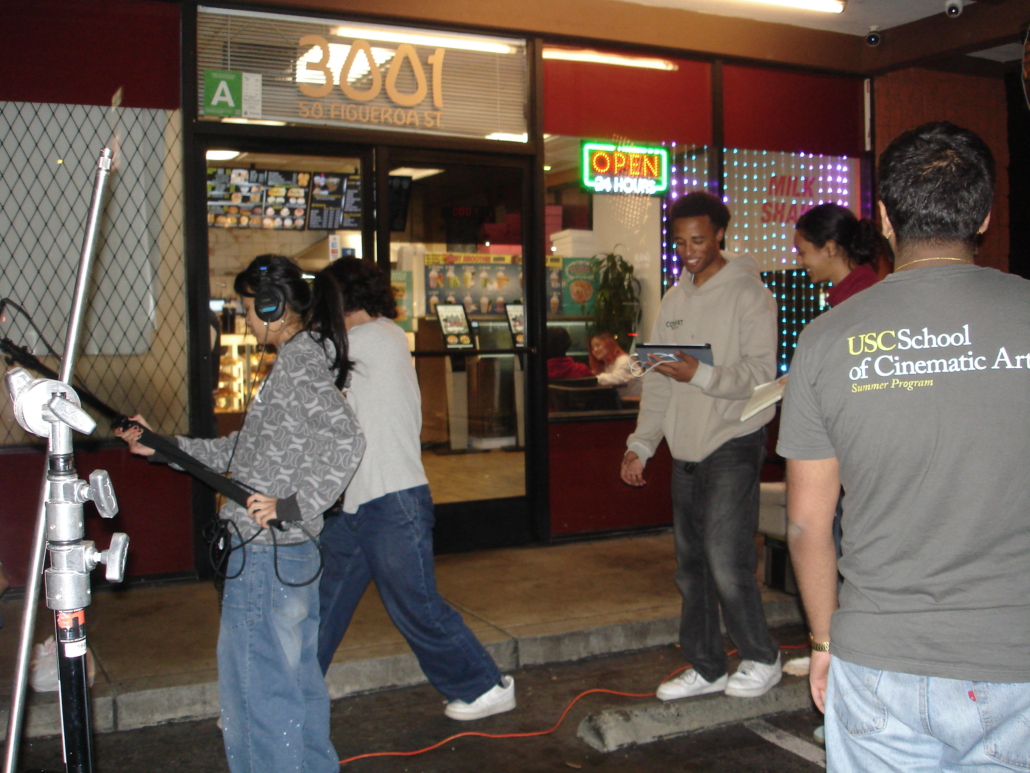

Stanley Turner and his friends created a uniquely USC film.
A chaotic frenzy to retrieve a stolen bike on USC’s Greek Row describes the plot of the short film “Bicycle Thieves,” written and directed by Stanley Turner, a senior majoring in cinematic arts, film and television production in USC’s School of Cinematic Arts. The film recently premiered at the Los Angeles Shorts International Film Festival on Aug. 11, shown in a slate of six other films.
“I thought that it was a really cool opportunity to just meet other people in L.A. doing what we’re doing,” Turner said.
“Bicycle Thieves” centers around a 20-year-old South Central native named Nano (Francisco Espinoza Miranda), who works as a Duffl delivery biker. While not a USC student, Nano is heavily integrated in the community, befriending frat guys and being dubbed an “honorary Trojan.” After his bike is stolen on the Row, Nano must navigate through the sea of drunk college students while discovering just how honorary that title really is.
The 21-minute film brings attention to the stark contrast between the University and its surrounding area, exploring how someone from the other side of the coin could fit in with the perceived bourgeois of a private university.
“That’s always been something that really has been on my mind: the divide between our school and the neighborhood around us,” Turner said. “It was the perfect grounds to explore the theme of belonging.”
While set in a uniquely L.A. landscape, “Bicycle Thieves” takes some inspiration from the 1948 Italian film of the same name. In both films, the protagonists rely on their bikes for their livelihood.
After their bikes are stolen, the protagonists quickly discover that few people are willing to help. They are sent on a wild chase, and even encounter the thief, but to no avail. The protagonist is viewed as an other, leading the film to examine class divides.
“This modern reimagining of that story [asks the audience,] ‘When [do] societal structures become shackles and barriers to people?’” said Lincoln Turner, Stanley Turner’s older brother and a producer of the film.
Stanley Turner grew up observing class differences and the different experiences those divides entailed. His transition from public to private school as a young teenager made this apparent to him.
“I was probably among the more well-off people at public school,” Stanley Turner said., “About seventh grade, my parents moved me to a private school, and then I learned what it was like to be on the other end of that.”
In the film, Stanley Turner highlights some of the local businesses and landmarks that are recognizable to USC students, including Spudnuts Donuts, Cannabis House and Duffl. Turner also incorporated South Central locals as characters and had impromptu cameos from partygoers on the Row.
“It felt very important to [Stanley Turner] and me as well, to make the film and specifically the location we’re talking about feel very homey and specific to the people that are here and have been here,” said Sarah Metwally, one of the film’s producers and a senior majoring in cinematic arts, film and television production.
One of the local business owners featured in the film was Rabin Woods, owner of Cannabis House. Being from the area, Woods offered a meaningful perspective to the film and allowed the students to shoot in his store.
“The combination of traditionally trained actors and people that are kind of new to all this creates something that feels so natural and so lived in,” Stanley Turner said.
Not only were some of the actors new, but so was one of the producers. Stanley Turner approached his older brother with the script during its early developmental period. Despite his main expertise being in acting, Lincoln Turner eagerly took on the challenge to help produce the film.
“I had the privilege of getting to grow up alongside him and to develop my artistry next to [Stanley Turner],” Lincoln Turner said. “I think he really navigated the challenges of it well.”
“Bicycle Thieves” has come a long way since its inception in April 2025. Turner received support from friends in his class of 2027 film-production cohort, who stepped on board as producers, cinematographers and even background characters.
Coming right off the heels of a busy junior thesis season, the crew was able to fight their burnout. For producer Metwally, it was refreshing not to be bogged down by the restrictions of the classes.
“I felt very stripped of my creativity [after the junior thesis class],” Metwally said. “When we started shooting, I remembered why we do these things, and artists like us scrape together things that we love to create a project that’s so close to our heart.”
For a film that champions community, fellow Trojans rallied to support the filmmakers in any way they could. Turner wanted to film a real frat party for the film, so he contacted fraternity members who allowed the crew to shoot during a party.
“Our friend Massimo [Soto] was able to get us into the frat party,” said Brandon Jaiyen, the cinematographer and a senior majoring in cinematic arts, film and television production. “[Our actor] was just acting like the character and talking to random people. It was very authentic.”
The candidness of the film allowed Stanley Turner to connect with people that he met during this process. Curious onlookers asked about the film, some even appearing as extras. The actors formed bonds and even showed up to the film festival to support the film.
“It was just cool to start with a network for the sake of getting a film location, but also like using the film as an opportunity to just make friends,” Stanley Turner said. “Work with your friends, and I think everything else is just gonna fall into place.”
Disclaimer: Francisco Espinoza Miranda formerly served as a staff writer at the Daily Trojan in Fall 2025. Espinoza Miranda is no longer affiliated with this paper.