USC finds new trends in Waymo data
Research reveals user concerns and demographic differences.
By RYAN YOUK
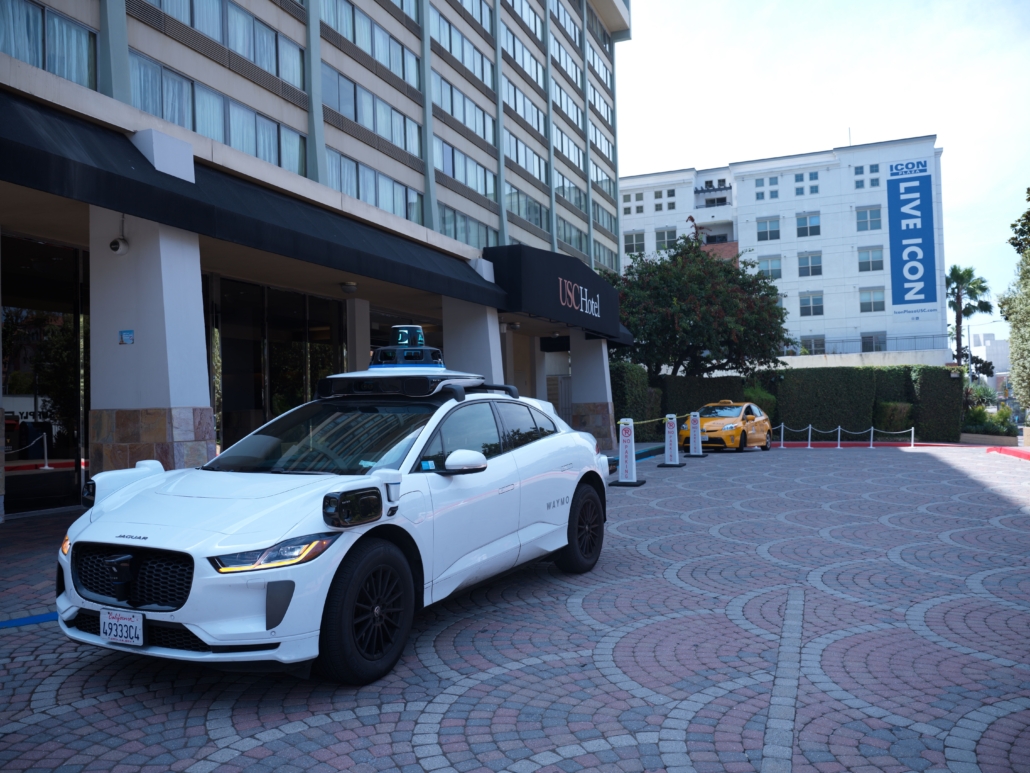

Research reveals user concerns and demographic differences.
It’s been nearly two years since Waymos first appeared on the streets of Los Angeles, and the question on everyone’s mind: Who’s using them?
Researchers at USC are looking to answer that question by studying L.A. County residents’ use of them, measuring demographics like mobility and sustainability.
While use has certainly grown, the survey found less than 5% of respondents had used a Waymo, compared to the near 28% who had used a traditional ride-hailing service like Uber or Lyft.
“I live in Culver City, where I see them all the time,” said Kyla Thomas, a sociologist and researcher who has been analyzing these trends since 2019. “Then there are other parts of L.A. County where people can’t even get a Waymo to come to their neighborhood yet.”Thomas is a research scientist at the USC Center for Economic and Social Research and LABarometer. Thomas’ study examines vehicle use patterns of 2,000 L.A. County residents while prioritizing accessibility.
“We provide tablets to people [with no internet access],” Thomas said. “That’s what makes [our data] more representative because the types of people who are on social media or using email might not be exactly reflective of the full L.A. County population.”
Thomas also noticed the significance of looking into demographics when it came to navigating autonomous vehicle technology in order to bridge any gaps.
“We find younger people are much more likely to use a Waymo than older people,” Thomas said. “There are all sorts of demographic considerations as well that have nothing to do with perception.”
The survey also found that both non-Hispanic White and non-Hispanic Black respondents were more likely than other racial or ethnic groups to use the service. The data also showed that those with a bachelor’s degree or higher were also more likely to use it.
Thomas found that many report feeling safer from harassment in Waymos, with Waymo outperforming ride-share apps and public transportation in modes of transportation voted most safe from harassment by Angelenos.
Women in particular felt much safer from harassment in a Waymo, with 20.7% saying they feel safer in a driverless service, compared to only 12.6% of women respondents who feel safe in an Uber or Lyft.
Katee Zetina, a junior majoring in health and human sciences, has been using Waymos consistently since high school. Zetina said she feels that Waymo can provide a safer option for riders who don’t want their driver to be a stranger.
“There’s cases where Uber drivers and Lyft drivers do stuff to girls,” Zetina said. “Waymo just gives me peace of mind that I’m going to get where I need to get for sure.”
Still, there was a discrepancy in overall safety perceptions, as respondents felt Waymos were the least safe among the options when it came to getting into an accident or any sort of injury.
“We find 12% of people feel safe from accident or injury in an Uber or Lyft compared to 9% of people feeling that way in a Waymo,” Thomas said. “I don’t know if it’s a matter of Waymo need[ing] a different marketing campaign. What is it going to take to get people to feel safer in these other modes than they feel in their own car?”Thomas explained that one thing she has to keep in mind while researching is that studies of autonomous vehicles are at an early stage and are being conducted in real time.
While her hometown is bustling with many self-driving cars, she believes the next step for more statistically significant data in measuring safety is to expand Waymo coverage.
Currently, Waymo operates in a 120-square-mile coverage area, spanning from Santa Monica to Echo Park.
Jonathan Lu, a junior majoring in applied and computational mathematics, uses Waymos about once a month. Lu enjoys riding in Waymos to control the car’s settings without needing to ask for the driver’s permission.
“My experience with Waymo has been quite positive in general,” Lu said. “I really like how interactive Waymos are, as they have a screen where you can look at the route, or play any kind of music that you want.”
While he enjoys those features, he also noticed that Waymos could learn roads better in different areas.
“Taking a Waymo feels pretty similar [to a ride share app], but taking an Uber or a Lyft feels more natural because I’m actually interacting with a human driver,” Lu said. “Sometimes a Waymo can take a longer or less convenient route, like it might only drive on local roads instead of highways.”
Zetina also said that while she saw the app’s technical issues at the start, overall it has been an affordable option for her to get around L.A.