USC looks to cut down on water use, turns to native plants
The University currently spends 101 Olympic-sized swimming pools’ worth of water on landscaping.
By DAVID RENDON

The University currently spends 101 Olympic-sized swimming pools’ worth of water on landscaping.
For 145 years, USC has embraced an East Coast, Ivy League look, but now it looks to embrace white sage, deer grass and California poppies as new work from the University continues to include more native wildlife in the campus’ landscape.
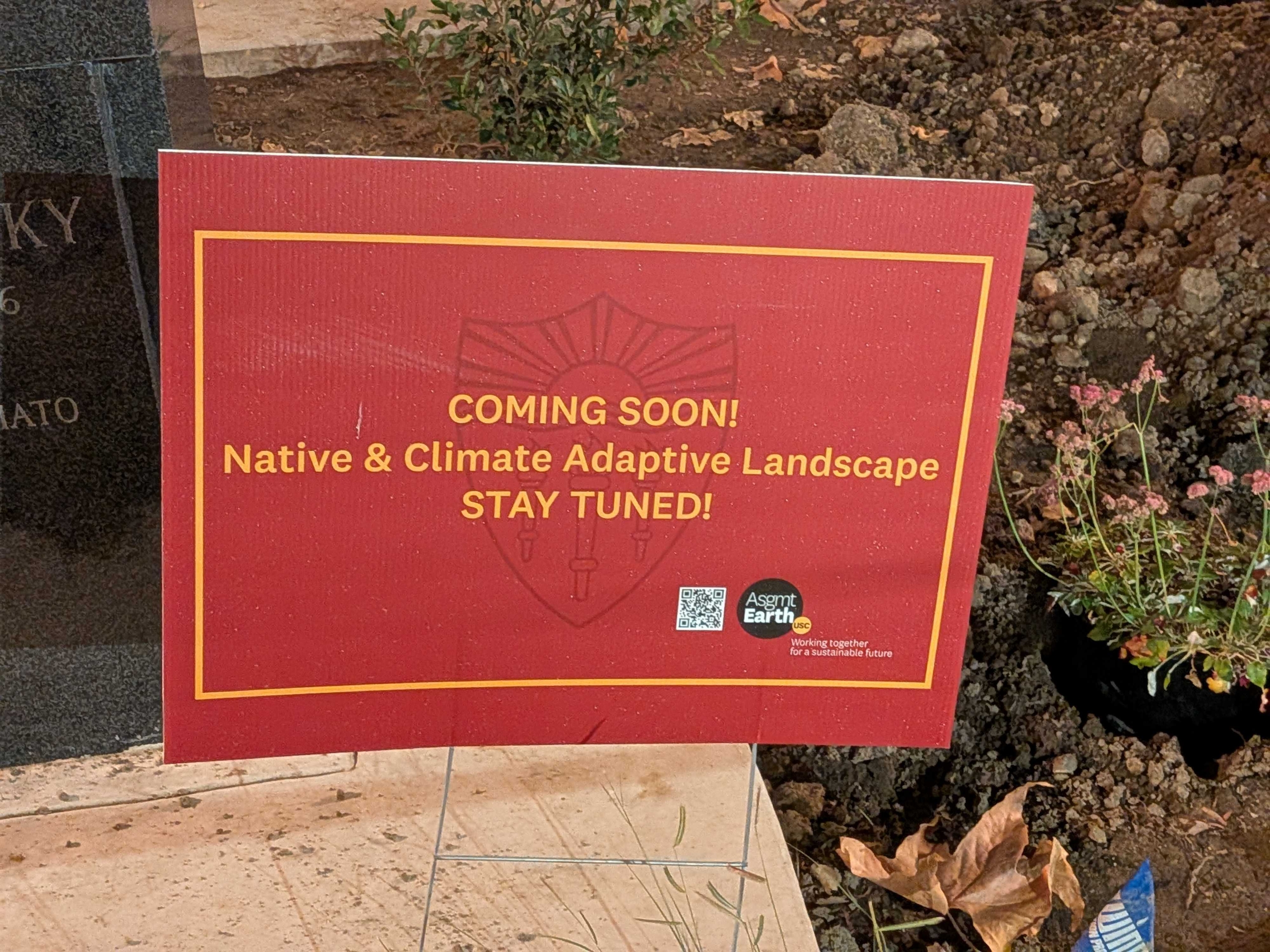
Several plots on campus are being reworked to bring native and climate-adaptive plants to campus. The goal is to eventually reduce USC’s water use by up to 75%.
Landscape architecture as a whole is moving toward embracing more native plants in its design, according to Esther Margulies, director of the master’s program of landscape architecture and urbanism.
“We realize that planting doesn’t exist in a vacuum, and that it is all part of our Southern California ecology,” Margulies said. “Every time we use native species, we’re increasing that habitat value and hoping to and helping to support all the species that depend on those plants.”
Margulies gave two trees as a hypothetical: while two trees could be nearly identical, a native one could support thousands of other organisms that depend on it, a non-native tree could not.
These native plants are essential, Margulies said, for creating healthy habitats, and many are drought-tolerant since they’re from the area. Native oaks, for example, can provide excellent shade and help create cooler spaces on campus.
According to the plan’s proposal released in 2023, USC is estimated to use over 66 million gallons of water per year on landscaping alone. That’s the equivalent of 101 Olympic-sized swimming pools.
But the road to saving water isn’t an easy one. To cut usage by even 30%, the study found that USC needs to transition all turf areas — save for baseball and football recreational natural turf — that are not used for tailgating into low-water-using plants, and about 30% of turf currently used for tailgating.
To reach 75% reduction, USC would have to convert the entire campus to low-water-using plants. Zelinda Welch, director of energy and sustainability, said 30% is a “safe” goal.
For now, USC is focusing on several pilot plots of low-water-using plants, including Queen’s Court, Doheny Memorial Library, the Royal Parking structure and the music buildings. The renovations near DML are estimated to save 90,000 gallons of water a year and Queen’s Court could save nearly 149,000 gallons.
The locations were selected after extensive conversations with stakeholders, Welch said.
“You always have to negotiate with those who might be using the area or, for instance, we have the Festival of Books, and so you always have to be very careful,” Welch said. “What seems like no one’s using, but in fact, we use it for the Festival of the Books or commencement.”
Margulies, who served on an advisory committee for the project, said that selecting where work can be done is very difficult because campus acts like a living, breathing environment.
“There’s a little bit of a two-way street where it’s easy for us to sit in our offices here and say, ‘The easy answer is we need to do a lot more turf reduction,’” Margulies said. “But then, as part of that process, to hear and to understand how those spaces are used, that much of our campus, where we still have natural turf or grass, these are really heavily used spaces.”
Several of the plots have been completed so far, and the others will be completed in November, Welch said.
Currently, it’s difficult to collect data on the plots to see exactly how much water they’re saving on campus, partly because many areas don’t have meters to measure water usage, she added.
“We tried to attempt to see if we could find areas [where] you could actually get real data, and that was a challenge,” Welch said. “For the most part, it’s going to have to be what the industry assumptions are for this type of work.”
Margulies said that USC should aim higher than the lowest hanging fruit of solutions when it comes to water reduction.
“We’re going to have a balance between some thirsty landscapes and much more drought-tolerant or much better water-conserving landscapes,” Margulies said. “Before we start putting most of our energy into our landscapes, personally, I would want to see that we’ve made equivalent efforts in our indoor water-use that we are being as water-conserving as possible.”
Even if areas aren’t chosen as part of the project, native landscaping work is still being done during renovations or during new construction, Welch said.
“When we go and we do work, which we do all the time, either ripping out a steam line and you’re putting in a new one, or you have to do a retrofit on a building,” Welch said, “Our project managers are really clear of when they go to replant.”
The plots can also serve as learning grounds for people on campus; it gives students and faculty who are interested in the environment and sustainability ways to learn about native wildlife, including local pollinators and bugs, Welch said.
“I’m super thrilled at seeing actually how quickly [projects have taken hold], since the adoption of that plan [is going],” Margulies said. “I’ve been on the campus for … close to 20 years now, and it is super exciting and thrilling to see how quickly we’re transforming these parts of the campus into something that is more sustainable, more healthy, more interesting — the landscape of the future.”