SCA alum’s ‘Peripheral’ brings memory to LA Shorts
Alison Church’s nonlinear film screened at the Oscar-qualifying shorts festival.
By JULIA HO
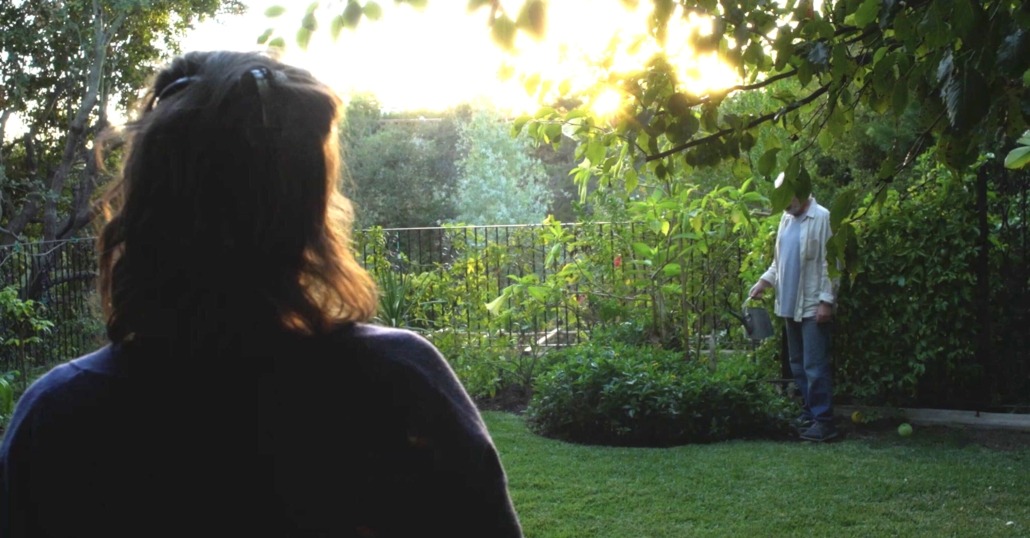

Alison Church’s nonlinear film screened at the Oscar-qualifying shorts festival.
Although impermanence may seem like an unusual preoccupation for a then-junior in college, Alison Church was always a nostalgic child.
“Even though the literal experience of being an aging couple isn’t something I can directly relate to, the emotional fear underneath it — and the fact that our experiences are temporary and our memories are fragile — is something I’ve thought about for a long time,” she said.
“Peripheral,” a non-chronological short about an aging couple named Nora and Elliot, screened Aug. 2 at Los Angeles Shorts International Film Festival, an Oscar-qualifying festival, in its L.A. premiere. It won best cinematography earlier this year at Trinity Film Festival in Connecticut.
Writer-director and sound designer Church, cinematographer and production designer Mikayah Lee, and producer and editor Henry Roth all graduated in Spring 2026 as film and television production students in USC’s School of Cinematic Arts. They made the short in “Intermediate Production,” a class where students rotate through crew roles on one another’s junior thesis films.
“‘Peripheral’ is about the passage of time and the fragility of memory, especially what happens to the moments we’ve shared with someone when eventually there’s no one left to remember them,” Church said. “Underneath that, there’s this question of what we leave behind.”
Church said she was drawn to fragmented storytelling because it more accurately mirrors how people actually experience their lives, where a particular sound or image can evoke something from decades earlier.
“I wanted memory, dream and reality to gradually coexist until you’re not really sure where one ends and another begins,” she said.
Water arrived first, among the earliest images she had, because it is never still, she said, much like moments in life. She arranged the film around two opposing versions of water. In the couple’s youth, it is a river — sunlit, bright, continuous; in old age, it is a leak spreading across their bathroom ceiling, a dark shape that keeps widening as the film progresses.
The short’s title came from a conversation with a friend, Church said. They had been talking about the range of vision in other species, which left Church thinking about how narrow humans’ views of anything really were. She began connecting that to what the film was already about: A memory that can’t be recovered as it happened, or the certainty of death that no one can look at head-on.
Church and Lee spent their time preparing on shot lists, storyboards, lighting and lens choices, hunting for small physical details that could do the emotional work without explicitly stating it. Lee, who had shot only her own projects and freelance work before “Peripheral,” built the contrast into the palette.
“There’s this clear contrast in the film from the past scenes being very bright, this happy memory, this fleeting energy of youth, and then the scenes where the couple was older, leaning more into the blues, leaning more into the somber energy and the longing for these memories back,” Lee said.
Roth, who handled locations, spent weeks driving through parts of L.A. he and the crew had never seen, matching the script’s images to real places.
“We knew exactly what Alison wanted, but it was like, ‘Okay, we’ve got to see if this exists in Los Angeles,’” Roth said. “That’s the game we had to play, and luckily, we found it.”
Beyond Malibu Creek State Park, he sourced the house where the couple’s later years were shot, with a garden that gave Church the film’s focus on landscape.
“Even after we’re gone, these landscapes still remain,” Church said. “The tunnel and the river and the garden become these spaces that hold on to the traces of people who have passed through them. … I liked imagining that nature might preserve something that our own memories eventually can’t.”
The same limit applies to the film’s focal couple.
“Love might be one of the closest ways we have of truly attempting to see another person, even though there’s always going to be things about them that are beyond our periphery,” Church said.
The soundscape came to Church early. She has played violin since she was 7 years old, grew up in orchestras and joined USC’s Student Symphony Orchestra. A score, to her, operates as its own vocabulary — it can carry what dialogue cannot, and set against the right image, the pair edges toward poetry.
Multiple composers, including Mic Ferrante, wrote original material for the short; Ferrante recorded an ensemble of string players. Church later asked him to break out the raw piano tracks so she could cut and space the notes until they fell where she wanted them.
The soundscape is quiet on purpose — wind chimes, laundry rustling, the drip. Church stripped the film down so those noises would register, after a sensation she gets sitting outdoors in silence: The recognition that a great deal is going on around her, and that her life is attached to something that continues past it.
People tell her the film is sad, and Church agrees — but said that isn’t the whole of it. She believes there’s hopefulness in it too, in the sense that decay in nature is a transfer rather than an ending.
LA Shorts was Church’s first festival Q&A. It was also the second time a stranger had approached her after a screening to tell her the film brought back a death in their own family. At Trinity, it was a man who had lost his wife. This month, it was a woman she has since become friends with.
Church will be the cinematographer for a feature in October for a fellow recent USC graduate. She said she plans to keep building films that get at inner life sideways, through image and metaphor, rather than moving a plot from one point to the next.
“Certain films in my past have made me feel very seen, and I hope to make work that can do that for someone else,” Church said. “Being perceived and perceiving someone else are really closely connected to love for me. Art and film can be a way of creating that recognition between strangers.”
Correction: A previous version of this article incorrectly referred to a leak forming on the couple’s bedroom ceiling in “Peripheral.” The article was updated Aug. 28 at 1:24 p.m. to reflect that the leak in the short occurred over the couple’s bathroom ceiling. The Daily Trojan regrets this error.