Campus blood drive promotes saving lives through donation competition
Students said it was easy to stop by between classes.
By RUBY MATENKO
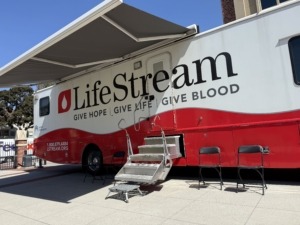

Students said it was easy to stop by between classes.
When he was 18, Juvenal Serrato, now the regional account manager for LifeStream Blood Bank, was involved in a big accident. During his recovery from the accident, he got the blood he needed to survive from a blood drive like the one held Wednesday by USC Campus Health, which sponsored a mobile blood donation drive at USC Village.
“It was a life-threatening [accident], and the hospital that [LifeStream Blood Bank] partners with in Riverside was actually the hospital that needed the blood donations in order to save my life,” Serrato said.
USC Student Health and Keck Medicine of USC reports that they sponsor monthly blood drives at both the University Park and Health Sciences campuses to help meet the ongoing need for donated blood.
According to the National Heart, Lung, and Blood Institute, about every two seconds, someone in the United States needs blood.
“We have a [blood donation] option that takes extra red blood cells that can save six lives with one single donation,” said Luis Maldonado, regional account manager for LifeStream Blood Bank. “We’re expecting at least between 60 to 70 donations today.”
Elizabeth Boyd, a junior majoring in business administration, is a student ambassador working to raise awareness about blood drives on campus. She is also promoting the Big Ten Network’s “We Give Blood” competition in collaboration with health care company Abbott right now, a nationwide annual donation competition between universities within the Big Ten conference.
“[The drive] will have a huge impact,” Boyd said. “American Red Cross — they just declared their second-ever national shortage. … It’s really important that we get this new generation of people [and] of young people our age in college to start donating for the first time and be more aware of the importance of donating blood.”
According to Boyd, the competition gets people energized to compete and donate more blood.
“It benefits people who may need transfusions or whatever medical things that they need, and why not?” said Alissa Zavala, a sophomore majoring in international relations and the global economy. “It doesn’t harm me. Might as well help someone.”
Boyd said that the mobile blood drive trucks get a mix of walk-ins and people with appointments, and they have been making an effort to get more people to sign up.
“This is actually my first time doing blood donation,” said Katie Wang, a graduate student majoring in supply chain management. “It’s really convenient because it’s just inside the school, so I can just walk here and then do blood donation and go back to school.”
According to the American Red Cross, it takes about eight to10 minutes to collect a pint of whole blood. When the donation is complete, a staff member will bandage the donator’s arm and provide post-donation instructions, which typically involve drinking fluids and eating something substantial with sugar or nutrients.
“It doesn’t take a lot of time; it’s just like 30 minutes,” Wang said. “You can do something that can help a lot of people.”
When Maldonado was asked why blood drives on college campuses were important, he said that it was important due to students’ willingness to give.
“When we have blood drives in local, community-driven city parts, people are just driving by. They’re busy. They’re working,” he said. “Students have time to come in, get a refreshment between classes, and they’re just more willing to find out about donating and trying it for the first time.”
Boyd emphasized the importance of blood donations and how they can impact people who are going through cancer treatments, transfusions, major accidents or surgeries.
“I actually have a friend at USC whose life was saved when they were a kid from having four whole bags of blood transfusions,” Boyd said. “There are people impacted by this, and you might not even know who they are. They might be your friends who have just never told you until now. But it’s just really impactful to know that people’s lives can be saved by this.”