Over 300 affordable housing units to be added near downtown Los Angeles
Two new projects aim to help address housing needs in Skid Row and Koreatown.
By ANYA MOTWANI

Two new projects aim to help address housing needs in Skid Row and Koreatown.
Two housing projects in Skid Row and Koreatown are working to add a total of over 300 affordable housing units. The project in the former is set to be a mixed-use mega development while the structure in the latter is a traditional apartment building.
These efforts came alongside the Downtown Los Angeles Community Plan Update 2040, an initiative by the Department of City Planning that looks to apply new zoning to “support the residential base,” according to the City’s fact sheet.
A 2023 report from the Angeleno Project found 80% of L.A. renters below and far below the poverty line spend more than half their income on housing. At that time, Los Angeles was about 270,000 units short of meeting affordable housing demand.
The biggest contributor to the housing shortage, according to a report by Enterprise Community Partners, a nonprofit working to increase housing supply, is lack of funding. That same 2026 report noted that about 40,000 affordable housing projects that could support more than 432,000 low-income households over the next five decades were simply awaiting funding to actually break ground.
Tom Grode, a coalition member of Skid Row Now & 2040 — a grassroots initiative to reshape Skid Row alongside DTLA 2040 — pointed to market-rate housing as one of the biggest roadblocks to building more affordable housing options in L.A.
“[Market-rate housing is] basically: ‘We’re going to build housing based on this premise that there’s going to be a bunch of people who are going to have a lot of money and can rent what we want it to cost,’” Grode said.
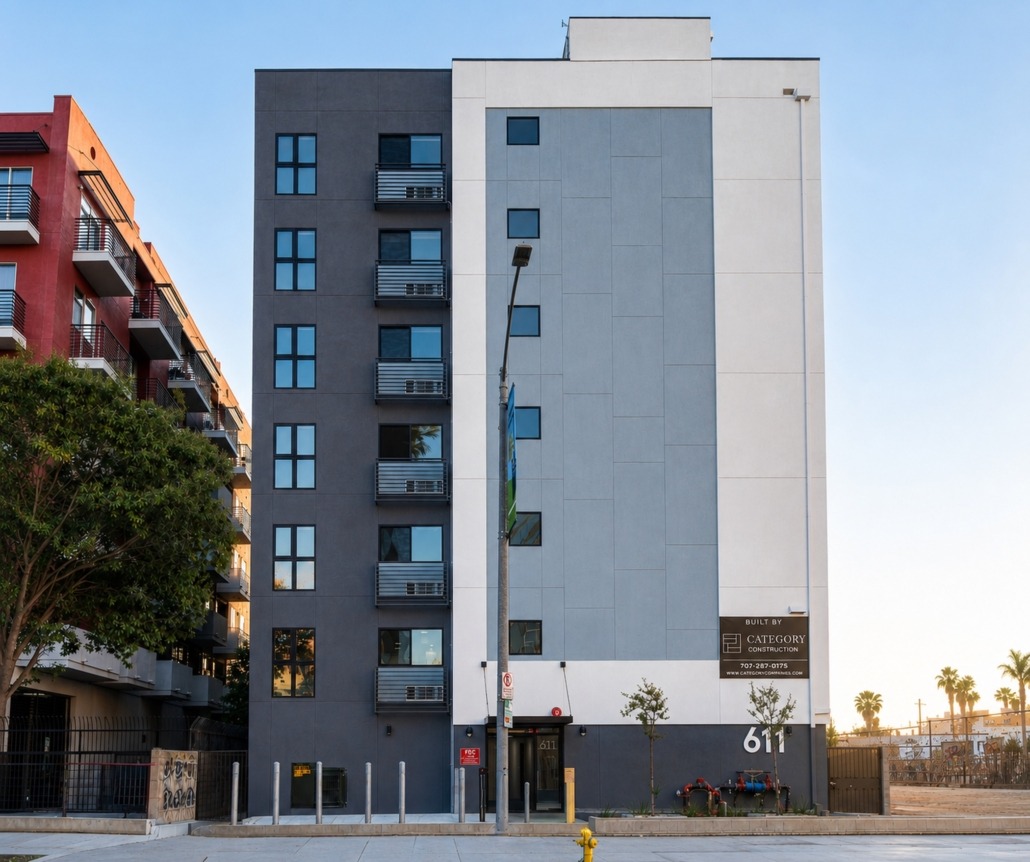
Where other affordable housing projects have faced years of roadblocks, the new 80-unit building at 611 S. Hobart Blvd. took about two years from drawing to construction. Developed by Atto Property Development, which is in turn owned by the Lee family, the project was the first to be completed under Mayor Karen Bass’ Executive Directive 1, which expedites planning for 100% affordable housing projects, among other criteria.
“The reason why the project was so quick was because right when ED 1 came out, we jumped on it, we just transitioned our full project and we went 100 miles per hour at it,” said Nicholas Lee, who oversees the operations team for his family’s office.
The building, which had its grand opening on Aug. 6, will have a 100-year covenant that ensures rent remains affordable for tenants. For Nicholas Lee, the goal with this building is to “get at least 80 families off the street.”
Real estate developer and USC alum, Leo Lee, chose to build in Koreatown because of its high population density and lack of affordable housing options, Nicholas Lee said of his father.
“Rent is too damn high,” Nicholas Lee said. “It doesn’t make sense. How are people gonna live? How are people gonna survive? How are people gonna feed their families? It makes no sense, and it’s kind of sad to see that a lot of people are getting pushed out. You see the homeless situation, you see everything going on, and it’s like everyone just wants to do something for a profit.”
Grode, who lived in Skid Row from 2013 to 2017, stressed the importance of community input in urban planning and building projects in any neighborhood. Community input contributed to the $2 billion Skid Row mega development, which is a designation given to multi-billion, multi-acre mixed-use projects like it. The development is set to be on the edge of Skid Row near Little Tokyo and the Arts District.
First proposed in 2021, the initial plan faced significant pushback from the community, according to Hana Noguchi, a community organizer with the Little Tokyo Community Council. LTCC is a coalition of stakeholders in Little Tokyo, made up of businesses, places of worship, nonprofits, residents and others.
“[The] Little Tokyo community had a lot of concerns around the project, including the lack of affordable housing, the scale of the building and the density,” Noguchi said. “Once we laid out all of our concerns, and we realized they were unwilling to make any changes, that’s the point where we decided to officially be opposing the project.”
LTCC and Skid Row Now & 2040 have since worked with developers, the property owner and city officials to reimagine the project.
L.A. City Councilmember Ysabel Jurado helped lead negotiations between Little Tokyo stakeholders, Skid Row stakeholders and the developer, according to her office. Jurado represents Council District 14, which includes Downtown L.A. among other constituencies. The 7.6-acre site, currently occupied by L.A. Cold Storage at East 4th Street and South Central Avenue, is one of the largest development projects in the city’s history.
“After months of negotiations, we are moving forward with an opportunity to make 4th and Central a model for community-guided development that builds people-powered neighborhoods,” a statement from Jurado’s office to the Daily Trojan read. “For generations, Little Tokyo and Skid Row have shaped the history, culture, and identity of this city while too often being excluded from decisions about their own future. This effort is about changing that legacy.”
In an Aug. 11 press release, the LTCC announced they had reached a Community Benefits Agreement including more extremely low-income housing than is required under DTLA 2040 as well as setting aside about 2,000 square feet for local businesses and nonprofits at 50% discounted rent. In total, 16.5% of the 1,589 units will be affordable at varying levels, according to Noguchi.
Still, the fight is not over for Noguchi, who noted many of the community’s concerns have yet to be realized in the CBA. For Grode, this is a journey others can learn from.
“It’s important for neighborhoods to get organized and to educate themselves as well as the basics of urban planning and zoning, so they know how to advocate for their own neighborhood, so that it doesn’t just turn into gentrification and displacement through market-rate housing,” Grode said. “That really is what it all boils down to: New money [is] going to come into your area, and, for the most part, push people out.”
Clarification: A previous version of this article incorrectly stated that the development at East 4th Street and South Central Avenue will be in Little Tokyo. The article was updated Sept. 9 at 6:38 p.m. to reflect that the project is in Skid Row, near Little Tokyo and the Arts District. The Daily Trojan regrets this error.