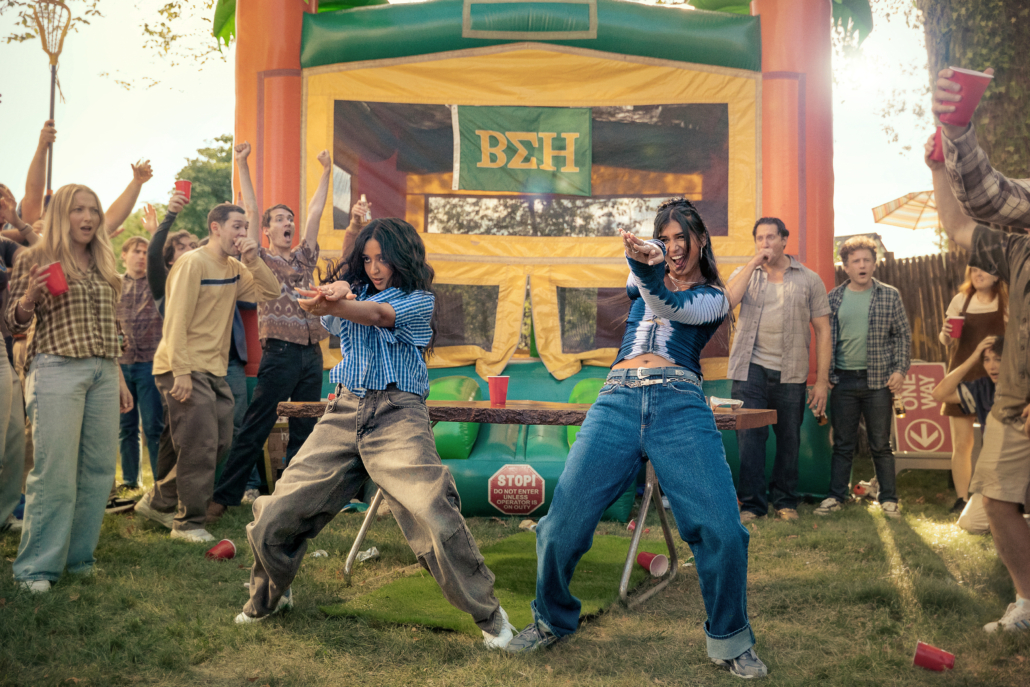
College is already a competition — for grades, status and the people who seem to have it easier. In “Best of the Best,” director Lena Khan turns that familiar presence into a vibrant Bollywood-fusion dance comedy, in which an emotionally complex friendship proves more compelling than the championship itself.
“This world of collegiate Bollywood dance was a very important part of our college experience,” said actor and comedian Hasan Minhaj, an actor and writer in the film, at a post-screening Q&A at USC on Sept. 14 with director Lena Khan.
That personal connection pulses through “Best of the Best,” a vibrant upcoming Netflix comedy that turns the familiar dance-competition formula into something more emotionally grounded. Khan’s film follows childhood best friends Maya (Maitreyi Ramakrishnan) and Anjali (Priyanka Kedia). As they enter the demanding world of collegiate Bollywood-fusion dance at UCLA, rehearsals, rivalries and growing ambitions test the friendship that first brought them together.
Daily headlines, sent straight to your inbox.
Subscribe to our newsletter to keep up with the latest at and around USC.
The premise contains many expected competition-movie beats: a talented team, intimidating rivals and the looming possibility of public failure. However, “Best of the Best” stands apart because it takes its characters’ feelings seriously. The film isn’t only about winning a dance championship; it’s about what happens when two friends begin to measure themselves against one another.
While the film features more emotional complexity than a typical story about a dance competition, some rival-team and underdog beats remain familiar. The script is at its strongest when it focuses on Maya and Anjali rather than the team’s more conventional path to the championship.
Ramakrishnan’s performance gives Maya an appealing mix of confidence and insecurity. She is ambitious, academically successful and determined to excel, but her ambition can make it difficult for her to see when she is hurting the people closest to her. Kedia’s performance as Anjali is quieter but just as compelling, particularly as the friendship’s long-standing emotional imbalance comes into focus.
Although Maya and Anjali eventually explode into an argument, Khan and the film’s writers first let the tension build through lingering resentment, awkward conversations and passive-aggressive remarks. The approach makes their conflict feel far more believable than the standard friendship breakup found in many coming-of-age movies.
The supporting cast also keeps the movie lively. Chaneil Kular brings charm to Arjun, Maya’s childhood acquaintance turned love interest, while Minhaj delivers a scene-stealing performance as Professor Latif. The humor comes from character dynamics and the heightened seriousness of competitive team culture rather than the raunchier jokes typically associated with college comedies. The script also plays with familiar South Asian stereotypes, turning them into self-aware jokes rather than reducing its characters to them.
Maya and Arjun’s romance is sweet, but it receives less development than Maya and Anjali’s friendship. As a result, its emotional beats do not land with the same force as the film’s central friendship.
Ramakrishnan and Kedia have an easy chemistry that makes it hard not to root for Maya and Anjali, even when they are at odds. Their relationship feels rooted in years of inside jokes, shared memories and unspoken expectations, allowing the film’s emotional moments to land without becoming overly sentimental.
At the Q&A, Khan said Ramakrishnan and Kedia trained six days a week, taking six dance classes each day in preparation for the film. Their commitment shows in the confident, athletic performances that make the dance scenes feel as emotionally charged as they are visually exciting.
Vivid costumes, intricate choreography and energetic camera work make each competition feel like an event. Bollywood-fusion dance is not a quick visual break between plot points; it is central to the characters’ identities, ambitions and sense of community. The routines blend Bollywood movement with hip-hop, contemporary styles and other influences, creating eye-catching sequences without feeling disconnected from the story.
The soundtrack heightens that energy. Each music choice feels intentional, whether it heightens the energy of a performance or underscores a more personal moment between characters. A Bollywood-inspired sequence set to “Bole Chudiyan” from “Kabhi Khushi Kabhie Gham” (2001) is a joyful highlight, tapping into nostalgia and cultural memory that make the film feel personal rather than generic.
Khan’s direction also makes the college setting feel lived-in rather than generic. The film does not merely use UCLA as a backdrop for parties or one-liners; it shows how a dance team can become the center of students’ social lives and senses of belonging. That attention to the community around the competition makes the stakes feel more personal than simply taking home a trophy.
The competition’s stakes are also grounded in a real collegiate tradition: Minhaj said more than 150 schools participate in Bollywood dance competitions across the country, giving the film’s rehearsals and rivalries added credibility and reflecting an established student community rather than one created only for the story.
The film also gives South Asian characters room to be funny, flawed, romantic and fiercely competitive without reducing their culture to a punchline. Its references to family, friendship and the pressure to succeed feel specific enough to be meaningful, yet universal enough to resonate beyond its core setting.
“Best of the Best” may use a well-worn formula, but Khan and the cast fill it with enough heart and cultural specificity to feel fresh. It is a joyful, emotionally grounded dance comedy that proves college movies can be entertaining without treating young people’s friendships and dreams as shallow.