BEYOND THE WHISTLE
At USC, game day is a language
Cowboy boots and tailgates shape Trojan fandom beyond the game.

By RIYA KALRA
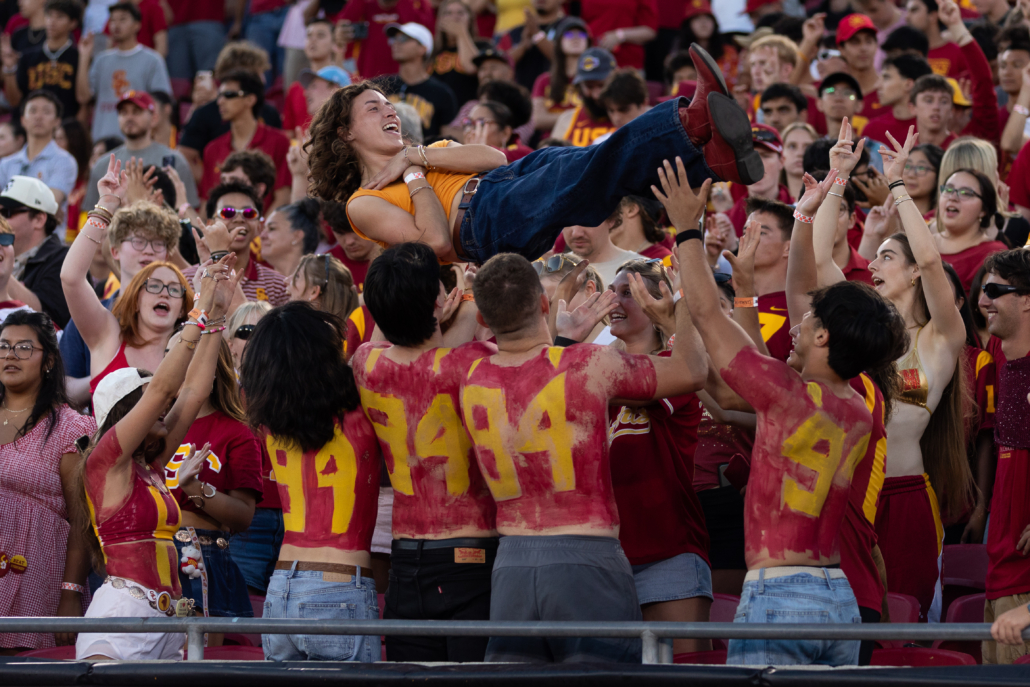

Cowboy boots and tailgates shape Trojan fandom beyond the game.
At USC, game day plans usually begin with a question that has nothing to do with football: “What are you wearing?”
For a school in Los Angeles — not the South — it is a little funny how quickly cowboy boots have become part of the game day uniform for fans.
The group chat starts early: boots or sneakers, skirt or jeans, cardinal red or something that looks good with a cardinal-and-gold accessory. By the time people start walking toward a tailgate, everyone is dressed up, phones are out and somebody is trying to find the one spot with the best light for pictures.
Then, eventually, there is the football game — complete with the Trojan Marching Band, the drum major’s sword at midfield and Traveler galloping around Los Angeles Memorial Coliseum after a touchdown.
That is not meant as a criticism. In fact, it’s kind of the point.
Game days at USC are not just about entering the Coliseum, watching four quarters and going home. It is a ritual.
There are tailgates, outfits, pregame photos and the walk down Trousdale Parkway as the Trojan Marching Band heads from Heritage Hall toward the Coliseum.
There is the inevitable postgame debrief in group chats, too. For some people, knowing every player, formation and statistic is what makes the day exciting. For others, football creates the backdrop for one of the few times when a campus as large as USC feels like one community.
Both are real forms of fandom in their respective ways.
It is easy to look at students taking pictures before kickoff and decide they are only there to be seen. Social media makes that judgment even easier.
A photo from the Coliseum can look perfectly curated: a cardinal-and-gold outfit, the field in the background and friends smiling in front of the stadium. Sometimes, yes, people are more focused on documenting the day than the game itself.
But that does not mean the tradition is insincere.
Sports have always been tied to identity. Fans have worn jerseys, painted their faces, saved ticket stubs and argued with family members about their favorite teams.
Social media has not invented performative fandom; it has just made it public. Posting a game-day photo is the current version of saying, “I was there.” It is a way of joining a collective memory, even if the post is just as much about the outfit as the final score.
As a girl who genuinely enjoys sports, I have always thought it was strange how people treat dressing up and knowing the game as opposites. If you know the roster, people are sometimes surprised that you also want to wear cowboy boots to the Coliseum. If you take photos with your friends before the game, people might assume that you could not possibly care about what happens on the field.
But that is such a limited way of viewing fans.
Getting ready is part of the excitement. It is no different from wearing a player’s jersey, planning a tailgate menu or learning every word of a fight song. It is just another way people participate. On game days, fashion becomes its own kind of school spirit: a way to show up visibly and say that the event matters enough to make an entire occasion of it.
Most importantly, the social side of game days helps create the atmosphere that makes college sports special. The football team might be on the field, but the crowd supplies the energy.
The Coliseum is not memorable only because of what happens between the lines. It is memorable because a big play makes complete strangers scream at the same time; the entire student section stands up during a close fourth quarter; a bad call produces the same frustrated reaction from two people who had never spoken before that day.
Those moments cannot be recreated through a photo dump or a TikTok. They happen when everyone forgets about the photo for a second because the game actually gets good.
I do not think the social media era has ruined game day. If anything, it has widened the door into sports culture.
Someone might come to a game because their friends invited them, because they want to dress up or because they want to experience a true USC game day for the first time. But once they are in the stands, they may end up invested in the score. They may learn the fight song, become attached to a player or understand why the person next to them is so stressed over a third-down stop.
Fandom often begins before someone can explain it.
USC game days work because they are both things at once: a football tradition and a cultural event. The tailgates, cowboy boots and photos are not distractions from the sport. They are part of how students make the sport their own.
But the moments that last are still the ones when the game becomes bigger than the post, and every phone in the student section finally goes down.
Riya Kalra is a sophomore writing about the intersection of sports and culture in her column, “Beyond the Whistle,” which runs every other Tuesday.