The Doomsday Clock isn’t a countdown
The Doomsday Clock rather keeps perspective on where humanity stands right now.
By TIM HAN

The Doomsday Clock rather keeps perspective on where humanity stands right now.
Renowned actor and former wrestler John Cena carries a special pocket watch that “keeps his perspective.” The front reads “memento mori”; he looks at it occasionally to remind himself that he is human — grounded and equal with others. His watch does not tell time, but keeps him aware of his thoughts and actions.
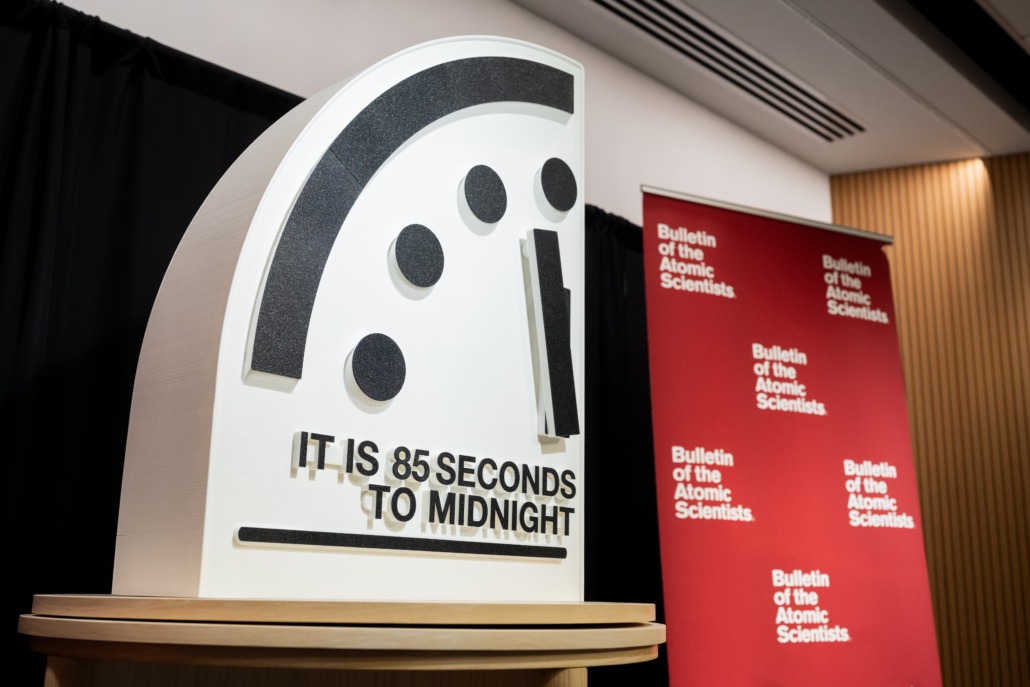
According to the Bulletin of the Atomic Scientists, the Doomsday Clock indicating global catastrophe stands at 85 seconds to midnight. Regardless of how accurate the clock is, it’s intimidating to see it’s the closest it has ever been to worldwide demise.
Clocks are powerful metaphors because time is an inevitable, abstract concept. There’s no stopping or manipulating it, constantly reminding us to be aware of time passing: not to be late to class, to meet a deadline, to coordinate with others. These manmade devices explore emotional arcs and raise stakes; first-year college students easily fall into the trap of stressing over how much time they have and end up not getting anything done.
But as powerful as these metaphors are, one must shift perspective while viewing these images: not panicking and blaming others for inaction, but identifying and executing what problem to resolve step by step, just as upperclassmen and graduate students effortlessly manage their tasks on time.
The Doomsday Clock was first introduced in 1947 as a cover for the Bulletin of the Atomic Scientists — a publication affiliated with the Manhattan Project.
When designing the cover, landscape artist Martyl Langsdorf chose a minimalistic approach of putting a clock to symbolize a sense of urgency. This first-ever Doomsday Clock was set to seven minutes until midnight, which was chosen because it “looked good” to her eye –– it was never meant to be the most accurate metric that pinpoints physical proximity to “midnight,” or human extinction.
Even the concept of doomsday or midnight needs extra clarification. On the official site of the Bulletin, the Doomsday Clock “warns the public about how close we are to destroying our world with dangerous technologies of our own making” — that is, the clock attempts to indicate the likelihood of a human-made global catastrophe.
There hasn’t been any room for political bias to enter the decision of setting the clock.
“The Bulletin’s Clock is not a gauge to register the ups and downs of the international power struggle; it is intended to reflect basic changes in the level of continuous danger in which mankind lives in the nuclear age,” said Eugene Rabinowitch, co-founder of the Bulletin, in a 1984 article in The Southeast Missourian.
This also implies that the Doomsday Clock can be stopped or manipulated; humans can turn the clock back to get as far away from doomsday as possible. In fact, history explains instances where humanity has successfully resolved doomsday-level international conflicts and threats.
Most notably, the fall of the Berlin Wall in 1989 and the signing of the Strategic Arms Reduction Treaty pulled back the clock to 17 minutes to midnight, the farthest back the Doomsday Clock has ever been set. It has already proven that it’s possible to reach mutual agreements and take collective action toward peace.
So why did the Bulletin of the Atomic Scientists — a world-class assembly of scientific experts — set the clock to 85 seconds? Out of all of humanity’s history, is everyone really on such thin ice? An answer to this question may be the multiple factors that bring in serious threats: nuclear risk, climate change, disruptive technologies and biosecurity.
Nuclear warfare is heightened again with major interstate conflicts over Russia and Ukraine, Palestine and Israel, and more, with the vast majority of global leaders having turned nationalistic.
The problem of excessive pollution and emission of harmful gases hasn’t been resolved, and predictions about global warming and irreversible tipping points are always under debate. Disruptive scientific and technological advances, including generative artificial intelligence, biological threats and surveillance, pose existential threats to humanity.
There are multiple scenarios that could bring demise. Compounding these problems, it’s no longer known what to focus on or rely on — false news, polarized biases and deceptive propaganda bring chaos to determining what is true and false, just and unjust.
Nobel Peace Prize-winning journalist Maria Ressa warns of the collapse of our shared information ecosystem.
“Without facts, you can’t have truth. Without truth, you can’t have trust. … Climate negotiations fail, arms control fails, pandemic response fails — not because we lack solutions, but because we can no longer agree on the problems,” Ressa said in the 2026 Doomsday Clock announcement.
This sentiment is what makes us so close to peril, not really in terms of time, but more in terms of awareness of what has to be done. The Doomsday Clock tells the perspective –– just like Cena’s pocket watch — to be aware of action and inaction and have a consensus of where humanity stands.
Eighty-five seconds till doomsday initially intimidates the global audience with striking symbolism, ultimately stressing that it is an important transitional phase in the modern human era. The Doomsday Clock isn’t about what we have done, but what we must do now: calm down, identify problems and tackle them.