Phillip Sliwoski can make science take shape in glass
As an in-house glassblower, Phillip Sliwoski creates and repairs specialized glassware for USC researchers.
By LARA OLCER
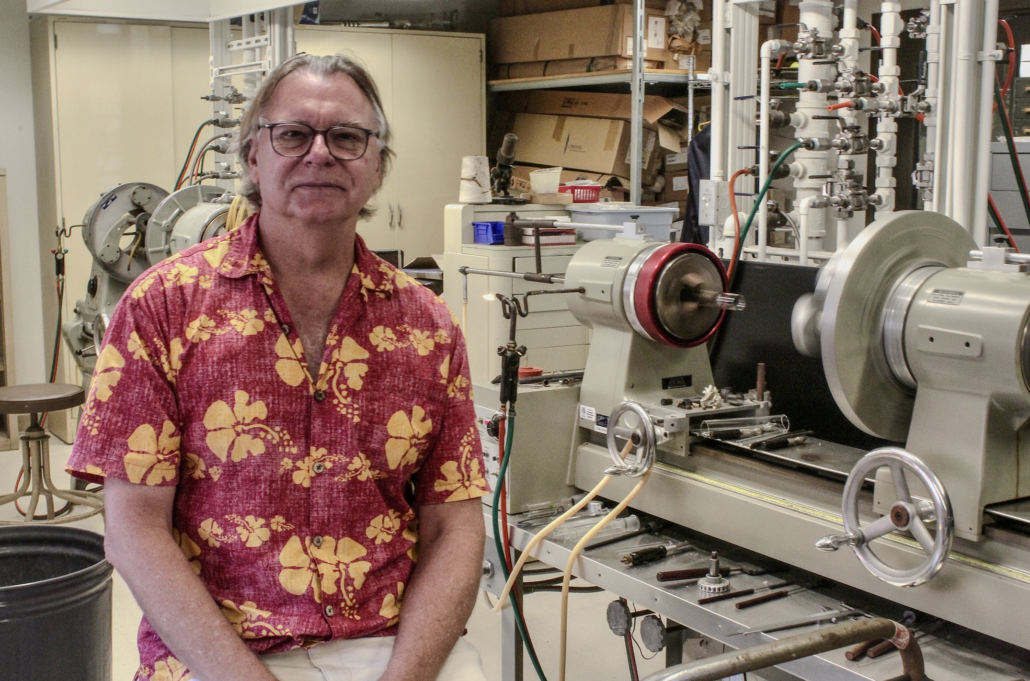

As an in-house glassblower, Phillip Sliwoski creates and repairs specialized glassware for USC researchers.
On the third floor of Mudd Building, a faint drill whirs, molten glass bubbles and a radio plays somewhere in the background. Equipment, tools and glass prototypes fill the workshop, covering tables and blueprints. In his Hawaiian shirt, Phillip Sliwoski moves through the workshop with ease, navigating around glass-blowing equipment.
For nearly 20 years, Sliwoski has been the Dornsife College of Letters, Arts and Sciences’ in-house scientific glassblower, making custom pieces for the University’s researchers and repairing decades-old glassware. Scientific researchers come to him seeking modifications to existing glassware, fielding ideas for specialized pieces and asking for repairs. Sliwoski works with them to figure out each item.
The appeal of the job for Sliwoski is simple: helping people.
“I enjoy doing my work, and it’s a pleasure to help people fulfill what they’re trying to do,” Sliwoski said.
Sliwoski has been blowing glass for more than 46 years. He started as an apprentice about six months before graduating high school and began working full time as a glassblower shortly after.
His days can look different depending on what requests or inquiries researchers bring through the door.
Often starting by drawing designs on a whiteboard in his workshop, Sliwoski sketches what researchers are describing and works through how their ideas can be made in glass. Some pieces take hours and several attempts. One of the more complicated pieces in his workshop took about three hours to make, with Sliwoski stopping partway to anneal the glass and relieve the stress created by heating the object.
“If I tried to do it all in one shot, it would fall apart, and I would be very upset,” Sliwoski said.
For researchers in Dornsife, having a glassblower like Sliwoski on campus is a valuable resource. G.K. Surya Prakash, a professor of chemistry and chemical engineering and materials science as well as a researcher, has worked with Sliwoski on glass apparatuses for his research group. Prakash said Sliwoski’s role is “very valuable [and] very important.”
Prakash said chemists sometimes need specialized apparatuses that cannot simply be ordered from a catalog. Sliwoski can design and build those custom pieces himself, drawing on a skill Prakash describes as both an art and a science.
“If it is not there, then we don’t have the expertise to do it ourselves,” Prakash said.
Xiaojun Zhang, an instructional laboratory manager from Dornsife’s chemistry department, has known Sliwoski for about 15 years.
“Most of the chemistry labs still ask him for glassware. … He is very valuable to the science community,” Zhang said. “He saves a lot of money [for] the department, for the [principal investigators] and for the whole University.”
Glassblowing may be an ancient craft, but the work Sliwoski does today is shaped by modern technology and understanding surrounding the glassblowing process. When he started, the catalog of available glassware was much larger. Today, however, much of the work is automated, and laboratories use smaller quantities of materials as machinery has become more precise.
The same precision comes into play when he repairs equipment: When asked what he has repaired most often, Sliwoski pointed to a Schlenk line, a laboratory apparatus used to handle air- and moisture-sensitive compounds under vacuum or an inert gas, which he said researchers frequently break by tightening the valves too much.
When asked how many times he had repaired one, he said “a couple hundred.”
Because the Schlenk line is just one example of the myriad kinds of equipment Sliwoski regularly repairs, finding someone with the skills to do that work is becoming increasingly difficult and rare.
Sliwoski is one of only a small number of scientific glassblowers in Southern California. The California Institute of Technology also has an in-house glassblower, but many of the other specialists Sliwoski knows of are based in Europe.
Without an in-house glassblower, repairs and custom pieces can take months to arrive. If the piece does not work as intended, researchers may have to send it back. At USC, Sliwoski can sometimes turn around a requested repair within the same afternoon.
For the researchers who work with him, however, he has a simpler hope.
“When you get your Nobel Prize … you don’t have to remember my name,” Sliwoski said. “Just say thank you to the glassblower.”