‘Someone has a crush on you’: Ditto dating spreads across campus
The app’s marketing strategy claims someone has a crush on students in emails.
By SASHA INGBER
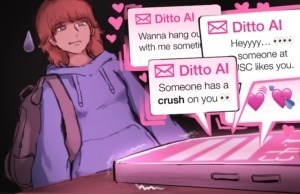

The app’s marketing strategy claims someone has a crush on students in emails.
An anonymous message has been landing in USC students’ inboxes over the last few weeks: “Someone has a crush on you.”
The culprit behind these messages isn’t a scammer; it’s Ditto, a college-student-matchmaking app.
Ditto is an artificial-intelligence-powered dating service designed for college students. It eliminates traditional swiping and texting interfaces by automating matches and date planning via text message. After signing up, Ditto gives users one match from their campus every Wednesday at 7 p.m.
Allen Wang, one of Ditto’s co-founders, said the company was created in response to what he said is a growing disconnect between people and technology.
Wang said Ditto began as a student initiative at UC Berkeley and UC San Diego. He said the founders of the service saw how their generation was affected by loneliness and noted how social media encourages people to consume content rather than make connections.
“We were like, ‘OK, so how do we reverse this trend and help people to spend more time with each other in real life, and build these genuine connections with each other?’” Wang said.
Instead of users spending time swiping and messaging, Wang said Ditto is designed to do the work for them: Users can text Ditto, provide their preferences and let the service arrange a meetup or date.
Ditto recently added a feature that allows users to submit information about their crush. The person receives an email telling them that someone on the platform has a crush on them and encourages them to sign up.
Eliza Fox, a freshman majoring in journalism, received a message in September that read, “Eliza, a real student in journalism has a crush on you. Someone has been hoping to make your headlines at Annenberg.”
Wang said the feature has also become a way for students to interact with their friends, with some users adding friends as a joke.
Fox said her initial reaction to the email was confusion, and that she thought the email was spam.
“The way they marketed it, it went into my spam. So it wasn’t as effective, because my phone realized that it was probably something that wasn’t real,” Fox said.
Despite this, Fox said telling students someone has a crush on them could be an effective way to market a dating app.
Wang said college students are an important audience for Ditto. The founders are Generation Z themselves and understand both the social environment and dating challenges on college campuses.
According to Wang, Ditto’s goal is not only to match people, but also to help plan what they do together:. The service can consider information about both users and suggest a meetup or activity.
Vivi Ducker, a freshman majoring in business administration, also received an email from Ditto during her first week at USC. The subject line stated, “Your actual date is ready.” The email stated that someone in a class had picked her as a back-to-school date and prompted her to reveal her match by signing up.
Like Fox, Ducker also thought the email was spam. After realizing the email was a marketing strategy from Ditto, however, Ducker thought the idea was creative.
“It was really cute,” Ducker said. “It was a great way to preview what it’s offering me. It just didn’t seem like something that I necessarily needed for myself at the moment.”
Both Fox and Ducker said they did not think Ditto’s approach necessarily brings back traditional dating.
“It’s as online as any dating app,” Fox said.
Ducker also said she viewed Ditto as more modern than traditional dating, because it still relies on technology and online matchmaking.
Wang said Ditto tries to look beyond basic interests and instead match people based on personality and intrinsic values using AI and algorithms.
For example, Wang said someone interested in hip-hop, streetwear or rap could be matched with someone interested in rock climbing or skydiving. While the interests may not overtly overlap, Ditto’s algorithm could identify that both people are adventurous and suggest that they try something new together.
The “someone has a crush on you” campaign came from conversations Ditto had with its users, Wang said. Users suggested that it would be fun to indicate who their crush was or help set up their friends with other users.
Wang said the company initially faced skepticism, because users questioned why they would want to meet someone they had not personally chosen or talked to. However, he said Ditto has found that users like the convenience of not having to spend time messaging before meeting someone.
Ditto has since expanded from California campuses to schools nationwide. Wang said the service is currently available on 20 to 25 college campuses and recently passed 200,000 signups.
For Wang, however, Ditto’s goals go beyond dating.
In the future, he said the company hopes to help people make other types of connections, including professional networking, finding mentors and co-founders, or finding people to play sports with.
“We want to make sure the future shifts towards humanity and not away [from] it,” Wang said. “We would want them to put down their phone[s] and then spend time with each other.”