Rejecting cadaver contract reveals political discourse misstep
Don’t take the contract rejection at face value; ask why it wasn’t done sooner.
By ALEX GROSS
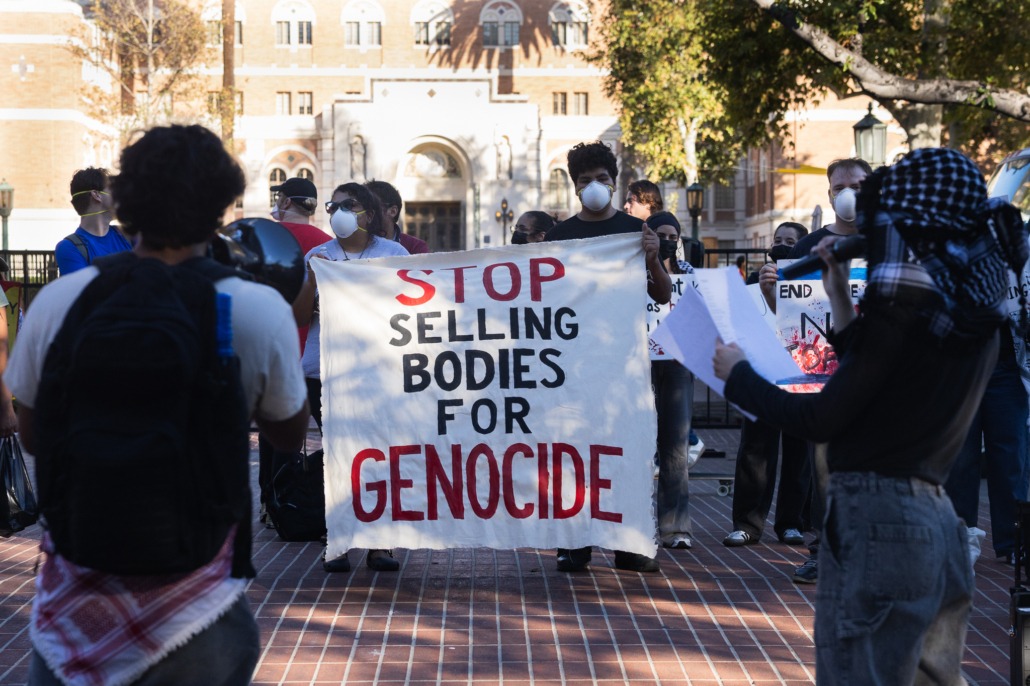

Don’t take the contract rejection at face value; ask why it wasn’t done sooner.
When Keck School of Medicine moved to not renew a contract to supply cadavers to the United States Navy last week, much of the campus community reluctantly rejoiced. Yes, the University will stop giving bodies for military medic training. But no, it wasn’t for moral reasons.
Even if Keck wanted to renew the contract –– which they did last fall –– they wouldn’t have been able to due to UCSD’s recent review of USC facilities to handle cadavers and subsequent halting of such donations to USC.
While the fact that our academic institution has one fewer tie to the military-industrial complex is ultimately a good thing, it shouldn’t warrant celebration.
USC still maintains over 360 contracts with the Navy as well as multiple others with different branches of the military. For those who support the USC South Central Against Labor Exploitation-Students for Justice in Palestine campaign calling on the University to “divest from death,” this rejection is nothing more than a baby step toward that goal.
The news of this one particular contract’s existence caused so much shock in large part because the medical training staff handling the cadavers included members of the Israel Defense Forces –– and the reaction was justified. Much of the outrage, however, seemed misdirected for the relative scale of revealed information.
Headlines highlighted the 12 cadavers that were used by non-combat surgeons, anesthesiologists and nurses in the IDF over the past two years, but what’s been overlooked are the far more immediate and pervasive connections that USC has to the Israel-Hamas war.
“There’s a very clear double standard too, with these Zionist organizations and their allowance on campus when … the sheer fact of [a student’s] relation to Palestine or to other Muslim groups becomes an issue for the administration,” said a member of SCALE-SJP who asked to remain anonymous.
The University meanwhile openly advertises study abroad to Israel and condones USC Hillel-sponsored Birthright trips. If USC is to ever truly divest from war, it must reevaluate all of its tangential relations to the culture that surrounds it –– and that includes programs like these which normalize the humanitarian crisis taking place just dozens of miles away from its international campus.
Though IDF training was only one component of the cadaver contract, it proved inflammatory enough to draw student attention back to the “Divest from Death” campaign. Unfortunately, the impact the contract’s rejection will have on USC’s complicity in war is nowhere near the impact it had on inspiring student activism.
“Our ‘Divest from Death’ campaign, similar to ones at other universities, calls for our University to look at where [its] investments and tuition goes … and we’re strongly advocating for that to be taken away from military funding and consciously moved,” the SCALE-SJP member said.
Since the cadaver program’s inception, USC has taken in over $1.1 million from the Navy, Annenberg Media reported. There has been no clarification on where those funds were allocated, though it can be assumed they didn’t help support the multiple academic advising departments that have been gutted or the student media organizations whose budgets were slashed. The University denied that it profited from the contract in a statement to the Daily Trojan.
The reality of USC’s extensive commingling with the U.S. military is that President Beong-Soo Kim has little to no oversight on the status of these contracts –– although the moral responsibility of where the University’s image and money ends up lies on him. No matter how distanced he was from the cadaver contract, its existence alongside Kim’s prized Open Dialogue Project is steeped in irony.
There was no open dialogue given to the families who donated cadavers to USC’s Anatomical Gift Program. Donors were told that their gift would “make it possible for others to live long and healthy lives,” when it really may have been used “by USC’s educational, research, healthcare, governmental, or industry partners in accordance with applicable law and USC policy,” according to the program’s website.
In its statement to the Daily Trojan, the University denied that bodies donated to the program were used for training IDF healthcare professionals.
It’s infuriating to know that our tuition dollars spent on education have anything to do with a military that has, on countless occasions, committed the war crime of bombing schools in Gaza. But don’t let the rejection of USC’s lone contract mentioning the IDF count as a conscious divestment.
Productive change has to be ethical, not just logistical, as SCALE-SJP noted in its statement regarding the end of the cadaver contract. Systemic issues like the University’s ties to the military-industrial complex have to be addressed at its source –– a solution which starts with an administration wanting to truly understand the needs of its students, not just feigning interest to appear transparent.
Though the Open Dialogue Project seemingly presents growth from an institution that called the Los Angeles Police Department on its own student activists just over two years ago, it’s done little to platform voices not aligned with the University’s agenda. Don’t let activism be confined to the boxes that authority is comfortable with it existing in –– continue to fight for a change of heart, not just financial interests.