The Trojan Marching Band is USC’s ‘beating heart’
From football games to graduation, the Spirit of Troy brings harmony to USC.
By PADMAVATHI NARAYANAN & OLAMIDE OLUMIDE
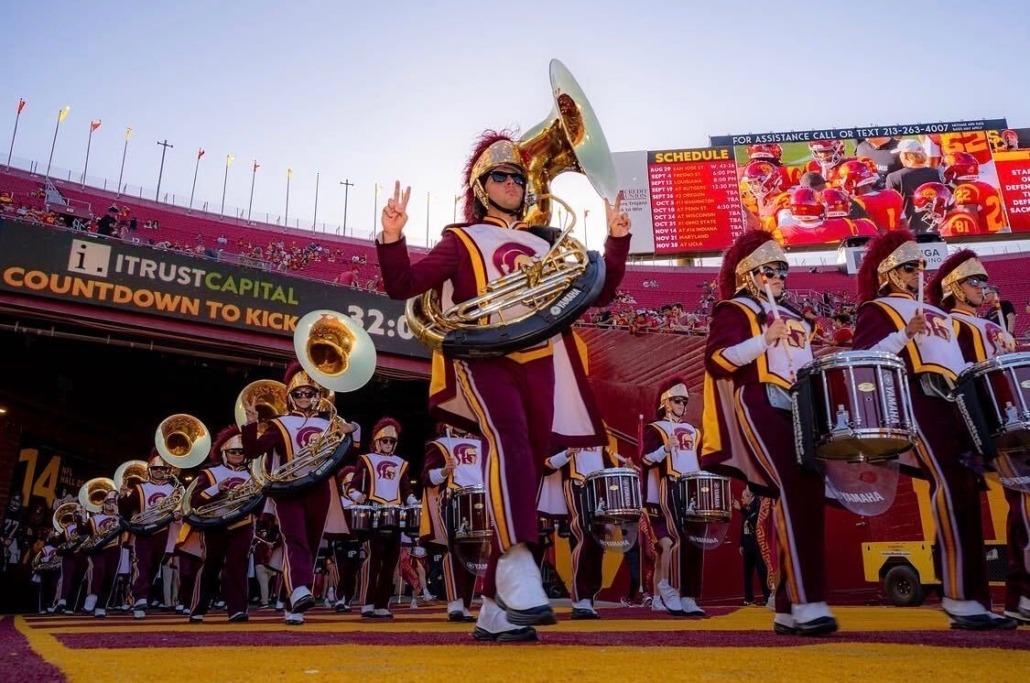

From football games to graduation, the Spirit of Troy brings harmony to USC.
Nerves filled Mason Culp’s senses as he took in the red brick architecture of USC’s campus, hoping to find something that told him he’d made the right decision.
That’s when he heard the sounds of the trumpets, trombones and drums.
“All of a sudden, I just hear the Trojan Marching Band, and boom! It’s right in my face,” said Culp, a freshman majoring in civil engineering and a trumpet player in the Trojan Marching Band. “The band [was] bringing so much energy, so much excitement.”
USC is notorious for its school spirit, and the Spirit of Troy — composed of the Trojan Marching Band, USC Song Leaders, USC Spirit Leaders and the University’s official mascot Traveler — plays an integral part in fostering community within the student body.
“The overall experience that you get when the Spirit of Troy is in the room is unique because they bring such an energy and a passion that you don’t see in a lot of other institutions,” said Henry Barnes, a senior majoring in human biology and a former trumpet player in the band. “This culture really makes the band stand out, not just for football, but for all of our events, whether it be commencement or graduation.”
The harmony the band brings to campus isn’t magically created; rather, it’s built through careful, practiced teamwork — especially ahead of game days.
“On game day, we’ll start at 7 a.m. in sectionals … and then we’ll do about 30 to 45 minutes of practicing, warming up our hands, practicing our music and going through exercises,” said Seth Grushkin, a freshman majoring in music industry in the drumline. “We’ll [join] the rest of the band on our practice field … and then we’ll run through our halftime show.”
Game-day prep doesn’t stop there; after a quick break, they go right back into marching and filling campus with their tunes.
“We’ll go behind Heritage Hall first. We do a rally there, and then we march over to Associates Park; we do a rally there. We come over to where Tommy Trojan is … and then we march all the way to [Los Angeles Memorial Coliseum],” Grushkin said.
Yet, behind the grandeur of the band, a strong community and cohesive leadership are what make them the Trojan Marching Band. The director of The Spirit of Troy, Jacob Vogel, plays a crucial role in cultivating the band’s community.
“Vogel is actually terrific. He’s one of the best leaders I’ve had in any organization, being able to manage a 350-person group with the skill he does,” Barnes said. “There’s a unique dynamic when you have 350 people out in the field; you have to respect the shaping of the piece [and] the needs of the director to emphasize different parts, but also be able to resonate within this big stadium.”
According to Grushkin, pre-game traditions, from running through the tunnel to butting helmets, also foster the tight-knit community that defines the Trojan Marching Band.
Despite the many different people involved in organizing the band and its performances, the value of the individual is never forgotten, Barnes said.
“I remember [Vogel] coming up to me after practice in [my] sophomore year,” Barnes said. “I’d only spoken to him once in [my] early freshman year, but he comes up to me and says, ‘Henry, how’s organic chemistry going?’ He recognizes the faces, recognizes the names and really creates a special environment where each person feels like they matter.”
Band camp is another fundamental part of how the band creates such a supportive community that shares its wins and struggles. During band camp, students spend the week before classes rehearsing from 7 a.m. to 10 p.m., according to Mayah Walker, a freshman majoring in psychology and a trumpet player.
“You’re with so many people, [and] you instantly get over 100 friends,” Culp said.
There’s a sense of unity encouraged within the Spirit of Troy — something they aren’t meticulously trained to produce. Unlike other institutions like Ohio State University or the University of Washington, USC’s band doesn’t do cuts, according to Barnes.
One of the most prominent ways Trojans feel the energy of the band is through the football games. For Walker, such USC games would not be the same without the band.
“I know lots of people that just come [to football games] for the band,” Walker said. “We have great football players, but without the band, the games wouldn’t be very hype.”
As a former member of the band who now spectates from the audience, Barnes said his appreciation for the band’s role in football games is amplified.
“As a student watching the games, I can listen to the band and see how meaningfully it contributes to that spectacle, to the game itself,” Barnes said. “Being able to reflect on that really gives me excitement and gratitude for what I’ve been able to do in the Spirit of Troy.”
Barnes explained that the band offers an opportunity to connect with others, and that USC culture wouldn’t be what it is today without The Spirit of Troy.
“It was exciting [to be part of the band], really, because you got to feel like you were a direct part of the athletics program, and really part of the beating heart of the University,” Barnes said.