USC student uses music as a gateway to creativity and healing
After fighting a rare liver cancer, Malakai Carey’s passion for music has taken off at USC.
By AANYA BANSAL & MELODY CEN
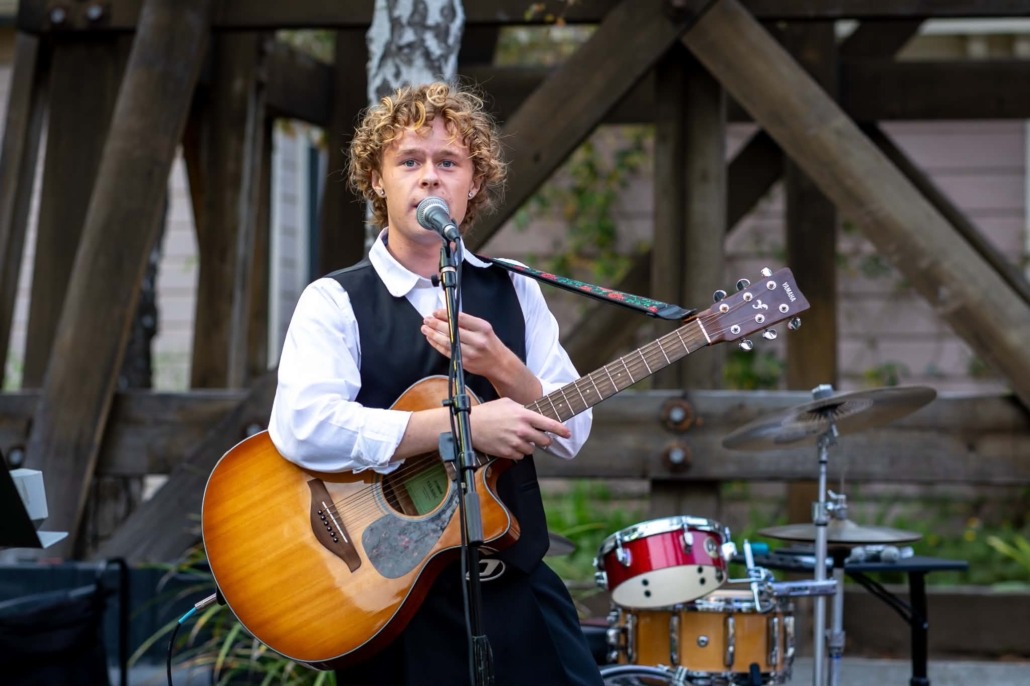

After fighting a rare liver cancer, Malakai Carey’s passion for music has taken off at USC.
Six-year-old Malakai Carey was flying first class to Chicago, for free. It was his first acting job, a commercial for Walmart, and Carey’s eyes were open wide in excitement.
“I started [acting] because of my mom,” said Carey, now a sophomore majoring in music industry. “She did acting when she was in her 20s … and she asked me if I wanted to do it when I was 6, and I was like, ‘Heck yeah!’”
After a guest appearance on “Modern Family,” stints on “Jimmy Kimmel Live!,” voiceover work for Disney, commercials for multinational companies like Audi and Acer, and other roles in various small films and TV shows, acting has taken a back seat for Carey.
Instead, Carey has begun to pursue another dream with the help of his mom: a career in music. He originally picked up songwriting as a way to express his emotions after being diagnosed with a rare form of liver cancer when he was 11.
Before receiving over 60 rounds of chemotherapy, Carey struggled with weight loss, pain and missing school. Due to the aggressive nature of the cancer, he underwent a liver transplant to prevent a relapse in 2019. The night of his surgery, Carey’s doctors told him he was second in line, but Carey still fasted in preparation.
“[At] about 9 [a.m.] I get a call, and they say get down to the hospital as fast as you can. And that was truly an amazing gift. I raced down to the hospital, got my transplant, had about a two- to three-month recovery, and I haven’t had an issue since,” Carey said.
Music helped him process his own battle against cancer, changes in his family and the death of a friend he made during his hospital stay, who died from blood cancer.
“We met, initially, on each of our first week [at the hospital]. … We ended up becoming really close, literally getting chemotherapy next to each other,” Carey said. “I ended up becoming cancer-free, [but] he was still battling. Unfortunately, when I was 13, he passed away and didn’t make it. That was really, really difficult for me.”
It was through his cancer journey and the support of his family and community that his love for music blossomed from a casual hobby to his passion.
“He’s always loved music,” said Cheri Carey, Malakai’s mom. “We’ve always had music in our home, but his ability to write music really started when he was battling cancer, and he had to figure out how to get it out of his head, and be able to know that he’s feeling [emotions], expressing [them] and processing [them] in a way that was healthy.
During his freshman year at USC, Malakai Carey hosted jam sessions in his dorm with over half a dozen other students, playing his guitar alongside friends’ instruments and singing. The group would shout out songs and harmonize late into the night, playing anything from “Best Part” by Daniel Caesar featuring H.E.R. to “Sailor Song” by Gigi Perez.
“Being up until 2 a.m., singing and playing guitar with people, it doesn’t have to be perfect,” Malakai Carey said. “It doesn’t have to be the most beautiful [rendition], but you’re there with people who love music, who just want to sing and hang out.”
Malakai Carey called music his “gateway to creativity” and produces songs using just his computer with the help of his friend, Diego Arratia, a sophomore and fellow music industry student. The two met as freshmen during New Student Convocation and realized they both lived in the Parkside Residential community.
As the director of events for USC’s music industry club, Arratia uses his production experience to teach Malakai Carey about digital audio workstations, plugins and sound equalization. Mostly, the pair just end up spontaneously recording.
“[Malakai Carey] heard a police siren outside. He grabbed his phone, opened up the window, started recording, and, in a song he released that we recorded in one night, the intros and the outros are that police siren,” Arratia said.
Arratia’s tips and tricks have helped Malakai Carey build on the production skills he’s been learning in Michael Smith’s “Desktop Music Production” class.
Smith, assistant professor of practice at the Thornton School of Music, and Malakai Carey’s musical bond traces back to when he was 12. They met through Smith’s business partner, TJ Stafford.
Malakai Carey had written his first song while receiving treatment when his mother reached out to Stafford, an old friend from high school. Smith and Stafford brought Malakai Carey into the studio to help produce it — his first time in a recording space.
“That first day he was actually behind a microphone in a studio, recording, and you could just see the light bulbs go off like, ‘This is what I want to do,’” Cheri Carey said.
A couple of years later, Malakai Carey returned, this time with newfound guitar skills. Now, with Malakai Carey attending USC, Smith has been able to see his growth firsthand.
“He doesn’t need to be pushed to go for something,” Smith said. “You point him in a direction, and he’s gonna go for it and come back and be like, ‘Alright, I learned these things.’ … [He’s] doing the things necessary, basically on his own, which is great.”
Moving forward, Malakai Carey plans to develop his production skills, looking to release singles by the end of the fall semester and a debut album or EP this summer.
Beyond his personal endeavors, Malakai Carey also has dreams to start his own nonprofit aimed at providing children undergoing medical treatment with musical instruments.
“[I want] to be able to give children something to get their mind off of chemo or whatever they may be receiving,” Malakai Carey said. “Even if it’s not cancer, if they’re battling another kind of disease, music is healing, truly healing, in a way that some people don’t understand until [they] actually experience it.”