K-pop’s ambition should supersede the Grammys
The genre is taking its first step to turn its global influence into a lasting cultural legacy.
By TIM HAN

The genre is taking its first step to turn its global influence into a lasting cultural legacy.
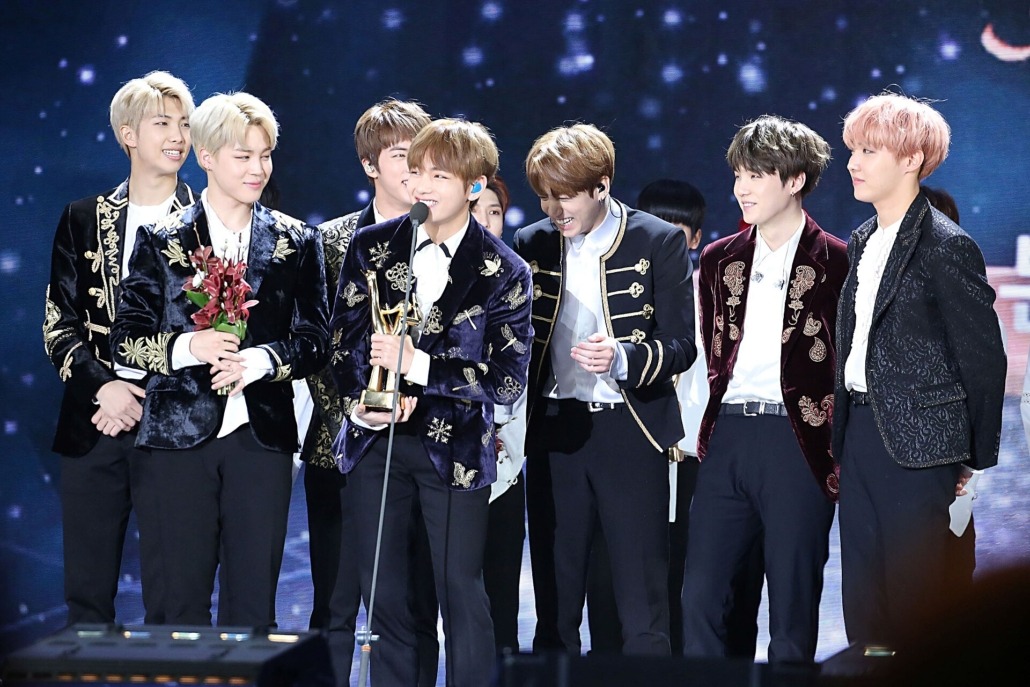
When the Grammy Awards announced a Best Asian Pop Music Performance category, BTS made the decision to boycott the Grammys. Fans didn’t even blink; they didn’t see it as a loss for the group. Many showed support for the decision — even another renowned boy group, Stray Kids, followed suit and joined BTS in protesting the Grammys.
Throughout the past years, K-pop groups always had to knock on the doors of the Billboard charts and the Grammy Awards, almost having to demand respect from Western music institutions. BTS intended to challenge this paradigm through their boycott, hoping their music would be “heard and loved for what it is” rather than being divided by region or language, as stated in their announcement.
For K-pop to build a lasting legacy, its stars must take bold actions like this to make their statement of not needing Western approval.
K-pop currently holds the potential to define excellence and sustain Asia’s growing influence in global music. And not just with BTS — there are many stadium-level K-pop groups, including but not limited to Stray Kids, BLACKPINK and SEVENTEEN.
As K-pop grows, so do concerns surrounding the culture. K-pop has always been tested on its legitimacy — rapid globalization has blurred its identity as a music genre. Internationally localized groups like KATSEYE and SANTOS BRAVOS face gatekeeping and intense scrutiny from some Korean fans. Concern arises over the idea of getting rid of the “K” in K-pop when a majority of the song is in English.
“[Defining] K-pop as ‘Korean pop’ is very outdated,” said Chase Kang, a Los Angeles-based K-pop and entertainment journalist. “It still has its core, but now people are finding what would be the appropriate definition to describe and explain that cultural phenomenon.”
With K-pop struggling to clarify its sonic identity, fans and industry insiders are demanding greater authority over how their music is judged and celebrated.
“[K-pop’s] origin is very hybrid-genre. They adapted a lot of different sounds from all around the world,” Kang said. “It’s not that surprising that K-pop sounds like [mainstream] pop music, but I do think K-pop still has their own culture [and] roots.”
Perhaps now is the time for the K-pop industry to understand what K-pop really has been the whole time: a tightly-knit cultural system — a highly industrialized entertainment mechanism and a multi-sensory cultural phenomenon that follows a proven playbook.
Meticulous training prepares trainees to become pop stars pre-debut. Countless music genres intermingle to convey new impressions and catchy tunes. Albums roll out in great detail with conceptual photoshoots, eye-opening music videos and collectible merchandise. Performance stages boast perfectly synchronized, elite choreography through months of hard work. Fans have countless ways to connect with their favorite members, from private messaging and artist communities to fan meetups and full-scale concerts.
This is what brought the indomitable cultural surge and the global popularity of K-pop, not just the music.
For K-pop to establish a legacy, it must build even more ambitious institutions and brands of recognition entirely targeted towards global fandom. K-pop insiders must crave the “Asian Grammys” now more than ever.
As K-pop seeks a higher purpose, a greater mission to bring cultural order to the industry emerges. “Fanomenon” is an upcoming 11-day K-pop music festival, fan awards ceremony and cultural exposition planned to take place annually, starting in winter 2027. The project aims to bring together Korea’s “Big Four” entertainment agencies — HYBE, SM Entertainment, JYP Entertainment and YG Entertainment — for the first time in a joint venture, a rare opportunity for the agencies to pause the competition and work toward establishing K-pop’s global legitimacy.
“There are a lot of talented people in the South Korean entertainment scene,” Kang said. “Rather than just compete [against] each other, they could make a breakthrough.”
BTS passed on the Grammys not only because they wanted equal treatment, but because the state of the industry demands it. The group bravely challenged the expectation for K-pop artists to become more Westernized to get global acclaim worthy of Grammy nominations. They’re hoping this message resonates with people who love K-pop’s culture, doing what they can to make this phenomenon last longer.