Third-country deportations are reprehensible
The United States Supreme Court must stop allowing deportations of undocumented immigrants to countries other than their home without due process.
By YIYI XU
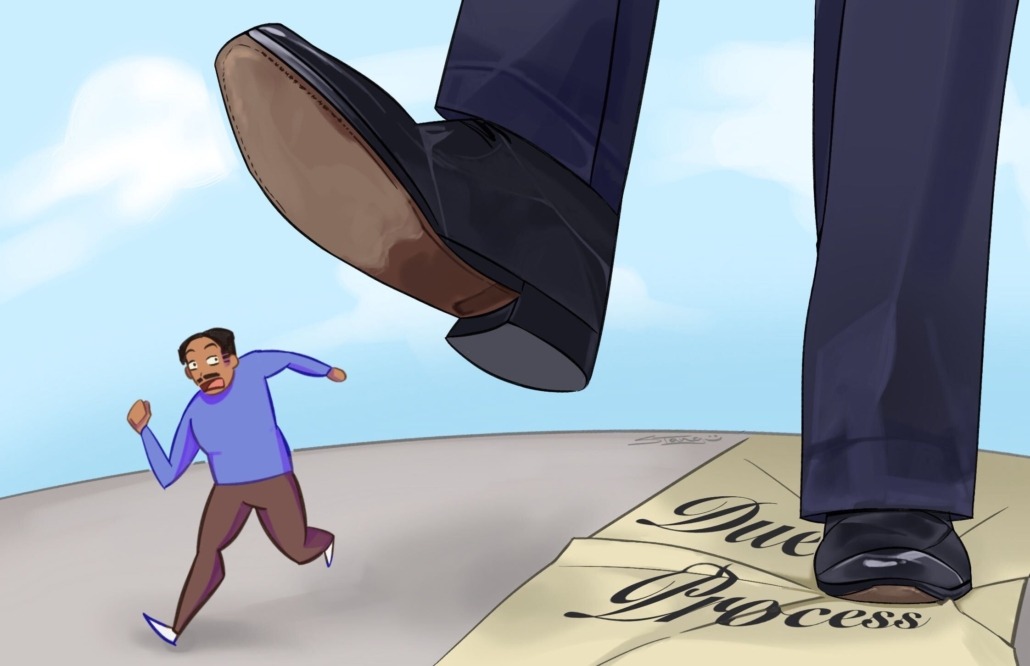

The United States Supreme Court must stop allowing deportations of undocumented immigrants to countries other than their home without due process.
On Sept. 29, the United States Supreme Court sided with President Donald Trump in an interim order to temporarily allow his administration’s deportation of undocumented immigrants to third countries — nations that are not the immigrants’ home countries — without notice. These third countries that immigrants have previously been deported to include Liberia, Equatorial Guinea, South Sudan and the Central African Republic.
The case has not been fully settled yet, and the Supreme Court is set to hear oral arguments Dec. 9. The question is whether the Trump administration’s deportation policy violates the Due Process Clause, a decision that may steer the direction of U.S. immigration policy and set a precedent that would be hard to overturn.
Among these third countries are some that the U.S. government itself determines as the most dangerous in the world: South Sudan and the Central African Republic are labeled by the U.S. Department of State with warnings like “Do not travel for any reason” due to “risk of unrest, crime, kidnapping, landmines and health risks.”
These countries have agreed to accept deportees who are not their citizens in large part because of arrangements with the U.S. to receive millions of dollars in payments to their governments. Yet, despite the extremely poor humanitarian records that some of these countries hold, the Supreme Court’s majority has decided that it would be permissible for individuals to be immediately deported to these countries without notice, nor with the chance to raise fear-based claims: a right to express fear of torture of prosecution upon deportation.
This is not the first time the Supreme Court has sided with Trump during his term: In June 2025, the Court issued a shadow docket in the Department of Homeland Security v. D.V.D. to pause a district court’s injunction, which requires defendants to get a minimum of 10 days to raise fear-based claims and notice. Following the suspension, the administration deported eight men from six different countries to South Sudan.
Then-Assistant Secretary for Public Affairs,Tricia McLaughlin, claimed that “[Immigration and Customs Enforcement] deported these eight barbaric criminal illegal aliens who are so heinous, even their own countries will not accept them.”
But this claim doesn’t justify immediate deportations without due process, nor does it justify setting a precedent to lift the requirements of notice to deportees in other cases. Out of the eight men deported to South Sudan, one was released upon arrival and two have managed to return to their home countries through repatriation, but four of the original group still remain in South Sudan.
Beyond third-country deportation, the Supreme Court has also made many other rulings in favor of Trump’s policy agenda, including expanding the President’s authority by allowing the mass firing of independent agency heads in Trump v. Slaughter.
In January, U.S. legal scholar Erwin Chemerinsky also found that out of the 24 shadow docket rulings that were related to Trump, 20 were ruled in favor of the administration. In a tilted Supreme Court with six conservative judges — among which three were handpicked by Trump himself — the increasing trend of partiality of the Supreme Court is undermining its legitimacy as an independent branch of government.
The eventual decision the Supreme Court makes could have an especially significant impact on the Los Angeles community: According to data collected by the USC Equity Research Institute, an estimated 35% of L.A. County’s residents are immigrants, and 27% of this group is undocumented, amounting to nearly a million individuals.
Trump has also been known to be hostile and dismissive to L.A. and its residents. In 2025, he sued the city over its inclusive immigration policies for establishing sanctuaries for undocumented immigrants.
More recently, in Nebraska, he suggested in a midterm campaign he would “let [Iran] take out Los Angeles,” referring to the U.S.’s ongoing War in Iran. “It is a very small price to pay,” he said.
If Trump decides to further crack down on undocumented immigration, it’s possible that L.A. could be his first and largest target.
As Justice Sonia Sotomayor put it in her 2025 dissent of the shadow docket in Department of Homeland Security v. D.V.D.: “In matters of life and death, it is best to proceed with caution.”
However, the increasingly partial Supreme Court seems to be more concerned with appeasing the Trump administration’s interests rather than upholding the constitution and carefully handling human rights.
To ensure that freedom and constitutionality is more than just window dressing for politically biased decision-making, we need a more impartial Supreme Court. At the oral arguments coming up on Dec. 9, the justices should keep in mind their commitment to due process and constitutionality. Anything less could risk setting a dangerous precedent that will be hard to remove.