
Alumnus innovates autonomous, battery electric railcars

A self-described “small-town kid,” Alex Peiffer never thought he would attend the University of Southern California. Growing up in Fostoria, Ohio, Peiffer recounted living in “a different world” — a railroad town far removed from the bustling campus life of University Park.
But having lived in the Midwest his whole life, including as an undergraduate at Ohio State University, Peiffer wanted a change. After a “terrible winter” in Chicago consisting of 40 consecutive freezing days, he remembers having wondered “what it’s like in L.A.” As he applied to MBA programs, his research led him to schools along the West Coast — among them USC.
Ryan Jach, an MBA student in the same core class as Peiffer, said that, although entrepreneurship was not top of mind for Peiffer when he began his MBA, he saw many of the early signs of Peiffer’s entrepreneurial disposition.
“He’s always pitching things,” Jach said. Even if those “things” meant “random vacations in Europe.”
Peiffer later joined the Universitywide New Venture Seed Competition, organized by the Lloyd Greif Center for Entrepreneurial Studies, where he said he began to understand the intricacies of developing ventures.
Conversations at the Marshall Military Veterans Association, which Peiffer became the president of, led Peiffer to take a friend’s initial concept — focused on electro-diesel hybrid locomotives — to Tim Luchini, a childhood friend who worked as an engineering manager at Boeing.
Though Luchini said he wasn’t immediately receptive to Peiffer’s vision, he saw the potential of something with “more of a truck-sized form factor, but [that could] take advantage of a bunch of the efficiencies that rails offer.”
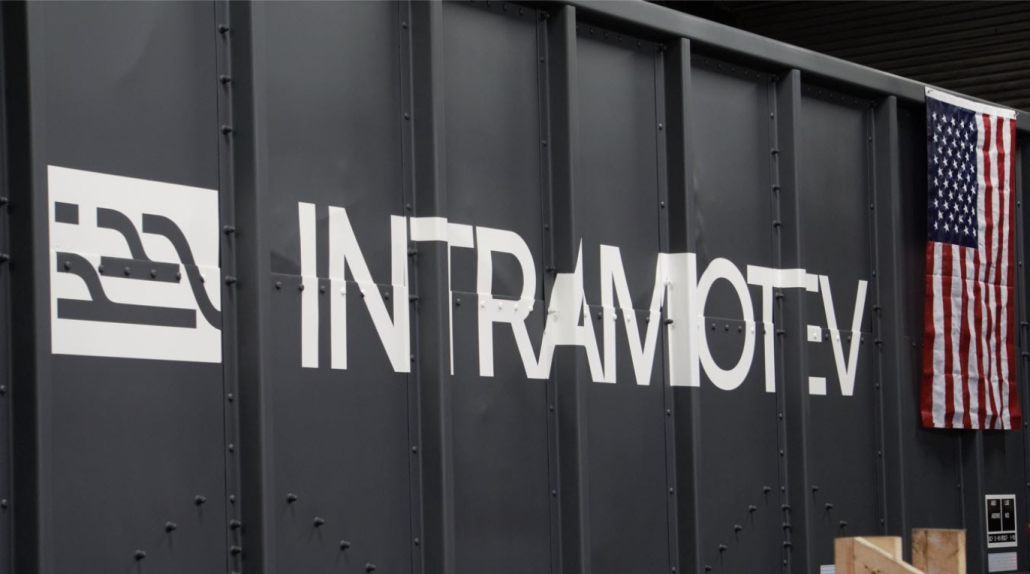
The impetus of Intramotev, the venture borne from these initial concepts, was freight rail’s inefficiencies as a transportation system, according to the company website. In the United States, there are around 1.6 million rail cars that transport goods each day, but a large portion of these cars remain idle, waiting for a locomotive to move them, according to a Wall Street Journal report. By implementing autonomy and electrification into railcars — which Intramotev is currently working on with their TugVolt prototype — these cars can actively transport goods in a way that takes fossil fuels out of the equation.
After graduating from Marshall in 2020, Peiffer took on a role as an associate brand manager at Nestlé while working hard on the side to ensure Intramotev’s financing. By doing so, the founding team could formally devote themselves to the venture.
Peiffer eventually succeeded in his fundraising efforts, and Intramotev launched in January 2020. According to Peiffer, the rail industry is historically optimized for large distances and even larger hauls, so there is a lack of short trains that can transport smaller hauls.
Given the insights Lucchini shared as an engineer in the aerospace industry, Peiffer said he saw technology’s ability to unlock this need.
“The biggest, both challenge and opportunity for the rail industry is the flexibility and competing with the flexibility and reliability of trucking,” Peiffer said.
With the increased attention on supply chain challenges during the pandemic, Intramotev’s mission has only grown more pertinent, Peiffer said. But Luchini reiterated that “our thesis and our approach” hasn’t shifted.
“The spotlight has been on supply chain and logistics in a way that probably has never been before. And that just makes it seem really timely in what we’re trying to do,” Luchini said.
Peiffer added that expanding rail travel would have many societal benefits, including lowering costs of freight, emissions and road congestion.
Throughout his entrepreneurial journey, the Trojan Family was invaluable for Peiffer. It was classmates and other USC connections that introduced Peiffer to “people that have turned out to be anchor investors.”
More broadly, Peiffer highlighted that “there’s so many things to do and so many things to learn because you have to wear so many hats that you rely on your network to find people to help you that have already been there.”
Peiffer said his journey and success shouldn’t be unique, offering three main points of advice for aspiring student entrepreneurs: “Build and establish and leverage a network,” “utilize that as you’re trying to build a company” and “just do it.”
“The opportunity is never going to be perfect. It’s never going to be super optimal timing or conditions,” Peiffer said. “You just need to get started and things will start falling into place.”
Nowadays, work is a little bit closer to home for Peiffer, given Intramotev’s headquarters in St. Louis, Mo. The railroads he grew up around in Fostoria are the very rails he is now working to reimagine.
But for Peiffer, the experiences he accrued and the relationships he built at USC have never been more important. “Even though a lot of people are… solo founders or have a small team of people that they rely on, it’s not the work of one or two or three people.”
Correction: A previous version of this article incorrectly stated the initial concept for hybrid locomotives came from Peiffer. The concept came from Peiffer’s friend. As well, the previous version of this article’s headline incorrectly stated that Intramotev’s railcars are electro-diesel. Intramotev’s product is battery electric and autonomous. The Daily Trojan regrets these errors.