Report says USC is ‘overly pessimistic’ about finances
The third-party report said recent USC budget cuts are not justified despite deficit.
By JUSTIN HA & KIYOMI MIURA
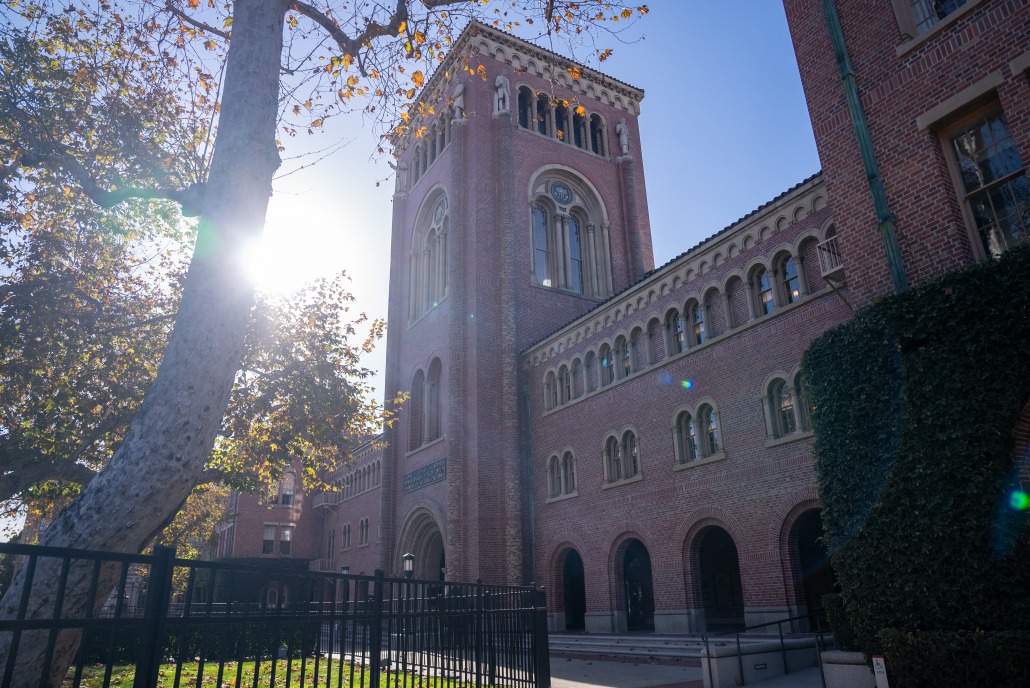

The third-party report said recent USC budget cuts are not justified despite deficit.
Amid budget cuts to schools and University programs — including additional cuts announced Monday — a financial analysis presented to the USC chapter of the American Association of University Professors on March 7 said USC is in “very strong financial condition.”
While presenting the report, Eastern Michigan University accounting professor Howard Bunsis, who conducted the analysis, said the administration is “overly pessimistic” about its financial health. The University did not respond to the Daily Trojan’s request for comment in time for publication.
The University announced Monday it would place a freeze on staff and faculty hiring, reviewing discretionary spending and reassessing its projects and contracts to ensure financial stability.
The Office of the Provost also wrote that all schools and central administrative units were asked to reduce their spending in a November 2024 letter posted on its website. Meanwhile, in December 2024, the University announced it would decrease the amount awarded for National Merit Scholarships beginning Fall 2025. The cost of attendance is also increasing by 4.11% to $99,139 for the 2025-26 academic year, according to the University’s Cost of Attendance webpage.
In the 2025 State of the University address March 4, President Carol Folt said the University is in a financial recovery phase and had a 2.1% operational deficit in 2024 — an approximately $158 million shortfall.
While the report affirmed the $158 million deficit, according to Bunsis, the need for budget cuts is not supported by the University’s positive cash flow margins, strong primary reserve ratio — an indicator of how long the University could sustain itself without revenue — and stable bond ratings.
Bond ratings provide an indicator of an institution’s financial health. Moody’s Ratings, a bond credit rating service, currently gives USC a stable outlook due to the University’s growing scale of operations and revenue diversity.
S&P Global Ratings, another bond credit rating service, changed its bond rating March 19 from stable to negative, stating that the University’s fiscal deficits, although anticipated to improve, are expected to continue in the fiscal year.
“The reason why USC has a [stable] bond rating is because they take in more than they spend every year, and they have a lot of reserves, and they have a lot of cash lying around,” said Bunsis. “They have strong bond ratings because their operations are very strong.”
Last year, the University reported around $11.7 billion in net assets in its consolidated financial statements. This is an increase from its reported $7.5 billion in net assets in 2014, which Bunsis said reflects the University taking in more cash than it spends. However, the University cannot access all of these funds as $6.9 billion of its assets have donor restrictions, limiting how or when they can be used.
Bunsis also wrote that the broad nonstandard financial categories in USC’s reporting makes comparisons to other institutions “useless.”
Whereas most comparable institutions break expenses into 10 different categories in audited financial statements, USC reports only three separate categories, “academic, health care, student services,” “support services” and “fundraising,” making it harder to understand where the money goes, Bunsis said.
“If you break that down into 10 buckets, you learn a lot more about what’s going on and where the money is going, and the fact that they only use three functional expense categories really camouflages what’s going on,” Bunsis said.
In comparison to other institutions, Bunsis said USC is “in the middle of the pack” when it comes to secrecy around financial statements.
Bunsis said private institutions like USC tend not to disclose their financial statements under the impression that such information, including enrollment statistics, is private.
“USC, by using only three categories in their audited financial statements, I think is really doing a disservice to the campus community,” Bunsis said. “USC is in very strong financial condition. It’s very plain to see, and I don’t get the lack of transparency given how well they’re performing financially.”
In the report, Bunsis wrote that USC relies on tuition more than comparable peer institutions. In 2024, 42.6% of USC’s expenses were covered by tuition — the fourth highest of 27 comparable peer institutions — according to Bunsis. The list of peer institutions was largely selected by the USC administration for comparison in the Integrated Postsecondary Education Data System.
Bunsis said that he believes administrators are concerned with slowing revenue growth from tuition. Enrollment, which rose every year from 2014 to 2020, has been gradually falling since 2022. However, Bunsis said if a private university’s tuition makes up under half of its total revenue — like USC — it has a “strong and diverse” revenue stream.
The report found the University has hired administrators at a higher rate than other types of faculty. Since 2019, the number of management employees — staff whose job is to direct policies and programs — increased by 14.6%, while the number of full-time faculty has increased by 0.5%, the report read.
According to Bunsis, instruction makes up 32.5% of expenses, while institutional support — executive-level activities — makes up 27.7%. Bunsis said the resources dedicated to institutional support were “incredibly high for a private institution or a public institution.”
According to the report, the average yearly salary for a “top administrator” in 2022 — the year of the latest available data — was $2,100,610.
The expenses dedicated to management have grown alongside the size of the administration. Since 2014 there has been a more than 80% increase in the total dollars paid to management, according to the report.
“Administrative costs are very high at USC,” Bunsis said. “Why do they spend more money than they should on administration versus the core mission? I couldn’t tell you why that’s the case.”
This increase has outpaced all other employee groups, including faculty, whose salaries have fallen behind inflation. When analyzed next to the faculty of comparable peer institutions, USC faculty salaries ranked 18 out of 27.
Additionally, reports from 2022 show 12.3% of all salary funds were going towards “institutional support,” which is largely made up of outside consultants. Bunsis said the number of consultants hired at USC is “ridiculous” and “something that [he] would want to know more about.”
Throughout the presentation, Bunsis called for more financial transparency from administrators. Bunsis noted a steep decline in instruction expenses from $2,445,995 in 2021 to $1,673,187 in 2022 and encouraged the University to explain the change.
“Even though USC is a private university, they get a lot of money from the federal government, and they should tell everyone what’s going on. It’s that simple,” Bunsis said.