Wayne Brady, a singer, actor and longtime improv comic — as well as an adjunct lecturer at the School of Dramatic Arts — has been on television making people laugh for over 35 years. When asked by three Daily Trojan reporters to tell his favorite joke, he mustered the following.
“Oh, wait, wait, wait. Then, then the guy, he said, he said, ‘Your mama!’” Brady said.
Everyone laughs.
It’s something that everyone can understand regardless of language. Even when a joke is remembered wrong or falls victim to a game of telephone, it can elicit laughter. That’s what Judith Shelton, an assistant professor of theatre practice in comedy and a professional stand-up comedian, believes.
“I’m curious to know … if laughter has any kind of accent. As far as I know, it doesn’t. Laughter is universal,” Shelton said. “When you can make somebody laugh, you’re reminding each of you that you’re human and that we’re all going through the same things.”
It should come as no surprise that students at USC congregate around comedy. The University is, after all, in a prime location for comedy: 30 to 40 minutes away from famed locations like The Comedy Store, Laugh Factory and Hollywood Improv. But students still choose to get their laughs in-house.
“I think it’s the place,” Shelton said. “We’re so close to Hollywood, we’re so close to where things are being made. And I think [at USC] everybody is accepting that … comedy is in all of your body. It’s coursing through your blood, and we just are letting it out.”
USC offers the traditional forms of comedy through improv, stand-up or sketch writing classes. However, according to Zachary Steel, the director of USC’s comedy department in SDA, the goal of the program is to experiment and discover what comedy could look like.
“The culture of comedy at USC is very inclusive,” Steel said. “We look at [teaching comedy] as a laboratory for an ever-changing population of humanity, … to see all the different colors of comedy and all the different ways that comedy can present itself in performance.”
Aside from the comedy programs in its schools of Dramatic and Cinematic Arts, USC houses a myriad of student-led groups that provide sketch and improv comedy to the University community — some of them to a nationwide audience.
Second Nature Improv, one of USC’s longest-standing troupes, has organized a nationwide collegiate improv festival, called Fracas!, for over twenty years. They invite troupes from all over the United States to interview with comedy and pop culture mainstays, share in workshops led by professionals, and perform in their varying performance styles.
“They don’t have this level … of comedy, of engagement at many other places,” said Ian Grady, a senior majoring in theatre and the longest-tenured member of Second Nature.
Dani Brown, a member of Second Nature and sophomore majoring in theatre with an emphasis in comedy, highlighted the unique opportunity that students at USC have to experience and share in the comedy scene. The accessibility to longtime professionals in improv like Upright Citizens Brigade and Groundlings may be taken for granted by Angelenos, but Fracas! visitors relish the opportunity.
“To be able to bring those materials to everybody else for a weekend, [to] college kids all over the country, it’s just great,” Brown said. “It’s amazing to see how inspirational it is for everybody.”
After a busy weekend of events, Fracas! culminates in a send-off party. The weekend allows for improvisers to make friends and, in Grady’s experience, to make unforgettable memories.
“I confronted a guy for stealing the ice maker from my freezer,” Grady said. “He started off with, ‘Listen, man, I’m so sorry. And secondly, thank you so much for throwing this. We go to school in Missouri, and they do not do anything like this out there. So thank you for inviting us.’”
“I’ve never been pregnant or birthed anything”
Improv comedy has been a staple at USC long before it entered the mainstream, thanks in part to USC’s oldest group, Commedus Interruptus.
“Commedus has been doing the same thing since 1989,” said Holden Peterson, a member of Commedus and a junior majoring in intelligence and cyber operations. “Same place, same time … it’s part of the culture of USC, every Friday you can expect to see Commedus out there.”
Commedus has had the opportunity to shape comedians for decades, from SNL’s Beck Bennett and Kyle Mooney to USC’s Nick Massouh, an adjunct lecturer who graduated from the University in 2000 and now teaches improv.
Massouh reflected on the influence that Commedus’ outdoor weekly shows had on him, an influence that he said contributes to what he does to this day.
“That time with those people performing on the lawn … that grew my love for comedy, it’s that experience of being on stage, making somebody laugh, feeling their energy,” Massouh said. “It’s unlike anything else. And once I felt that, I was hooked.”
Commedus holds rich traditions, from starting every show with the same song to hosting a 24-hour show where at least one member will be on the lawn and perform at any given time. It doesn’t matter if no one is watching — they have to play.
“At some points you are performing for no one except your own want to succeed,” said Lola Gilmore, a senior majoring in theatre and the only senior currently in Commedus Interruptus. “It is nothing but sheer determination to be able to say ‘I did those 24 hours, even when no one was watching. I held true to myself, and I held true to my teammates.’”
The experience brings the best out of each performer, especially when it comes time to rely on “Lola queer pride and gay hour” at 2 a.m. and “Anchorman-Holden’s-Good-Morning-Los-Angeles hour” at 10 a.m.
“I’ve never been pregnant or birthed anything, but from what I understand of what my mother said of having three children … giving birth and being pregnant sounds awful,” Gilmore said. “She’s like, ‘Yeah, but you forget every time you’re happy. Once it’s happening, you’re like ‘Fuck, this is awful,’ but the lead up is so beautiful and the aftermath is so beautiful’. I would feel the same way about our 24-hour shows.”
“It’s helped me find God. And he’s mad”
Comedy has become a staple of on-campus entertainment. It is an honored baton for those who fill the halls of its storied troupes. Crucial to that legacy, according to its foremost participants, is the opportunity for whimsy.
“Improv is like playtime. I love playing with my friends,” said Lyndsay Wong, a member of Second Nature and a junior majoring in writing for screen and television.
The charm of improv for Wong is how inseparable it is from community: to do improv, one has to be with others. Different comics on campus also emphasize how carrying comedy with you in life helps shoulder its burdens.
“As I go through my day, looking at things from a comedic perspective makes life more cope-able, like it’s actually always not that serious,” said Temi Salaam, a member of sketch comedy group Fourth Quarter All-Stars and a sophomore majoring in public relations and advertising as well as dramatic arts.
In fact, a comedic perspective in daily life can be so impactful that Luca Riggs, a member of the Merry Men improv troupe and a sophomore majoring in cinematic arts, film and television production, spoke on the spiritual impact that comedy has had on his life.
“It’s helped me find God. And he’s mad,” Riggs said.
“It’s the build-up and release of tension”
While comedy can be a tool to alleviate life, its purpose can go deeper. Spoiler Alert Improv, a troupe specializing in narrative improv, believes their comedic performance style goes beyond the absurd.
“It’s the truth in absurdity,” said Kasia Monet, a member of Spoiler Alert and a senior majoring in theatre. “We have very honest people as characters, put into these insane situations, and so the truth of how these real people would react is incredibly funny. Just to think about ‘Yeah, that’s how a grandmother would react to a ninja.’”
As Salaam and Wong identified, comedy can be fun. Monet showed it can be reflective. But it can also be immensely liberating and relaxing.
“[Comedy is] the build-up and release of tension,” said Avery Zerr, a member of Spoiler Alert and a junior majoring in dance. “‘Comedic relief’ is such a good term for it. There’s a payoff to whatever it is, whatever emotion it is, that’s cool.”
Past “relief,” performing and seeing comedy can also mean healing. As a deeply creative discipline, it can also be deeply personal.
“Comedy, to me, is an escape. I struggle with a lot of mental illness … so I feel that comedy is an outlet,” said Sydney Linko, a member of sketch and improv group Ludus Remedium and a junior majoring in theatre with an emphasis in comedy. “It’s such a creative outlet that we can explore and manipulate to better fit us and to help us cope.”
Not only can comedy have a place as a reflection of self but also as a reflection of society. Like all art, comedy can be a space for social criticism. At USC, it takes all of these forms, sometimes simultaneously.
“[Comedy is] an avenue for critique of politics, or things happening currently in society, or it can just be absurdist expression,” Grady said. “A truly crazy art form like comedy is so many things.”
Performers of all kinds congregate at USC, and many of their acts exist to entertain audiences, but the best performers understand the weight their performances carry, smiles and all.
“In these relatively dark times we’re in right now, it’s important to have comedy, not just for the laughter and for the joy, but also for this social commentary aspect,” said Kerawin Heaney, a member of the Merry Men and a senior majoring in theatre.
But the idea that comedy can push society’s boundaries is not new. Hannah Moore, a member of Commedus and a junior majoring in theatre, pointed out how some of the first lead roles for women in television were in the 30-minute sitcom, citing Lucille Ball, Mary Tyler Moore and Carol Burnett as performers of immense renown who first rose to fame through comedy.
“Comedy, historically, has been a structure for empowerment,” Moore said. “Comedy has always been at the forefront of societal change and addressing where the problems in society lie and getting people to laugh at it and confront their own opinions on it.”
“A joke is a story”
Through its ability to create joy and poke fun at some of the most pressing issues, comedy can weave a tale and wow an audience. Even the least strung-together disciplines within comedy have artists pushing the form to its utmost as a way of telling a story.
“If you really loved improv, you started asking ‘How can I go further with this art form? How can I push the envelope?’” Massouh said. “People have been pushing formats, trying new things, going deeper with the work … trying to build a different type of laugh and different type of comedy out of deep storytelling.”
But this goal does not mean forcing something into place. If anything, comedy’s nature lends itself to being a bridge between performers and laughers-by.
“Comedy … is collaboration, whether it be with the performers collaborating with each other, or a stand-up comic collaborating with his audience to engage with them,” said Eli Buettner, a Second Nature member and freshman majoring in dramatic arts with an emphasis in comedy. “Comedy is the best bridge … for connecting people.”
Steel said that in telling a story, everyone is going to have a different reaction to it. There is always going to be a different interpretation, and different points will stick to some, but everyone will laugh at a joke.
“When something happens on stage and everyone in the audience has this uncontrolled sound that comes out of them, that is something where we’re like, ‘Oh, wow,’” Steel said. “We all respond to this and then we go, ‘Oh, we’re all human beings.’”
According to Moore, any one gag is as much a story told as the one before — with a beginning and an end.
“A joke is a story … if you want to tell a joke like, ‘Why did the chicken cross the road? To get to the other side.’ If somebody laughs — which they would never laugh at that — but if they did, you’ve told a story and you’ve elicited an emotional response which is very powerful, and you can kind of rely on what the emotional response will be,” Moore said.
Just as each joke has a different effect on every audience member, all those individuals might themselves have a joke to tell.
“Each person has their unique voice and I want to hear it, and we need more people to come out here and be comics,” Linko said. “I know you’re funny. Come on out here. We love you. I love you. Sorry.”
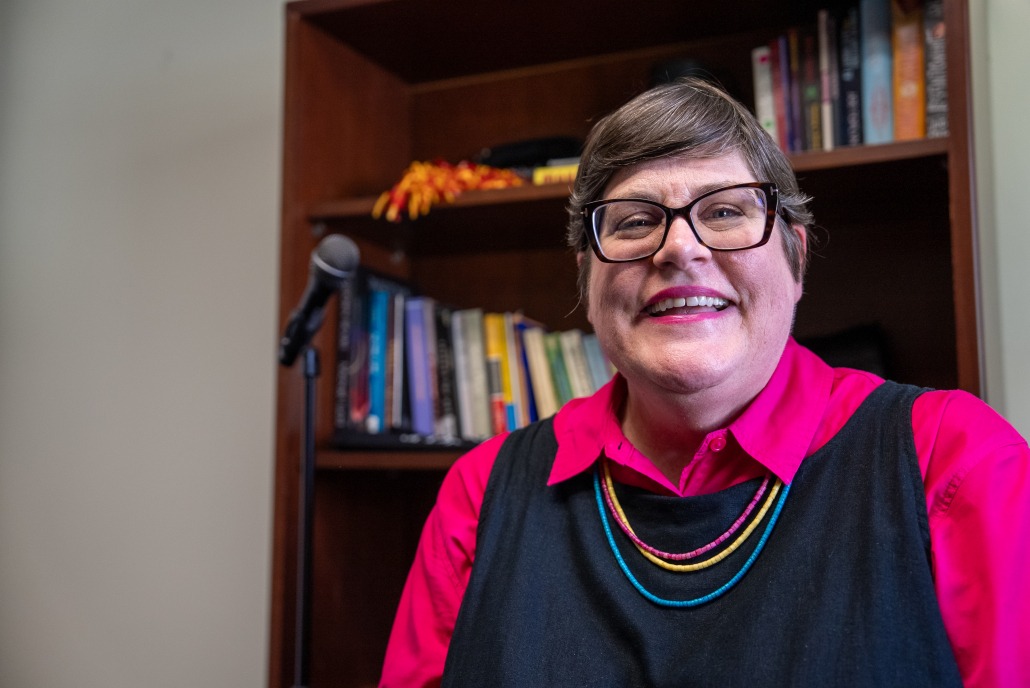
(Henry Kofman / Daily Trojan)
“It’s incredibly rewarding. I wish it paid more.”
Massouh teaches improv not just at USC but also in workshops with corporations. He recalled a time when he was working with a law firm, and they told him that many of the employees rarely spoke to each other and never had a real moment, and his workshop changed that. Anytime he does work at mental health facilities, he said those who are least willing to participate in “play” are the ones who end up being the saddest when it’s over.
“It’s incredibly rewarding. I wish it paid more, because then I could just do it all the time, and I would just be super happy,” Massouh said. “I’ve had so much feedback from students here who said that doing improv for a semester changed their life.”
For too long, comedy circles had a “right” and “wrong” way to be funny, Massouh said. He’s not interested in teaching that. He wants to find out who everyone is and what makes them funny.
“I don’t want to treat the class as a homogeneous cloth,” Massouh said. “I want to treat each person as an individual, because everybody brings something different, and I want to create an environment where they can bring their unique self to the world.”
To Shelton, part of the appeal of teaching stand-up is watching people figure out and accept who they are. Discovering yourself is a never-ending process; Shelton, 57, is still doing so and encourages others to start looking in college.
“The students are taking things that dog them — they’re slaying dragons on stage — and that can be heavy to walk through that with them,” Shelton said. “But I’m telling you, I laugh all day long. My job is the best. And I love watching artists fall in love with themselves.”
Brady said he has been told so many times by people that watching him on improv show “Whose Line Is It Anyway?” inspired them to enter comedy. But, he himself was inspired by watching comedians like Richard Pryor, Eddie Murphy and Martin Short, and later his contemporaries like Robin Williams, and he stressed the importance of his education in comedy.
He recalled watching PBS, black and white reruns and old British sketch comedy groups and absorbing it all as a child. He didn’t know that these would be tools he would utilize later in life; he just knew it was what he loved.
“My dream teacher would have been Robin Williams,” Brady said. “I watched every Robin Williams movie and every Robin Williams stand-up as a student, and I would argue that my style is really nothing like Robin’s, but I learned what I needed to.”
“You gotta punch the clock and put in the work”
In learning what has come before, Massouh expressed how much of his life he has dedicated to refining his improv skills. Even after performing on and off campus, taking on different styles of improv and teaching it for years, he still says he hasn’t reached a final destination.
“It takes years to become an advanced improviser. We call it time in; you gotta punch the clock and put in the work,” Massouh said.
Comedy is an ever-changing game, which is why Steel teaches a clown class. USC has made moves to respond to the “booming” clown community and offers medical clowning and a theatre clown class. To clown is to encourage the inner idiot within us all, Steel said, and is the perfect test for any performer, especially those who want to enter comedy, because you have to be okay with being laughed at.
“It is an enigma,” Steel said. “It’s a constant puzzle that you can never solve … You have to get up on the stage and try, and that requires courage.”
But the stage isn’t the only place for experimenting with comedy. With more content every day available to doom scroll on, some have resorted to seeking their comedy fame on social media. However, Gianmarco Soresi, a stand-up comic who has thrived on TikTok, warns against the idea that virality equals talent.
“The problem with TikTok — but this was the problem with TV before that and Myspace and everything — is that human beings go, ‘Well, if you’re good on this, you’re good on this,’” Soresi said. “And TikTok is just a completely different medium.”
Soresi warned against the notion that, because you can create a popular TikTok, you can jump to the stage and excel. If you want to find success, you have to put in the work. Soresi credits roast battles for teaching him the importance of joke writing.
“A note that I always want to give younger comics is that every punchline has to be not just funny but a surprise,” Soresi said. “The whole idea of giving a room full of people to simultaneously laugh is similar to a scary movie … that’s a physical reaction you’re asking for someone to get from your words, and, to do that, they cannot see it coming.”
This means that any comedic performance needs to be carefully crafted; good comedy is a labor of love. Comedians like Chris Farley wouldn’t have made it in today’s world, Soresi said — the social media game changes the landscape completely.
“There’s a lot of terrible comedy specials out right now,” Soresi said. “There’s a lot of miserable comedians selling out around the country who are terrible and awful, and I think the art form is in pain.”
Soresi fears comics today don’t dedicate themselves enough to the actual discipline of comedy.
With at least five improv groups, several sketch groups and an opportunity for stand-up comedy around every corner, students at USC are putting their noses to the grindstone because, in such a competitive community, to get any attention, they have to be at the top of your game.
“It’s a privilege that our job is to try to be as funny as possible,” said Frankie Alvarez Lora X, assistant director of The Suspenders and a junior majoring in theatre. “We’re so willingly able to devote our hours and hours and weekends and weeks and months on end to this, because we just love the outcome so much.”
From sketch to improv, the effort put into honing the craft of comedy creates an environment that allows both a progression of the art form and a tight-knit group to come through at the same time.
“[The members of Second Nature] already see each other six to eight hours a week, just rehearsing and doing improv, and we’re like, ‘No, no, that’s not enough,’” Grady said.
“People love being around funny people”
The bonds built through comedy may come from different places, but they represent on-campus families for their performers. Shelton argues there might be a chance to create an off-campus family as well.
“Comedy is a very good place to meet a sweetheart for an evening or a lifetime,” Shelton said. “Everybody says ‘I want somebody who makes me laugh,’ People love being around funny people.”
Building relationships and community tends to merge around humor. Shelton’s number one piece of advice for students who haven’t made friends is to join comedy.
“It’s a great way to bond to deal with scary things,” Shelton said. “Go audition for the sketch troupes, go to the comedy fair, do all that stuff, because once you get in a comedy troupe, you are bonded forever.”
The Suspenders perform one show every semester, and it is the culmination of all their hard work. From the pitching stage in January all the way until their performance in April, said JT Waugh, the director of The Suspenders and a senior majoring in theatre, the group rehearse every Monday and Wednesday, with many coming from work and practicing until the dead of night.
“This is a very unique space that really no one else in the world can experience,” Waugh said. “The 20 of us are all here together … for one reason, because we love each other and we love what we do.”
This sentiment permeates the USC comedy scene, on and off the stage. In the middle of the Daily Trojan’s interview with Second Nature, questions were thrown aside in favor of something much more important: it had just passed midnight, and it was officially one of their members’ birthdays.
After a song sung and cookies eaten, the rest of the troupe’s members echoed just how much they cared for each other.
“My entire time freshman year, all I wanted was to be able to hang out with a group of friends,” Grady said. “Now, after being on the troupe for all that time, I feel that myself and everyone here has been able to cultivate that friendship in a sense that we just want to hang out outside of rehearsal.”
“There’s so many different ways to tell a joke”
Grady and Second Nature have found their people at USC, their people in comedy. As individuals and as performers, their ideas mesh together. This, Commedus’ Moore said, is not something to take lightly.
“It’s a very intimate thing to find somebody who tells a joke the same way that you do, because sense of humor varies,” Moore said. “So when you find somebody that gets the mechanics of a joke in the same way that you do, that’s a very powerful thing.”
While the melding minds of these comedians sing together in harmony on stage, it does not mean that they alone have the keys to the city. There are many ways to be funny, as there are many ways to engage with comedy at USC.
The School of Cinematic Arts just hosted the seventh edition of its comedy festival. Sketch show USC Comedy Live! is celebrating its tenth season. Satire publication The Sack of Troy still jabs at other journalistic organizations on campus — they are alive and well.
The forking road of comedy at USC leaves many options for students, just as comedy takes many shapes. There is no formula to be funny; not everyone will find the same things funny. But for many, part of the journey is learning to appreciate this individuality and versatility.
“Before [joining the Merry Men], I came in with the notion that comedy was black and white, and some things are funny and some things aren’t funny,” said Nathan Bass, a member of the Merry Men and a freshman majoring in public policy. “There’s so many different ways to tell a joke and so many different ways to be funny.”
Today’s campus comedians know this, and its educators want to make sure that it is a mindset that persists and allows for play, inspiration and — ultimately — laughter.
“Our philosophy of [comedy] is that it is a very individualized and personal process of discovery, that there isn’t a blanket way to make someone laugh, and there isn’t one definition of what is funny,” Steel said. “It is a constant process of discovery for the students of comedy — but also for the teachers — to see the students in front of them and discover what it is about them that is so special that would make people laugh.”