Dornsife researchers develop breakthrough in safer opioids development
The group of researchers were the first to take snapshots of the moment naloxone reverses an opioid overdose in the brain.
By LIZZY LIAUTAUD
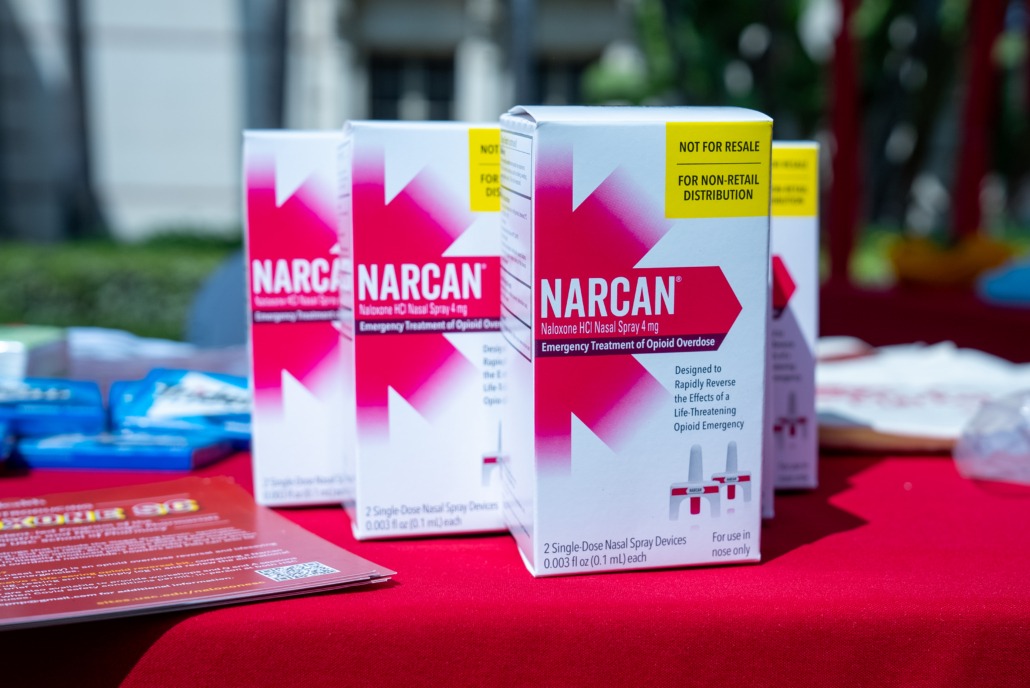

The group of researchers were the first to take snapshots of the moment naloxone reverses an opioid overdose in the brain.
The opioid crisis has killed hundreds of thousands in the United States, as painkillers have become stronger and more addictive. In a major step toward producing safer painkillers in the future, researchers from the Dornsife College of Letters, Arts and Sciences mapped out the moment naloxone, an opioid overdose treatment, reverses the process of an overdose in the brain.
Cornelius Gati, an author of the research paper, said nobody had ever seen how Narcan, the brand-name version of naloxone, affects the brain’s receptors. Gati and a team of Dornsife scientists were the first to capture snapshots of that moment using electron microscopy, which they detailed in a research paper published in November.
Gati said scientists only recently discovered that most prescribed opioids are too potent for consumption, after struggling for years to understand why they have such strong side effects. Naloxone is an antagonist, a substance that stops opioids from interacting with brain receptors.
“These novel synthetic opioids are so potent that Narcan can’t work anymore,” Gati said. “We would want antagonists that bind even tighter, even longer, even better, to out-compete these very potent synthetic opioids.”
The group created 3D models of opioids hitting brain receptors, and of naloxone stopping the receptors from activating. Gati said the diagram will help pave the way for creating new antidotes that will more effectively stall the receptor.
Saif Khan, a Ph.D candidate studying molecular biology and an author of the study, compared the opioid receptors in our brain to tiny machines whose function is altered when opioids, or naloxone, hit them. The goal of the study was to visualize how exactly these tiny machines are being affected.
“If you had really precise information about how that machine works, down to every single nut and bolt, you would be able to better manipulate it in ways that are desirable for you,” Khan said.
Mohsen Ranjbar, a Ph.D student studying chemistry working with Gati, said the study produced groundbreaking snapshots depicting the moment Narcan stops opioids from interfering with receptors. The process used high-resolution electron microscopes that allow scientists to look at atoms and capture snapshots of the entire process.
“This is novel. This is wild. And people used to say … ‘With the techniques that we have right now, it’s not possible,’ but we did it. That’s the novelty of our work,” Rajbar said. “But we just added maybe a line, a single line, to this book of pharmacology.”
Gati said the group focused on Narcan to address the crisis created by new, potent synthetic opioids like fentanyl, which are stronger than the treatment. Narcan only sticks to brain receptors for a short time, Gati said, so many patients dealing with fentanyl overdose require constant doses to stop the effects of the opioids.
“Narcan is obviously a life-saving drug, but it has many, many pitfalls,” Gati said.
Khan said the research will help scientists design new painkillers that manipulate receptors differently so that the pain-relieving properties remain, but the strong side effects don’t.
“It opens up all these new avenues for other labs to get involved and to develop not just new and safer opioids, but better treatments for people who are suffering with the effects of opioids,” Khan said.
Gati said that developing new drugs is not as effective in addressing the opioid epidemic on its own.
“People are not going to buy less potent street drugs. So I think it’s always going to be important to design … better painkillers, but also to have molecules that are able to compete with these potent street drugs as well,” Gati said. “It’s a double-edged sword.”
Khan said their research is just the beginning of understanding opioids.
“This work that we have done as a group will spear a lot of groups across the country to take this forward in ways that we may not be able to,” Khan said. “To enable us to get to a place where we have new, better drugs. It requires, you know, people from different walks of science are coming together, and I think that’s inevitably what’s going to happen.”