Reconnecting with Indigenous culture is complicated
Examining the difference between individuals seeking out lost cultural connections and others making false claims of Indigeneity.
By CHELSEA LATTA
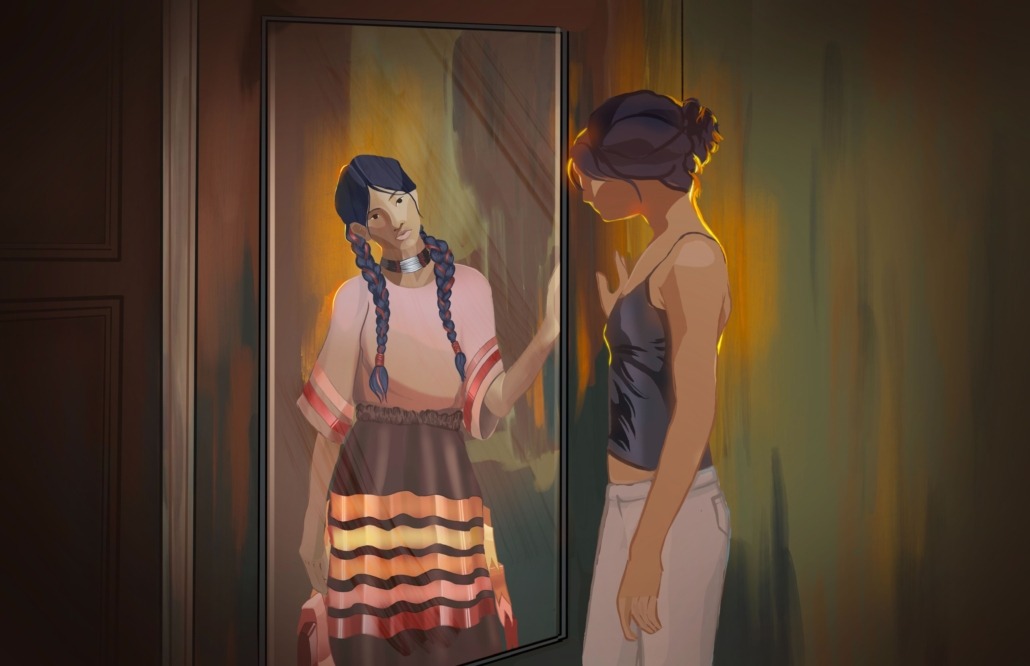

Examining the difference between individuals seeking out lost cultural connections and others making false claims of Indigeneity.
I was raised by a single mom. She is truly the best parent I could’ve asked for and has worked tirelessly to support me and make sure I feel secure in who I am. However, one fundamental difference between us is that I am Indigenous Mexican, and she is white.
Growing up in a small, predominantly white Midwestern town, I have always identified closer to my Indigenous Mexican heritage. Living somewhere so culturally insensitive, I became used to kids asking me if I was smuggled across the border or saying their parents wouldn’t let them be friends with someone who “looks like me” because I must be here illegally.
These experiences taught me to keep my head down and tell myself that their ignorance was not a reflection of my culture or who I am. Feeling constantly on the outside of my peers led me to find comfort in my roots — and to hope that in college I would find community
With an absentee father, any instance when I said I was Indigenous, I was asked the question I learned to dread: “What is your tribal affiliation?” My response was always the same: “I’m not tribally affiliated,” which some people accepted and others did not.
Even with people I’ve just met, I’ve been asked why I don’t reach out to my father to fully reconnect with my roots. What I never said out loud was what I was thinking: Why is it on me to reach out to the man who has never tried to be involved in my life just to get others to accept my identity?
Upon arriving at USC, I remember my first encounter with the previous Native American Student Assembly co-executive directors, and saying I wasn’t tribally affiliated made me nervous that they wouldn’t accept me. However, they were immediately kind and welcoming. Finding a home in that community has allowed me to be an advocate for my culture, so much so that it led me to be elected as one of NASA’s current co-executive directors.
Many people in the Indigenous community remain critical of individuals claiming their roots while lacking a traditional upbringing. There is often an unspoken belief that if you weren’t raised in an Indigenous household, don’t speak a Native language or participate in the traditional lifestyle, you don’t have the right to call yourself Indigenous.
I wasn’t raised in an Indigenous community. Just last year, I attended my first powwow. I am not federally recognized as Native American. Undoubtedly, I continue to claim my Indigenous roots. It’s a part of who I am, how I’ve been perceived and my connection with my ancestors — therefore, that to me means I am Indigenous.
No other ethnicity is required to prove their lineage or carry around a card stating their affiliation, and honestly, I find that notion bizarre. Why, then, is Indigenous culture so gatekept and hard to reconnect with — especially when so many individuals were forcibly deprived of that side of their identity?
With so many Indigenous children in the United States during the 1950s and 1960s forcibly
removed from their homes and “adopted” into white families, there are multitudes of Indigenous descendants with no direct access to their culture.
If you are Indigenous, you have the inherent right to know your culture, whether you are tribally affiliated or not. The attempts to separate those without tribal affiliations are just an extension of the colonizer mindset, which set out to erase our culture and existence through the horrific history of genocide, Indian boarding schools, and blood quantum requirements.
Governmental attempts to eradicate Indigenous culture led to so much historical knowledge being lost, many innocent lives taken, and the furthering of generational trauma.
Blood quantum itself was created by white settlers, intending to progress the erasure of Indigenous people. This process is incredibly inaccurate, as countless families assigned blood quantum have been altered by colonizers’ determinations of how “Native” someone appeared. Those inaccuracies followed every single person in their lineage, narrowing the definition of Indigenuity to the point of disappearance.
This is just further evidence of the annihilation of Indigenous culture succeeding once again. With this, we need to fight for the opportunity to reconnect and the right to go back to our cultural roots in any way that we can in order to preserve what is left of our heritage.
In the past few years, the rise of so-called “pretendians,” individuals claiming Indigenous descent without proof or ancestral ties to the culture, has complicated this conversation. These individuals falsely claiming Indigenous roots often do so purely for the sake of receiving scholarships or some form of profit. In claiming a culture they do not have a right to, they taint the reconnection process for those with actual ties to the community.
“Pretendians” are a continual issue and must be called out and forced to stop appropriating Indigenous culture. They are just behaving as modern-day colonizers, adapting Indigenous knowledge and traditions for their personal benefit.
However, those with Indigenous lineage working for reconnection deserve to know who they are and where they come from, without judgment and without bias. For those of us who have lost connections through no fault of our own, the right to return should remain intact. Someday we will find our way home.