USC Asian Pacific Film Fest raises student filmmaker voices
The festival brought together filmmakers, industry professionals and audiences.
By KIRA MANELSKI
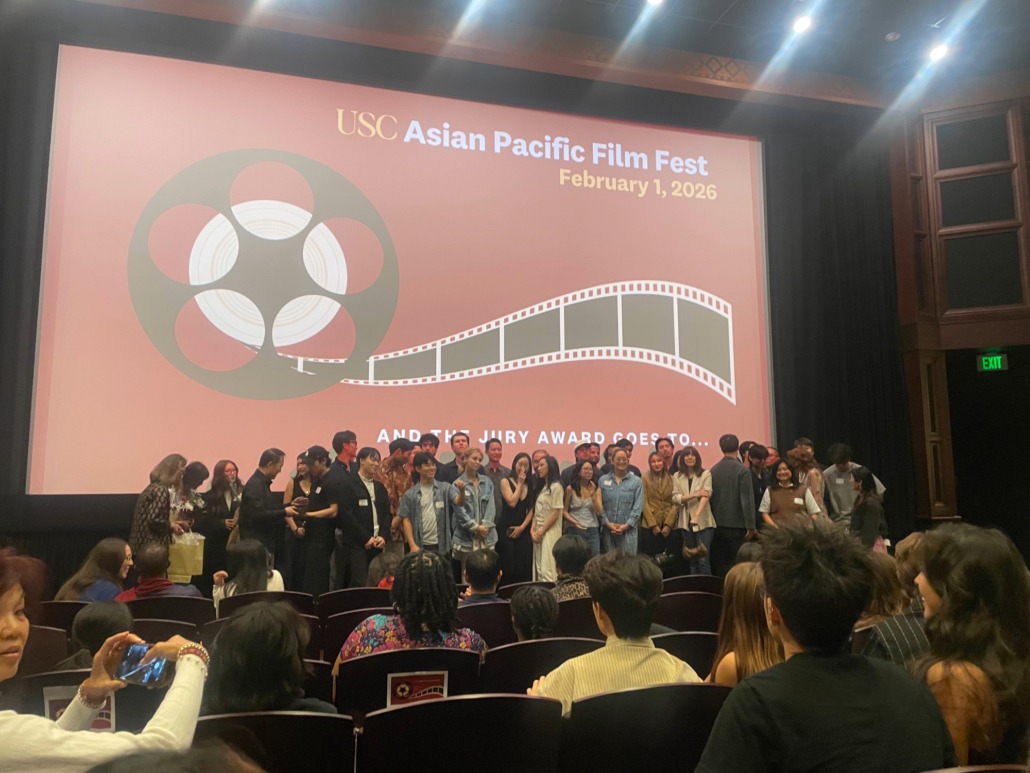

The festival brought together filmmakers, industry professionals and audiences.
A few audience members wiped away tears at the USC Asian Pacific Film Fest on Sunday after the screening of “Sweet Farewell,” a short film about a Vietnamese dessert shop struggling to survive after changes in its community. The short film was one of nine screened during the film festival, which centered around amplifying APIDA voices.
Students and alumni packed the Ray Stark Family Theater for the festival, a collaboration between the Asian Pacific Alumni Association and the Asian Pacific Cinema Association. The festival featured short films by students and alumni as well as a panel of honorary jury members with credits including “Hacks,” “Finding Nemo” (2003) and “Shortcomings” (2023).
Vivienne Ishida, co-director of festival programming for APCA and a sophomore majoring in dramatic arts, said the festival was more than just a series of screenings, but rather an opening to create a space for the APIDA community.
“It’s just so cool to have that opportunity, … with everything that’s going on in the world right now,” Ishida said. “We are celebrating APIDA voices, but also storytelling that should be shown to people of all cultures.”
Lana Do, co-president of APCA and a junior majoring in business of cinematic arts, said the festival aimed to remove obstacles for Asian filmmakers.
“We want to lower the barrier of entry to the entertainment industry,” Do said. “A lot of people, especially Asians, find it hard to get into this machine. So we want to create as many small stepping stones as possible.”
The evening opened with a Q&A of the jury panel, which included producer Jinko Gotoh, actress Ally Maki, and filmmaker Freida Lee Mock, followed by the nine screenings, and concluded with an awards ceremony.
For Cynthia Nguyen, the writer and director of “Sweet Farewell,” one of the films screened, the Asian Pacific Film Festival was a symbol of visibility and space for APIDA students to have their voices heard.
“So many people find comfort [in] being able to see stories and people like them reflected on the screen,” said Nguyen, a senior majoring in cinematic arts, film and television production. “We may not feel the need to put perspectives like ours forward, but it’s always important to remember that we are still here.”
Ashish Mohanty, the writer, producer and lead actor of “Masala,” another screened film, said different media play a role in cultural identity. For him, “Masala”, which focused on family relationships and evolving culture, was about exploring the way he felt about his own identity.
“Culture, in a weird way, is two-pronged: who you are and the way you grow up. Family sociology is one part of [the] culture, but the other part is the stuff you see in media and on screens,” Mohanty said. “Being able to bridge those and have shared experiences makes people feel less alone and supported.”
These themes of representation brought up by the filmmakers mirrored what Ishida and Do said they wanted attendees to take away from the festival. For Ishida, the film festival was about expanding how APIDA stories are understood.
“Especially within APIDA communities, as they’re on the rise, we should continue to uplift them,” Ishida said. “I hope it gives insight for people who are not in APIDA cultures into APIDA communities, and broadens the stereotype to not just necessarily the smart kid or the immigrant stories, but that there [are] other struggles that we go through.”
Similarly, Do said she hoped APCA provided a space for the Asian community to see itself in the art fields. She said organizations like APCA help students feel supported in careers that didn’t seem like an option for them growing up.
“Some people didn’t [grow up] surrounded by Asian communities, especially in Asian communities interested in film, because most of us want to be doctors or lawyers,” Do said. “It’s just part of Asian culture to want the kids to not do something in the arts. APCA really cultivates that — everyone can pursue their dreams if they want.”
Pursuing dreams was a theme of the night, with the honorary jury highlighting the importance of simply going for it. Gotoh urged students to embrace failure and told them simply, “Don’t be afraid.”
“Look how diverse this room is. It’s important that you know our voices are heard,” Gotoh said during the opening Q&A. “Our voices are seen on the screen because people are inspired when they see themselves on the screen.”