The Kennedy era was never ‘Camelot’
We often think of the Kennedys as symbols of an optimistic era of United States politics, the family’s methods reveal a darker undertone.
By CHARLOTTE DEKLE
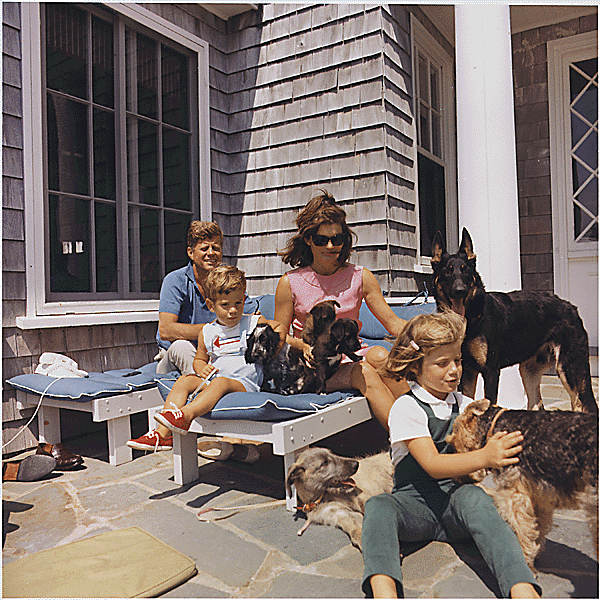

We often think of the Kennedys as symbols of an optimistic era of United States politics, the family’s methods reveal a darker undertone.
There’s a scene in the new FX miniseries “Love Story” in which an ailing Jackie Kennedy is dancing around her Manhattan penthouse and listening to the finale of “Camelot.”
For decades, the musical came to represent the cultural image of the Kennedys — to quote the title song, a “brief shining moment” of grace, optimism and possibility in American life. They represent a nostalgic early 1960s moment where there was a young, handsome man in the White House with a young, attractive family.
However, the “Camelot” ideal was constructed by the family itself to obscure the more nuanced picture. Yes, the Kennedy family advanced liberal causes and ushered in a new era of politics. In many ways, they were representative of the United States — a family descended from Irish immigrants who were magnanimous, liberal, charming, shiny and happy people, the lives of many of whom were cut short by a series of tragedies, which continue today.
However, their methods of achieving and maintaining power were ruthless, cutthroat and representative of immense privilege. They are not remnants of a bygone era of political class; they reveal what has always been true about United States politics: ambition and money reign supreme.
The political machinations began with patriarch Joseph P. Kennedy Sr., a financier and ambassador to the United Kingdom who had presidential ambitions of his own. But after advocating for appeasement and neutrality in the face of an increasingly antagonistic Nazi Germany and proclaiming, during World War II, that “Democracy is finished in England,” his prospects dimmed. He redirected his ambitions toward his sons.
In a The Guardian review of a Kennedy Sr. biography, Sarah Churchwell wrote, “The only exception to what seems a nearly sociopathic lack of empathy was his devotion to his children — but anyone so monumentally self-interested presumably considered them to be extensions of himself.”
This sociopathic dedication to rearing a president meant that the Kennedys did not play pretty politics. In a 1946 Massachusetts Democratic Congressional primary, John F. Kennedy faced nine opponents, two of whom were named Joe Russo. Fearing the stronger Russo would capture the Italian vote, Joseph P. Kennedy Sr. reportedly orchestrated payments to the second Russo to enter the race to confuse voters.
Although the vote splitting would not have impacted the outcome — JFK got more votes than both Russos combined — these underhanded strategies were central to the maintenance of power and often get excised from Kennedy narratives. The Kennedys’ political power often meant they could get away with what others couldn’t.
After the assassinations of his older brothers, youngest son, Sen. Edward “Ted” Kennedy, became the family’s last hope for a presidential dynasty. On July 18, 1969, he drove off a bridge on Chappaquiddick Island, resulting in the death of Mary Jo Kopechne, a political strategist for Robert F. Kennedy’s 1968 presidential campaign.
Kennedy was able to avoid much media scrutiny because Neil Armstrong walked on the moon two days later. It’s an almost perfect encapsulation of the Kennedy dynamic: a horrible incident overshadowed by a marvelous achievement.
To his credit, Sen. Kennedy acknowledged that the action was unforgivable and that it haunted the rest of his life and career. But he still got to be a senator from Massachusetts. The Chappaquiddick incident revealed a two-tiered system, where the Kennedys — and, more broadly, those with immense privilege — get a slap on the wrist and everyone else suffers.
The money and ambition continue into the 21st century, and the surname plagues politics.
Current U.S. Secretary of Health and Human Services, Robert F. Kennedy Jr., leveraged the Kennedy name in an ad for his 2024 presidential campaign before entering federal office. Weaponizing the fact that the Kennedy family is famously Democratic lends faux bipartisan credibility to RFK Jr.’s insane beliefs; his own family disavowed his ideology. He is now wreaking havoc on the health of Americans.
Jack Schlossberg, JFK’s grandson, is the latest example of nepotistic Kennedy ambition. He wrote condescending Vogue articles, including one preceding the 2024 presidential election explaining how polls work to Vogue’s primarily female audience, and is now running for Congress in New York’s 12th Congressional District and almost constantly invoking JFK’s legacy in his campaign posts.
Kennedy has no actual political experience, but he does have a J.D.-MBA from Harvard. Ignore the fact that his grandfather’s name is on a Harvard building; it seems that “Camelot” continues.
None of this discounts the contributions of the Kennedy family. JFK created the Peace Corps and championed civil rights legislation. Ted Kennedy, called the “Liberal Lion of the Senate,” was a proponent of nationalized healthcare and advanced the Americans with Disabilities Act. The Kennedys were champions of the “New Frontier,” and that legislative legacy should be recognized.
The Kennedy family is distinctly American: deeply shaped by wealth. Retiring the “Camelot” ideal of the Kennedys means accepting that there was never a civil point in United States politics — it has always been cutthroat. Understanding this can help us finally imagine a world beyond “Camelot.” We can understand United States politics for what it has always been: shining and cruel.