Troy Phi celebrates Filipino culture
Pilipinx American Cultural Night hosted a variety of performing arts showcases.
By ZACHARY WHALEN
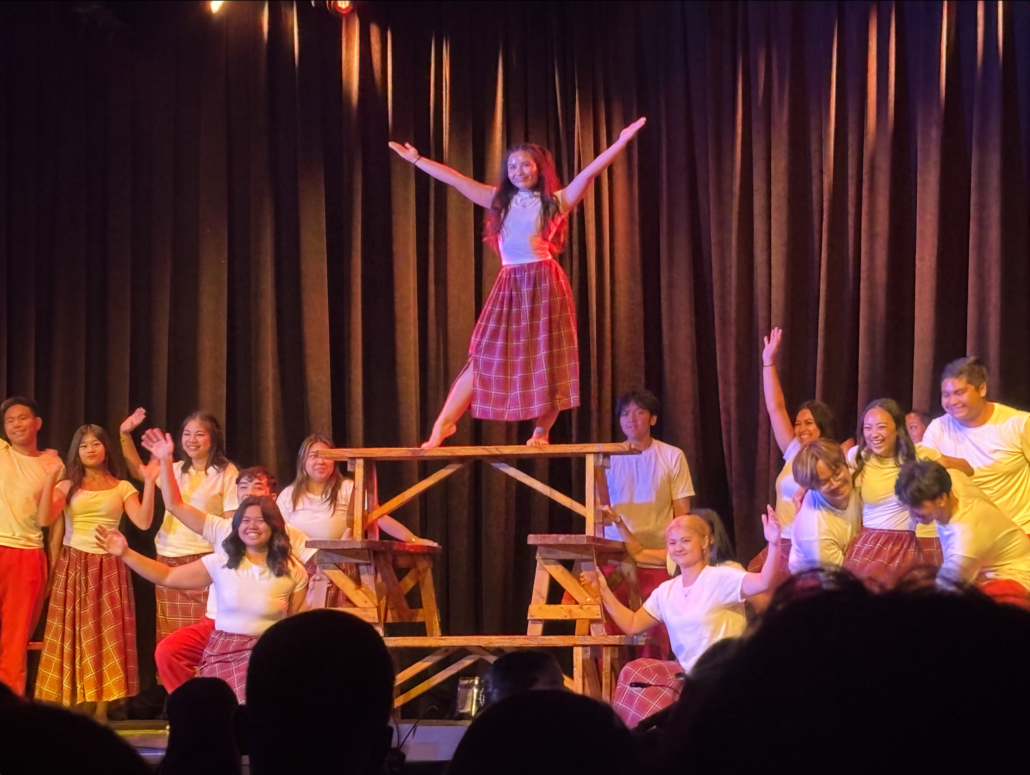

Pilipinx American Cultural Night hosted a variety of performing arts showcases.
The Trojan Grand Ballroom erupted in cheers and applause as Troy Philippines’ traditional Tinikling dancers momentarily stopped dancing over moving bamboo poles to lower blindfolds over their eyes. The audience cheered even louder when the performers resumed, seemingly guided by sound and memory alone as they danced between the bamboo.
The Tinikling dance was one of multiple performing arts showcases at Troy Phi’s Pilipinx American Cultural Night on Sunday. The event featured an orchestra and band, as well as a combination of dance and vocal performances that showcased the event’s theme of pagkakaisa, or “unity,” in Tagalog.
Clare Sanchez, one of the directors of Pilipinx American Cultural Events for Troy Phi and a junior majoring in biomedical engineering, described the Philippines as a “quilt of cultures” that were grouped together under the category of the “Philippines” during Spanish colonization. Sanchez said she fell in love with how unique cultural dances from different parts of the Philippines were, and she wanted this year’s PACN to highlight cultures from across the archipelago.
“When I applied to be PACN director as part of Troy Phi’s executive board, I emphasized how much I wanted our show to focus on the parts of the Philippines we hadn’t before,” Sanchez said. “Entire cultures and populations of our people fall into this umbrella of Filipino, and yet, in our show … these cultures were nowhere to be found. This year, we wanted to step towards making sure they are seen.”
Sunday was Troy Phi’s 34th PACN and the first to feature dancers performing the Lumagen, a traditional Filipino dance inspired by the Indigenous people of the northern Philippines. The dance features rhythmic stomping and coordinated movements. The dance represents warrior spirit and a connection to nature, according to the PACN program itinerary.
Tylen Bell, one of the Lumagen dancers and a senior majoring in environmental studies, said it was great to be part of PACN’s first performance of Lumagen and that he loved being able to participate in the event.
“It’s great to have a place and space and event to display our culture, come together as a club, as a community, [and] bring our families and friends together,” Bell said. “This is my last PACN; I’m grateful that this is one of the biggest ones we ever had.”
Cailin Reyes, the president of Troy Phi and a senior majoring in public relations and advertising, said her favorite part of performing at PACN was the Tinikling dance, which she had been afraid to do since her sophomore year when she first became involved in PACN. Reyes described Troy Phi as a family, and said participating in PACN was one of the first ways she felt connected to and immersed in Filipino culture.
“[PACN is] just such a good way for me to connect with my culture and learn more about my history and background as well,” Reyes said. “We celebrated our 50th anniversary last year, so seeing a cultural organization be able to be here for this long, especially at USC, is very meaningful, and I’m glad to be part of that history.”
The performances at the event were a blend of traditional and modern art: Dances ranged from hip-hop to Ssayaw sa Bangko, a traditional dance that has performers jumping on and off benches. The vocal group Troy Philippines Voices sang both Bruno Mars’ “Just the Way You Are” and “Mahika,” a song by Filipino artists written in Tagalog. One of the final performances was modern Tinikling, where dancers performed the traditional Tinikling dance to a medley of pop songs.
Divya Ranjith, an event attendee and a sophomore majoring in biological sciences, said going into the event, she had no idea how many historical and modern styles of dance were part of Filipino culture, and that she appreciated the show’s exploration of identity and Filipino culture.
“[The event] was the coolest thing ever,” Ranjith said. “They did a beautiful job showing that anyone can be a part of [Filipino culture], and they did [a great job] showing what identity truly is … it’s not just a definition, but it’s a broader term that covers anything that you feel like you’re a part of.”
The event was structured around a play that featured seven actors telling the story of Filipino students fighting for accurate and diverse representation in their Filipino studies classes. The play also touched on themes of navigating biracial identity, with one character expressing that he felt his community didn’t see him as a “real” Filipino because he was biracial.
Alex Johnston, one of the directors of PACE and a senior majoring in chemical engineering, said she was incredibly proud of the event and hoped the audience left understanding how many different ways one could be Filipino.
“No matter where you came from, what kind of Filipino you are, you’re still Filipino,” Johnston said. “There shouldn’t be this divide between which kind of Filipino you are — I feel like that happens sometimes.”