USC Shoah Foundation observes Yom HaShoah
Holocaust survivor Yetta Kane gave testimony of her lived experience in Poland.
By DUO YANG
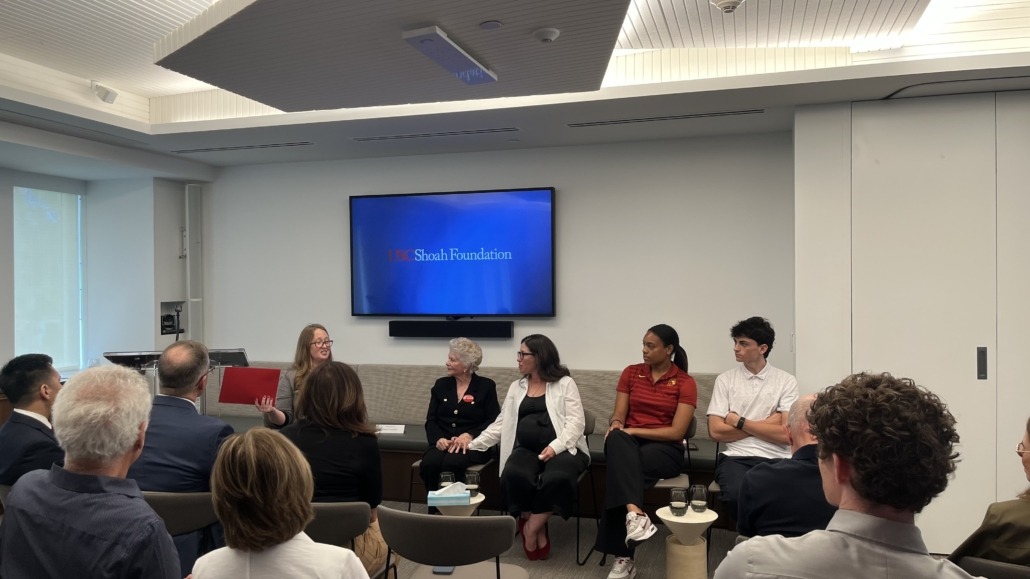

Holocaust survivor Yetta Kane gave testimony of her lived experience in Poland.
USC community members gathered Monday afternoon at Leavey Library to mark the observance of Yom HaShoah, the Holocaust Memorial Day observed in Israel and by Jewish communities around the world commemorating not only the number of victims, but active resistance.
The event, “Dialogue Among the Generations,” was hosted by the USC Shoah Foundation and featured an intergenerational panel of speakers, including Holocaust survivor Yetta Kane and her granddaughter Emily Kane Miller.
German troops displaced Kane’s family in 1941, who spent time in a displaced persons camp before immigrating to Los Angeles in 1949. Kane’s story was archived by the Shoah Foundation in 1995 as part of their Visual History Archive, the world’s largest collection of video testimony from Holocaust survivors. The event opened up with a portion of the video testimonies by both Yetta and David Kane, her late husband, who explained why they decided to share their story.
“When our children were younger, we never talked about [the Holocaust] … We felt we did not want to burden them with our pain, with our agony,” Yetta Kane said in the video recording.
Eventually, as their children grew older, the Kanes thought it was important for future generations to know what their ancestors had gone through in order to carry on the legacy of Jewish survival.
“I came to the realization that I must do everything to perpetuate the memory of the Holocaust so it should never happen again. I must give this testimony. I must go out and speak. I must teach,” David Kane said in the video recording.
Yetta Kane said part of the reason she shares her experiences today is because she believes in the ability of people to heal from hurt and find kindness and love for one another, lest history repeat itself. Through sharing her story, she said she hoped to inspire compassion in people, and for them to help others as much as they can.
“We’re all God’s children. We all have the same needs, and we are able to always try to help another human being, because we don’t know [if] tomorrow, we’ll need help — to be inclusive, to be kind, to shine a light when there is darkness in any way we can and by helping another person,” Yetta Kane said.
Kane Miller said she has been extremely lucky to have had the opportunity to hear her family’s story since she was young. Her grandparents did not begin telling their stories until the ’90s, so she learned her history at the same time as her parents.
“Growing up as a grandchild of survivors has always been something that I felt very grateful for, something I feel very motivated by,” Kane Miller said. “God forbid something like this ever happened, or should ever happen, but I think there are so many of us that use it in a way to platform positivity and joy and hope.”
Jaxson Blum, a freshman studying international relations, became involved with the Shoah Foundation during his junior year of high school through a junior internship program before enrolling at USC. He said that people outside the Jewish community can still play an important role by listening to and sharing stories.
“I don’t come from a Jewish background. You know, these stories oftentimes went unnoticed in school,” said Blum. “[Testimony] is incredibly powerful, that someone across time can share their story with you without even knowing. With that comes a responsibility [of] how you continue to carry that story, even though it may not have started with you.”
Yom HaShoah is one of the two internationally recognized Holocaust remembrance days, the other being International Holocaust Remembrance Day. The international remembrance falls annually on Jan. 27, and was chosen by the United Nations in 2005 to mark the liberation of Auschwitz-Birkenau. In contrast, Yom HaShoah centers on the commemoration of survivors rather than liberators.
The date of Yom HaShoah was chosen in 1951 by Holocaust survivors living in Israel to mark the beginning of the Warsaw Ghetto Uprising, said Robert Williams, a speaker at the event and CEO and Finci-Viterbi chair of the Foundation. The Uprising was a 1943 resistance movement that started when 700 Jewish youth resisted the force of German troops to try to prevent the deportation of Jews to concentration camps.
“These origins matter. Yes, we must remember the sacrifices made by liberators to end the Second World War and the Holocaust, but we must also never forget that the victims and the survivors of the Holocaust were not passive witnesses to their fate,” said Williams. “Many Jews fought back, many resisted in other ways, and all had agency and innate humanity.”