It can be more than just a GE
General education classes can teach you things you never would have learned elsewhere.
By ARMAND SJARIFFUDIN
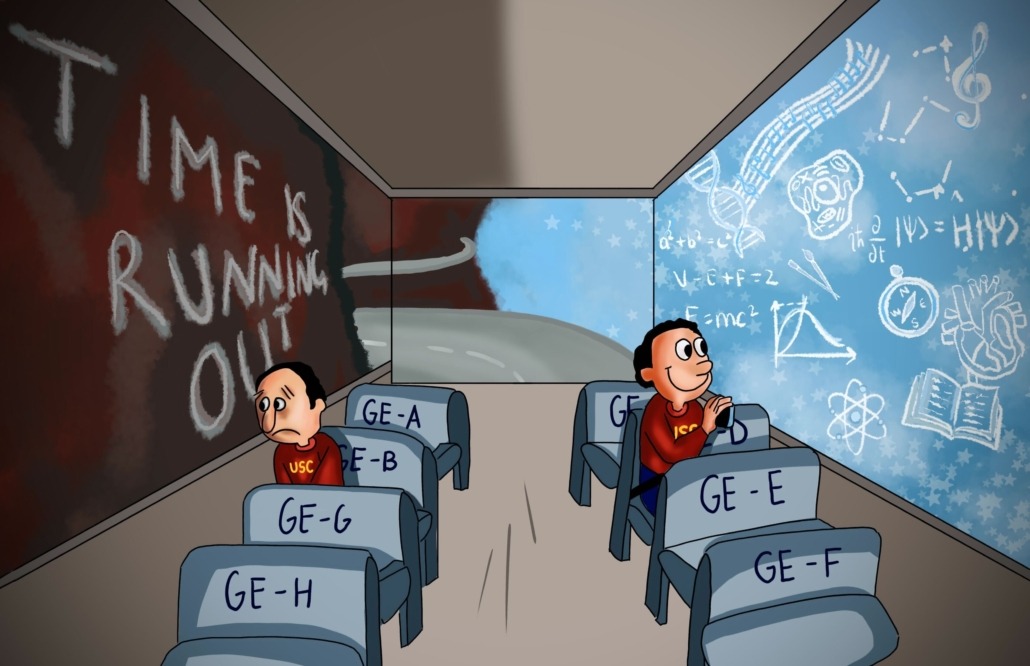

General education classes can teach you things you never would have learned elsewhere.
It’s August of 2025. I am a freshman, asking for advice on my courses from a residential assistant on my floor. She asks me what my classes are for the fall, and I tell her one of them is: “The Power and Responsibility of the Press,” a journalism class that I admittedly signed up for because it satisfied a general education requirement.
My RA’s eyes grow wide. She tells me to drop the class immediately, that she had an abysmal experience and a final grade she was not happy with. I try to do just that, and look for any sort of substitute. When I can’t find one, I decide to just stick with it and try my best.
Flash forward to today, and I’m glad I ended up taking the course, even if it was just a GE. I am not a journalism major, but the class was an invigorating exploration of what up to that point was a hobby I had in high school, which I never would have expected to evolve as a genuine passion.
If it wasn’t for “The Power and Responsibility of the Press”, I probably would never have kept writing, never have made the steps to understand my role as a student at USC and above all else, I probably wouldn’t be here, an opinion writer for the Daily Trojan. When I pondered my trajectory, I realized how much I was thankful for the GE system, which, coming in, I thought would be nothing more than a chore, and my willingness to engage fully with classes outside of my major.
For context, the concept of general education curriculum was first introduced in 1931 at the University of Chicago. Robert Haynard Mutchins, former UChicago president, first implemented the system to foster greater democracy through a more well-informed, engaged student body.
Hutchins believed that education was meant to prepare students to contribute to society at large. The GE system was his way of preparing his students for an integrated society predicated on a shared understanding between several disciplines.
Nevertheless, Mutchins’ vision has definitely been decoupled from how students now view the GE system. Pepperdine University conducted research on students’ perceptions of GE classes in 2021, with 92% of surveyed students wanting fewer GE requirements, and 61% saying they would actually be inclined to move to another major if they had fewer GEs.
Pepperdine’s data is indicative of a student culture that may not see the inherent value of GE classes and, therefore, view them as meaningless. In fact, another writer from the Daily Trojan wrote a piece arguing against the GE system.
I feel all of these opinions are valid, and I myself have had moments where I questioned what I was learning in my GE classes. However, my experience with my journalism course showed me that GE classes can push you into prospects you would have never anticipated for yourself.
It can be easy to fall into the habit of learning to achieve a grade or tick off a requirement. With GE classes, this effect is only tenfold. But when GE classes are honed in on, and value is assigned to things we learn regardless of whether or not they are relevant to our major, meaning can be found in places we never expected. My journalism class is one example, but I have other experiences where taking a GE has directly led to my having a richer breadth of knowledge.
One class I’m taking this semester, “Introduction to Latin American and Iberian Studies,” exposed me to a variety of texts that directly relate to the global fight for peace and freedom, principles I assign so much value to.
My freshman seminar class in social analysis taught me the importance of civic engagement and the unsung influences shaping how our politics function today. It was actually a major basis behind my piece on polarization and my growing interest in political science.
All of these examples seem isolated, but they all form the foundation of who I am as a student and the passions I hope to carry as I progress through college. I would have never anticipated that I’d be exposed to all sorts of diverse perspectives and disciplines through GE classes, but I am eternally grateful for the opportunity.
We won’t always be exposed to opinions or lessons we agree with or find interesting in GE classes. But that doesn’t mean that we can’t make the most of whatever it is we’re learning.
Engaging with GE classes can show us things we never would’ve expected to find important, but it takes effort on our part to extract that value. So show up, pay attention, and try to engage with what it is you’re learning. You never know what you might walk away with, or what journey you might be embarking on.