When the arts become co-opted
In a time of growing censorship, creators must fight for authenticity.
By EMMA IBRAHIM
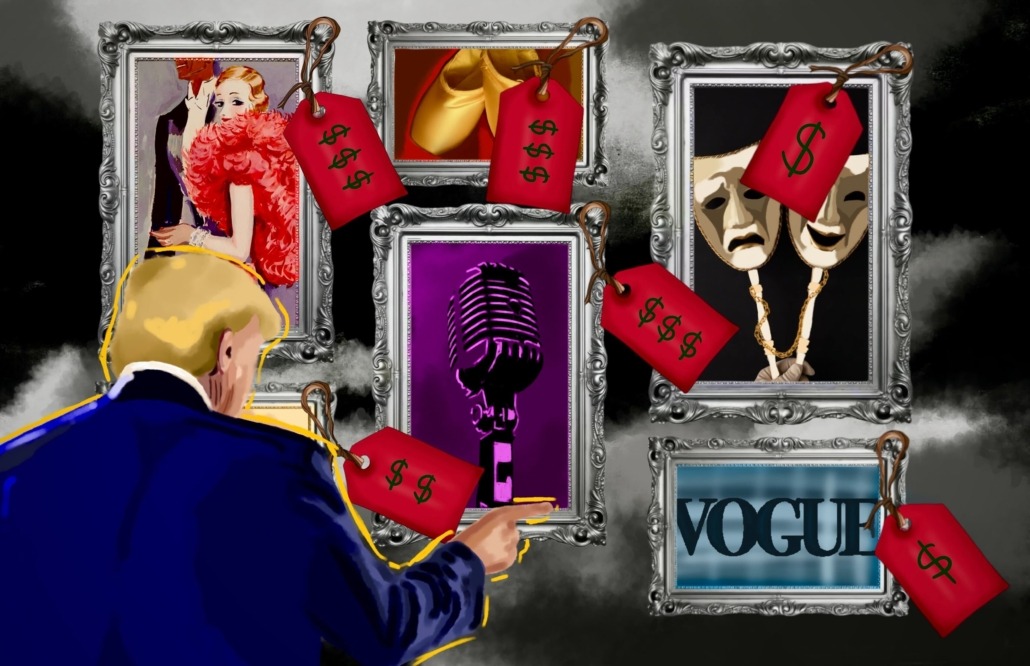

In a time of growing censorship, creators must fight for authenticity.
I can trace my childhood around Washington, D.C.’s cultural institutions — from class field trips to the Kennedy Center to all the Smithsonian museums I’ve wandered through. D.C. is colored by much more than its politics; it is colored by musicians playing drums outside the Metro stations, jazz and food festivals, and street murals. But just like people, cities ebb and flow.
Each time I return home for breaks, I watch as the city I grew up near morphs into one rewritten in President Donald Trump’s image.
The Kennedy Center, our nation’s chief cultural establishment, is just one of many institutions swallowed up by our president and renamed after him. If you drive through the district, you’ll notice buildings like the United States Institute of Peace now bear Trump’s name, and banners of his portrait drape the entrance of some federal agencies.
Piece by piece, the culture that defines D.C. — and our country — is threatened by this administration. As our cultural institutions become co-opted and reshaped, we must look to art as an avenue of resistance, especially the art facing repression.
In March 2025, the Smithsonian Institution became entangled in Trump’s futile string of executive orders, with one aimed at purging museums of exhibits the administration deemed divisive or a distortion of the U.S.’s “true” history.
D.C. is home to 19 of the Smithsonian’s 21 museums, each carrying the legacy of histories that were fought to be told. The executive order placed a bullseye on the back of the most piercingly moving museum I’ve visited: the National Museum of African American History and Culture.
Among Chuck Berry’s cherry red Cadillac Eldorado and a baseball signed by Jackie Robinson, the museum houses Emmett Till’s original casket and riot pennies from the Tulsa Race Massacre. The “Slavery and Freedom” exhibit explores enslavement and its enduring legacy, chronicling a story of oppression and resilience through a time capsule.
As diversity endeavors near their demise, Trump’s framing of the shameful aspects of American history as antithetical to our country’s values threatens to erase an entire people’s heritage as well as artistic freedom.
Last June, Kim Sajet, the director of the National Portrait Gallery, resigned after Trump’s efforts to fire her over her commitment to diversity, equity and inclusion initiatives, which the president said was “totally inappropriate for her position” in a post on Truth Social.
Our president intends to wash over the city’s culture, imposing unwelcome changes and deploying the National Guard to enforce his agenda.
But D.C. is a community of resistance, and protest is a birthright. Whether it’s the March for Our Lives following the Parkland shooting or Black Lives Matter protests in the wake of George Floyd’s murder, people travel from all over the country to unite with residents in the fight against injustice.
And the resistance travels beyond marches on the National Mall — it’s in the art. An anonymous activist art collective called The Secret Handshake has installed several satirical protest exhibits around the district, including a sculpture of Trump and Jeffrey Epstein holding hands titled “Best Friends Forever” and later renamed “Why Can’t We Be Friends?”
After Trump ousted the board and installed himself as chairman of the newly rebranded Trump-Kennedy Center, many performers, including the San Francisco Ballet, canceled their performances in protest. The Washington National Opera, which had been performing at the center since 1971, discontinued its programming there altogether.
And it’s no different in Los Angeles. When the aggressive wave of U.S. Immigration and Customs Enforcement raids hit the city last summer, artists created and distributed resistance.
A backdrop of one of the anti-ICE protests, Barbara Kruger’s 1990 “Untitled (Questions)” mural painted outside the Museum of Contemporary Art’s Geffen Contemporary building in Little Tokyo poses the questions: “Who is beyond the law? Who is bought and sold? Who is free to choose?”
Another installation, “Am I Next?,” projects images on the sides of downtown buildings featuring the faces of everyday Angelenos, accompanied by the question, “Am I next?” and the “We Belong Here” installation projects messages like “Invest in the oppressed.”
As censorship intensifies, art must continue to do what it does best: subvert. To create is to disrupt the status quo, crawl under people’s skin and demand their attention. But when we surrender to those who seek to silence authenticity and pressure us to stop creating, the battle against censorship is truly lost.
Whether it’s through music, sculpture, dance or writing, we must persist in our protest against the erosion of civil liberties and continue creating.