WORD ON THE STREET
Gen Z is more than just the social media generation
FX’s “Adults” nails down how this generation communicates beyond the screen.

By MARINA YAZBEK
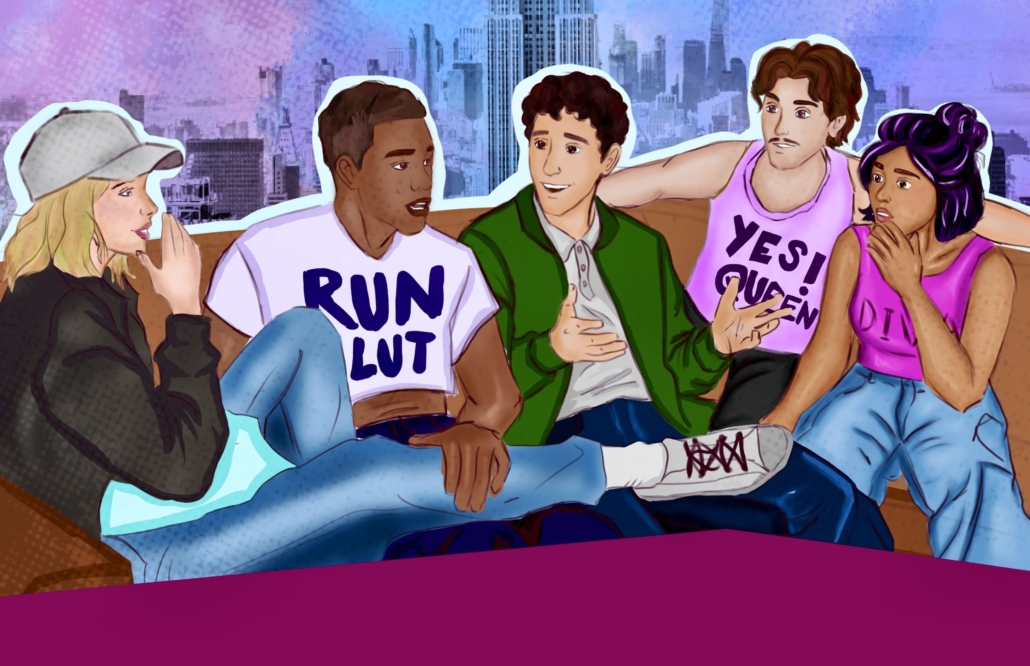

FX’s “Adults” nails down how this generation communicates beyond the screen.
Five to six friends in their mid-20s, a token conversation spot — usually a couch or restaurant booth — and the eternal hangout. Since the rise of “Seinfeld” and “Friends” in the ’90s, nearly every sitcom follows a formulaic approach. And it captures my attention every time.
Watching a college brochure-worthy group of young adults navigate their chaotically unstable lives has made up over 50% of my television consumption throughout my teenage years.
I have cackled at Marshall (Jason Segel) and Barney’s (Neil Patrick Harris) “slap-bet” in “How I Met Your Mother” and rewatched clips of Nick (Jake Johnson) and Jess’s (Zooey Deschanel) perfectly timed “Green Light” elevator kiss in “New Girl” more times than I can count.
While I’ve heard the “all sitcoms are just a rip-off of ‘Friends’” comment a million times from television purists, I still defend the formula. Shows like “How I Met Your Mother,” “New Girl,” “The Big Bang Theory” and “Girls” aren’t just carbon copies; each offers an adjusted portrait of how young adults communicate during the show’s run-time.
During a binge rewatch of “Friends,” I found myself thinking about how the jokes, some of which I feel are outdated, they’re what make the series the most quintessentially ’90s show ever.
In the same vein, Jessica Day’s quirky twee aesthetic and Marnie Michael’s (Allison Williams) second-hand-embarrassment-inducing a capella cover of Kanye West’s “Stronger” might resurface painfully cringe memories for millennials, but they’re also the details that set the shows apart as a product of their time.
Despite the plethora of ’90s to 2010s friend groups perfectly portrayed in television, I’ve struggled to find many representations of Generation Z on TV that don’t feel like they’re wildly exaggerated and written by a millennial whose exposure to our generation is primarily via 2020 TikTok trends. In every depiction, most of which are in teen dramas, writers fail to translate our online language into verbal communication. That is, until FX’s “Adults.”
I remember rolling my eyes while watching Ginny (Antonia Gentry) receive a “Happy Friday” Snapchat video from Hunter (Mason Temple) on “Ginny and Georgia.” I also wanted to turn my head away from the screen when Jeremiah (Gavin Casalegno) started dancing to “So Pretty” — a song I firmly believe is reserved for 2021 TikTok transitions only — in “The Summer I Turned Pretty.”
The most unbearable trends on social media, many of which our generation pokes fun at, are transformed into identifying Gen Z traits in these shows, making them more rage-bait watches than anything else.
Despite how brainrotted our generation may seem online, most of us have enough personality not to be dominated by buzzwords, trends and our phones when we speak to each other. My friends and I can spend hours sitting on the couch in our dorms just chatting each other’s ears off, much like the friend groups portrayed in so many older sitcoms.
“Adults,” FX’s Gen Z young-adult sitcom, seems to be the one show that finally understands this. The show’s second season was released at the end of last month, bringing the rambunctious bunch of roommates back to screens.
The show centers around a group of five roommates, Issa (Amita Rao), Billie (Lucy Freyer), Paul Baker (Jack Innanen), Samir (Malik Elassal) and Anton (Owen Thiele), who are staying at Samir’s parents’ house in Queens while they’re away.
The group is both hilarious and incredibly accurate to the chaos that is our generation. The cadence of their speech sounds just like how my friends, peers and I speak. They decorate their sentences with an unfortunate amount of “like”’s and talk at a mile a minute, often carrying a lot of stress and dramatics in their voice. Although they employ some phrases in their vocabulary that are distinctly Gen Z, such as “lock in” and “on the prowl,” it isn’t in your face.
The show finds its success in intelligently focusing more on portraying general issues that pertain to the young adult audience, including the unstable job market, digital footprints and open relationships, instead of drowning the dialogue in trending phrases that will inevitably be tired in the next few months — I’m looking at you, “chud.”
By focusing on how we talk to each other in conversation and searching for real-world topics that interest us, rather than what’s trending on our phone screens, “Adults” successfully captures a genuine portrait of this generation.
When I choose to watch TV, I don’t want to see another portrayal of the TikToks that populate my for you page; I want to see the discussions my friends and I passionately share in the living room and the laughs heard through the walls of our dorm. “Adults” may be the “Friends” of our generation, an accurate depiction of what it’s like to live with roommates in the 2020s.
If more shows follow suit, we may finally feel more connected to our on-screen representations.
Marina Yazbek is a sophomore writing about language and its role in popular culture and entertainment in her column, “Word on the Street,” which runs every other Tuesday. She is also an Arts & Entertainment Editor at the Daily Trojan.