Hidden hands are part of the Trojan family too
The work behind USC’s polished campus life is often overlooked — it’s time students notice.
By ATHENA BAUTISTA
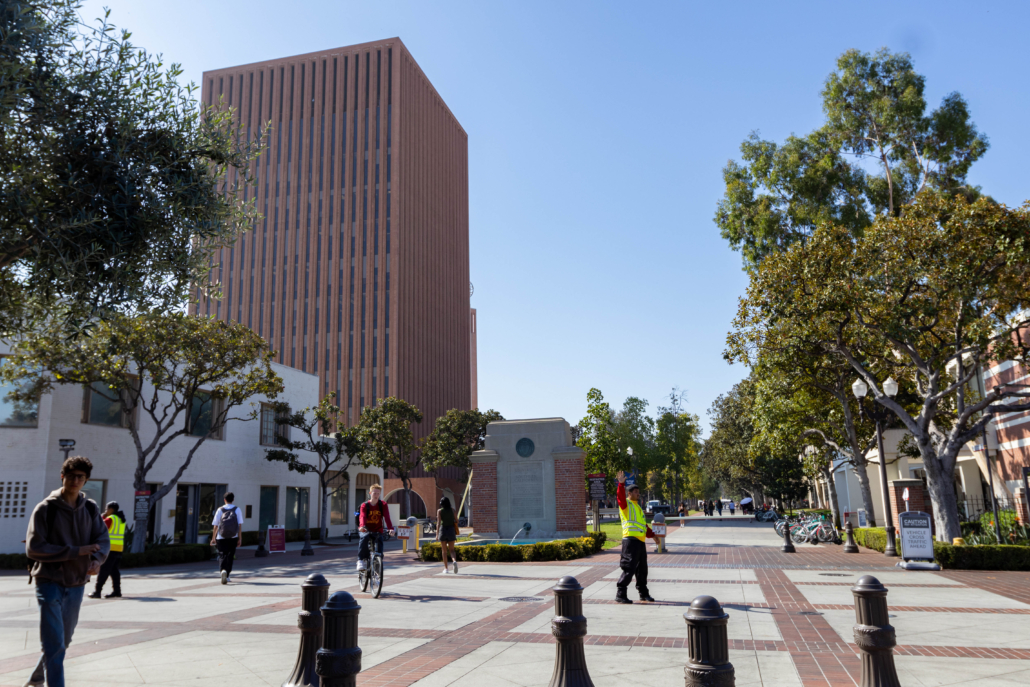

The work behind USC’s polished campus life is often overlooked — it’s time students notice.
Growing up in the Philippines, the idea of class has always persisted in my mind. Although I had a middle-class upbringing — with a yaya, or nanny, and a private school education — my family did not have appliances such as a fridge or an oven. After immigrating to the United States, I was called rich for having a nanny, yet my family was considered low income even though I had running water and electricity without constant brownouts.
These conflicting experiences of class taught me that communities and cultures define class differently and, therefore, treat people of that class differently.
My upbringing taught me to understand how essential service workers are to a family and community. Since getting to USC — a place known for its affluent students — I’ve noticed that students are supported by service staff regardless of their respective socioeconomic backgrounds, and most don’t appreciate them as they should.
USC staff manage so much of what students need, from food to air conditioning problems; their daily tasks are what students rely on, consciously or unconsciously, to get through school and through life. However profound that support may be, there seems to be little acknowledgement of the work these staff members do.
Jolynn Hallum, a sophomore majoring in in legal studies, said the nature of being a university student can make your vision clouded on what is actually important in life, therefore informing which relationships you form.
“You’re in a bubble at university, and we’re also young adults,” Hallum said. “It’s difficult to conceive anything beyond that. I think it’s like, ‘I’m in this tunnel vision of being a USC student so I’m doing all my USC student things.’ However, I think that with the chaos of university life, [service workers don’t] cross [your] thoughts, but I think [for] a lot of people, there is a lot of respect still for the staff here.”
Students may respect staff and interact with them in a friendly way, but their own swirl of activities and academics prevents them from truly acknowledging these helping hands.
Yadira Maldonado Orozco, a sophomore majoring in law, history and culture, noted that seeing staff members who look like her and her family brings her both feelings of home and discomfort.
“When it comes to the people who work here, noticing that they all look like me, it’s kind of a weird feeling sometimes,” Maldonado Orozco said. “How do other people view me? The white rich kids, are they gonna view me in the same aspect that they view them as?”
Another problem is not just about unawareness, but being deeply conscious of class differences and similarities that bar students from furthering a connection. Despite these barriers, students still have memorable experiences where staff made them feel at home.
For Maldonado Orozco, a small conversation with a maintenance worker made her feel at home. Seeing staff that shared her background was a privilege, as their support gave her a new perspective on her own opportunities and efforts to change the future for her family, she said.
However fulfilling those moments may feel, it is still easy to hide in an individual bubble. There is a feeling that students might bother staff while working, but it’s worth stepping out of one’s comfort zone.
Maldonado Orozco also mentioned that students don’t need to make expensive gestures that make both parties uncomfortable.
“It’s not that big of a deal; they’re also people,” Maldonado Orozco said. “For them, it’s just their day-to-day being here.”
USC emphasizes the importance of the Trojan community, but that community isn’t complete without staff members.
“They are part of your Trojan community and if we’re emphasizing [community] at USC so much, that’s a huge selling point of this university,” Hallum said. “You’re at USC, [they are] your Trojan community.”
While the title of student consumes much of our day-to-day lives, it is also important to be an active member of the Trojan family. This Trojan network does not only mean finding alumni to do coffee chats with or staying five minutes after class to talk to your professors; it is also acknowledging and appreciating the staff, too. Their work is also what makes your USC journey possible.