Community Coalition rebuilds underserved neighborhood
South Central residents uplift their neighborhood through political mobilization.
By KAYJEL MAIRENA
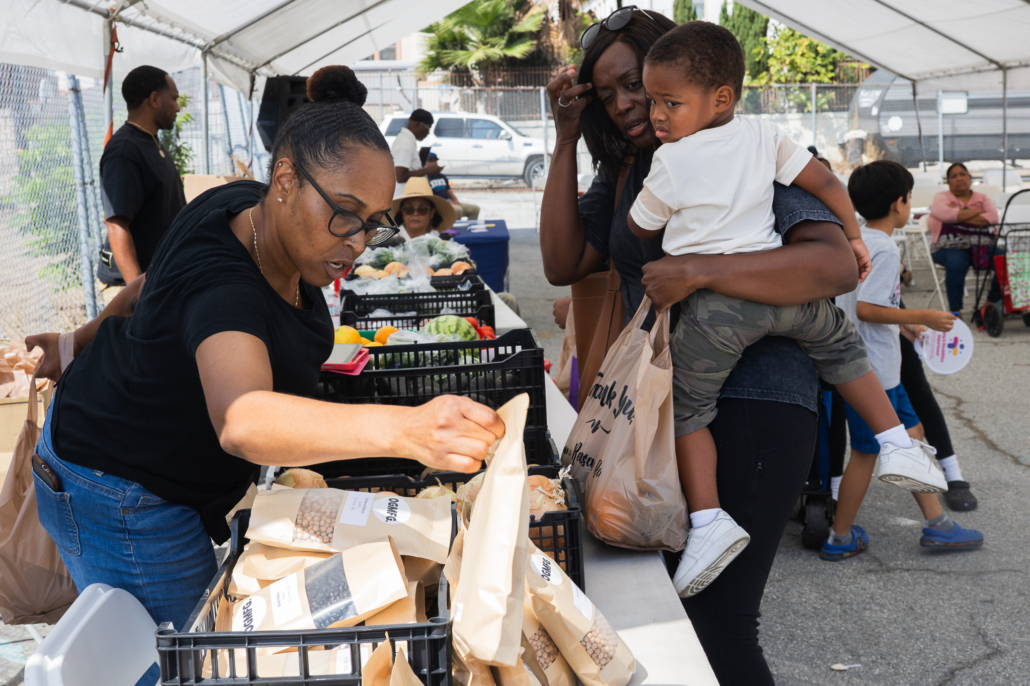
Community Coalition, an advocacy group based in Los Angeles, offers resources and a sense of community to people in their times of need. (Kayjel Mairena / Daily Trojan)
South Central residents survived a public health crisis in the ’80s and mass incarceration. After years of governmental neglect, a group of Los Angeles residents formed a coalition to give resources to their neighbors when they felt that lawmakers weren’t.
Tamiko Estelle, a representative of the Community Coalition, said officials have mismanaged the area for decades.
“This has been going on [since the] ’70s, ’80s,” Estelle said. “You can’t just vote this one time and then think, ‘Oh, it’s supposed to be done tomorrow.’ Change, it starts somewhere, but you got to build it.”
Daily headlines, sent straight to your inbox.
Subscribe to our newsletter to keep up with the latest at and around USC.
Community Coalition is an L.A.-based intergenerational advocacy group of residents focused on improving their neighborhood through social activism. Its goal is to combat education inequality, biased policing and poverty in the South Central area.
South Central activists and now-L.A. Mayor Karen Bass founded Community Coalition in 1990 in response to poor conditions in the neighborhood. In 1993, 23.8% of L.A. County residents were living in poverty, according to the Federal Reserve Bank of St. Louis.
At the organization’s headquarters on South Vermont Avenue, people can receive assistance with housing, food scarcity and financial aid.
“We have the Community Coalition [pick] up kids from high school. They mentor, tutor. They take them places,” Estelle said. “We have child care provided, so it’s not just leave the kids at home. We have a way to help.”
The organization held a food bank down the street from its headquarters with Prosperity Market, a Black-owned food truck and farmers market, on Saturday. The Prosperity Market pop-up is one of several efforts by the Community Coalition aiming to fight resource insecurity.
The event took place in an empty parking lot underneath a white canopy. Anyone walking on the street who saw it was welcomed. Upon entering, each person received a $50 voucher for a hot meal and discounted groceries, which could be redeemed on site.
“If they can’t help you, they will meet you. They’ll help you,” Estelle said. “They have a sister or a partnership that can guide you somewhere else [to find] resources, with anything like diapers, housing [and] a lot of things. That’s what led me [here]. Somebody invited me, and I never left.”
Estelle is in her “late, late, late” 40s now, she said, and has gotten her mom, daughter and aunt to join too.
Aside from providing relief, a large part of Community Coalition’s work entails neighborhood mobilization, including voter registration drives.
Community Coalition and policing reform activists furthered their Stop the Stops campaign, an initiative to ban pretextual stops, in March. After years of advocacy work, the City Council voted 13-0 to ban pretextual stops, when officers stop a car for a minor violation to investigate further unrelated criminal activity.
Ricky Wright, a Community Coalition representative, said pretextual stops are “a very dated and discriminatory practice.”
“Pretextual stops, nine times out of 10, don’t lead to any successful evidence of a crime,” Wright said. “What we found is not only are they unsuccessful, they’re putting Black and brown folk from our community in stress.”
The motion now sits with the L.A. Police Department Board of Commissioners, which has the power to make the ban official.
Another major campaign, Wright said, is the Free the Land initiative, which targets sex trafficking on the Figueroa Corridor and aims to close “motels that have been nuisances in the community.” With an open space, the organization hopes to reimagine the neighborhood.
“One of the things that we’re really proud of is the Evermont Plaza. We’re having a grocery store that’s going to be in our community, a community that’s like a food desert,” Wright said. “We have to bring outside organic food, so now we’re closing a lot of spaces like motels and seeing [if] we put parks there [or] put mental health resources there.”
According to Wright, to receive aid from Community Coalition or to join, all a person has to do is show up. The organization is mostly made up of residents from South Central, Wright said.
“It’s really important to us that we have Black and brown solidarity in our neighborhood, and that the people from our neighborhood, who are being mostly directly impacted by the issues, are the ones making the decision and organizing around them,” Wright said.
Wright said that if a person can’t make it out to Community Coalition, they should build their own group and take care of one another “when the state fails to.”
“It doesn’t have to be with any of us here because we all have a role in the movement. It starts with you,” Wright said. “We need protesters. We need writers. We need documenters so that they can tell the stories that we want to tell.”
Janell Sanders, an L.A. resident, said she wanted to volunteer for Community Coalition after receiving a $50 voucher she used to purchase groceries.
“I’ve been through a lot,” Sanders said. “You never can look at someone and tell what they’re going through. Stuff like [the Community Coalition] is needed, and I just want to be able to help people and make people feel welcome and comfortable, like everybody made me feel today.”