The SAT should make a comeback
USC’s test-optional policy may further harm the school’s socioeconomic diversity.
By LILY TRAN
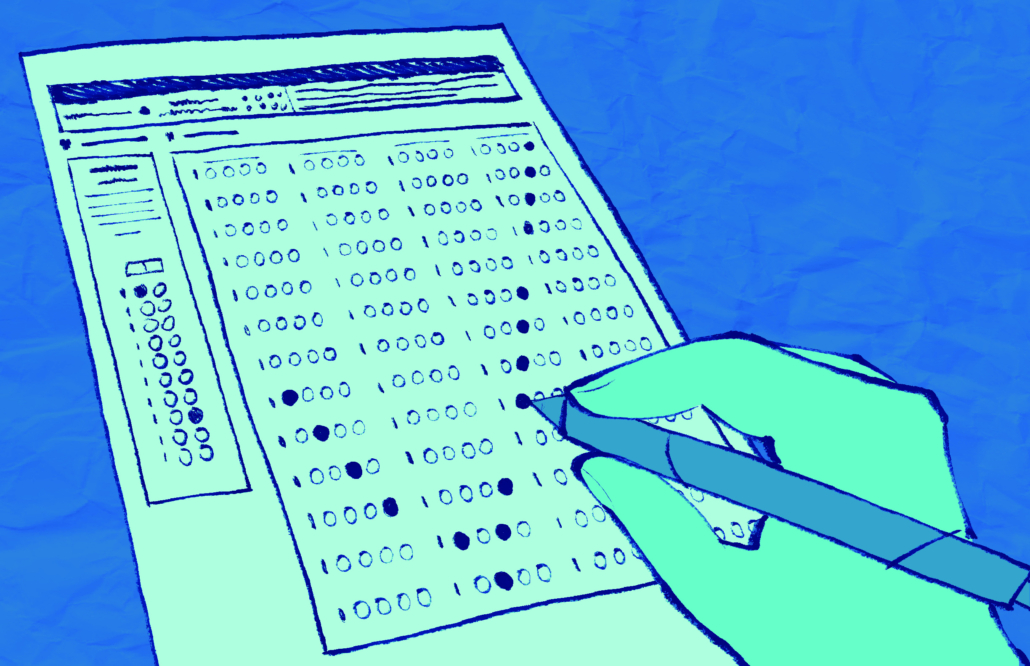

USC’s test-optional policy may further harm the school’s socioeconomic diversity.
The USC admissions website states its “admission process has always been holistic, and [it is] confident in [its] ability to identify student potential using the totality of what is presented to [it], regardless of test scores.”
Many elite universities said this when they dropped standardized testing, claiming it would remove barriers for low-income students who don’t have as much access to SAT preparation. And yet, six years later, many elite universities are deciding to bring standardized testing back. Honestly, it might be for the better.
All schools, including USC, should make standardized testing required again because it can level the playing field for low-income students, providing an easier, more accessible way to stand out among peers with greater access to prestigious extracurriculars. When you take the SAT away, the only ways to assess one’s application are through extracurriculars, GPA and essays, which are even more skewed in favor of the wealthy.
A January 2024 study conducted by researchers at Opportunity Insights showed that the SATs are a better indication of future college GPA compared to one’s high school GPA. College admissions don’t account for grade inflation, which many elite private schools often have to make sure their students look better on paper compared to others.
As someone who attended a rigorous private high school in Los Angeles, I can attest that many private schools find ways to make their overall student GPA higher, whether it’s adding an extra grade point to their scale or even having a different grading system altogether. Without the SAT as a factor in admissions, high school GPA becomes a key indicator of academic success, which favors private school applicants.
The study also found that SAT scores were a general predictor of college grades regardless of a student’s financial background.
There is no evidence that students from higher-resourced backgrounds outperform those with less access. There is no cheat code to doing well on the SAT. Even if you can pay for intense tutoring, you still have to put in the effort to get a good score, making it a slightly more even playing field for everyone rather than simply relying on an arbitrary metric like GPA.
While I acknowledge that those who can afford tutoring will forever have an advantage in the college admissions process, nowadays SAT tutoring is one of the more freely accessible resources. With websites like Khan Academy or workbooks in your local library, compared to the pay-to-play summer programs that high-income students primarily have access to, SAT preparation is significantly cheaper to have.
So why has USC decided to remain test-optional?
Morgan Polikoff, a professor of education at USC, said there simply isn’t enough evidence yet that USC admits fewer college-ready students as a result of being test-optional. However, Polikoff also said politics may play a huge role in USC’s decision.
Polikoff argued that requiring the SAT again, which statistics from the Brookings Institution show favors certain racial groups, could be used as evidence of bias by the Trump administration if admission rates for underrepresented racial groups don’t go down.
This means requiring the SAT could drive down minority enrollment at USC and diversity rates. Even if SATs gave those of lower socioeconomic status a fairer chance in college admissions, it may not be worth changing, especially since affirmative action no longer exists.
Still, remaining test-optional can harm the college population.
A January 2025 study conducted by researchers at the National Bureau of Economic Research showed that test-optional policies disproportionately hurt high-achieving students from less privileged backgrounds. Though remaining test-optional was supposed to give these students a fairer chance in admissions, many of them choose not to report their scores for fear that they cannot compete with higher scores from privileged students.
This is because they don’t realize –– and because admissions offices don’t advertise –– that their scores are often evaluated within the context of their background. A 1200 from a disadvantaged background looks marginally better to admissions officers than a 1400 does from a privileged background, according to the study. Test-optional policies have encouraged students to not submit scores when they should have, harming upward mobility.
While I respect USC’s decision to remain test-optional, this conversation is worth revisiting. Changing the policy could allow for a more diverse socioeconomic student population –– which USC is already struggling to cultivate due to its high tuition. Additionally, it would ensure that admitted students are ready for the school’s academic rigor, rather than falling behind because their high school grading scale was much easier than the University’s.
It seems there will always be an unfair advantage in college admissions for those of higher socioeconomic status, but requiring the test again and assessing it within the context of one’s background could be a step in the right direction.