Open Dialogue Project covers how to facilitate meaningful interactions
The interactive workshop explored how to find value in conversations with different perspectives.
By REILLY SIMONS
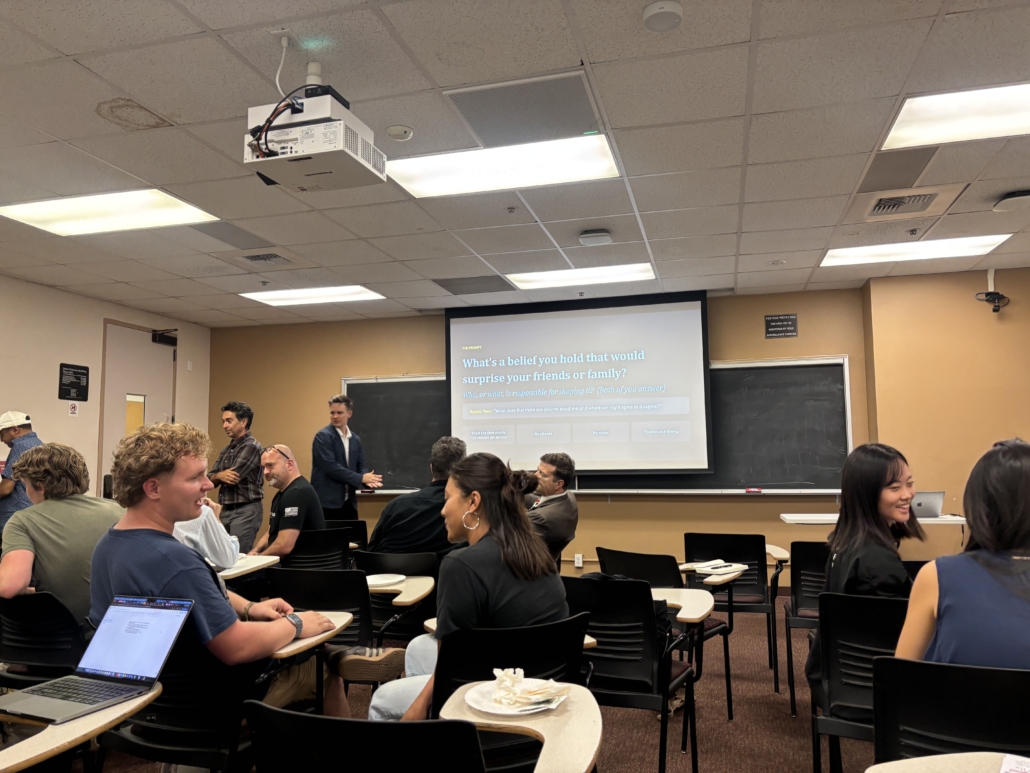

The interactive workshop explored how to find value in conversations with different perspectives.
“What is the profession of this participant?” was a question posed to attendees at the Why Some Conversations Change Minds (and Most Don’t) interactive workshop, hosted by the Open Dialogue Project, on Monday.
In a poll, attendees were given various photos of individuals and asked to guess their professions. Jonathan Webster, a USC alum and managing director at StoryCorps, a nonprofit focused on storytelling, hosted the workshop. He said the poll was “intended to illustrate that automatic process that follows from a question like that” and how humans tend to take in information that affects their responses before actual conversations.
“You’re presented something like this — what does this person do?” Webster said. “You’re already taking in input that’s going to inform your answer even before you’ve begun to actively engage with the question.”
After the initial poll, attendees were asked to think about something they used to believe and no longer do. Forty-two percent of respondents said new information or evidence changed their belief. This specific polling result would not match a broader sample taken from an audience representation of the United States, Webster pointed out.
When asked to give an example of a belief changed by new information, Wesley Clum, a sophomore majoring in political science, said his past support of artificial intelligence development in the U.S. He later changed his mind after learning more about the topic.
“The new information around the future of AI and what it’s been doing recently is changing my mind pretty significantly,” Clum said.
Clum also spoke about the value of attending these events as a USC student, since they offer fresh perspectives.
“Having an opportunity for people to go learn about something that is outside of their bubble is really important,” Clum said. “It makes students here more knowledgeable and better thinkers as well.”
The dialogue then moved toward the question, “Why does everyone argue?” Webster explained the mechanism of “what gets rewarded gets repeated” and used social media as an example.
“We communicate a lot in comment sections, and what is the thing that gets rewarded?” Webster asked. “Dunking on someone, an effective dunk, definitely gets rewarded. … The reward is in winning. You’re trying to own the other side. You’re trying to dominate them. It’s not about an exchange, and it’s not about listening.”
According to Webster, the solution is listening closely, sharing openly and asking genuinely.
Attendees were instructed to have a conversation with someone from a different background. After these one-on-one conversations concluded, many people said they could have used more time, reflecting a sample of a wider group where 70% of polled NPR listeners “wanted to talk to the same person again.”
Additionally, guests were challenged to apply this mindset to their day-to-day lives by incorporating an extra question that isn’t necessarily required in their next conversation.
During the questions and answers portion, Angelina Silvestri, a master’s student studying science in integrated design, business and technology, said she wondered whether this advice would change in a setting involving one-directional communication, such as educational content. Webster noted a significant difference by pointing to the anonymity online conversations provide and the lack of constraints that comes with it.
“I’m always looking to grow, expand my knowledge base, and [I] love when someone can change my mind or when I learn something new,” Silvestri said.
At the end of the event, Webster acknowledged that it wasn’t important if anybody’s mind was changed by their conversations — their ability to understand the other person’s perspective was what truly mattered.
“You shouldn’t really go into a conversation trying to change things,” Webster said. “You should go into a conversation trying to understand their mind, and from there, you’re gonna have a much better idea of where to go next.”