JAM JOURNAL
Being a theater kid means more than you think
Theater is important because of the community it provided me.

By CHARLOTTE DEKLE
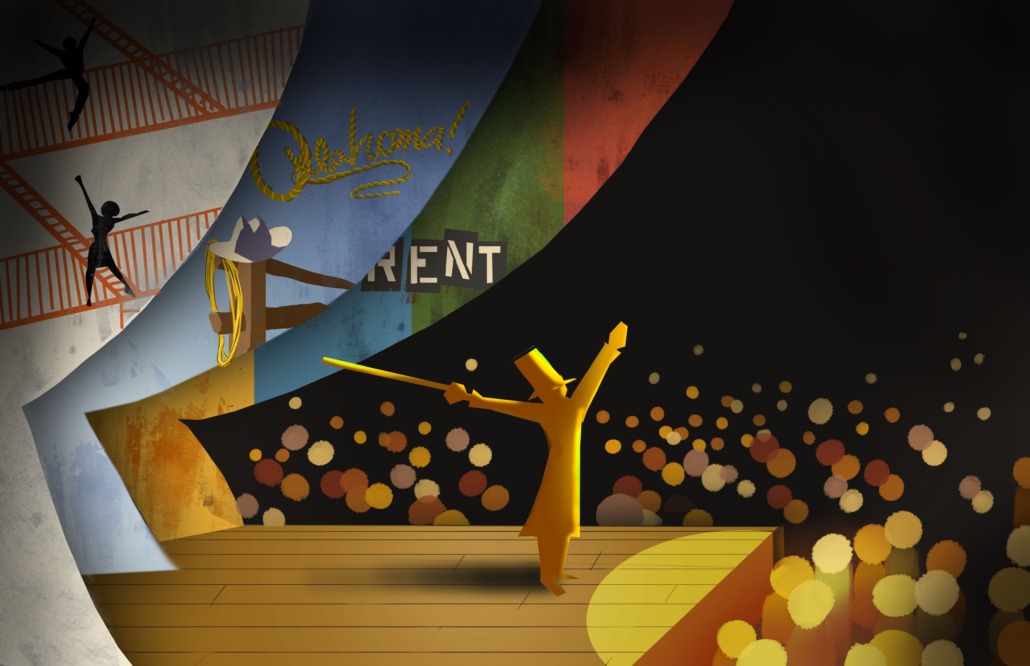

Theater is important because of the community it provided me.
Anyone who knows me even a little knows that musicals are an enduring, central part of my identity. The only Spotify playlist I listen to regularly is my 64-hour musical theater collection, filled with rock operas like “RENT,” golden age classics like “Oklahoma!” and anything Rachel Zegler has ever sung.
Despite musical theater’s centrality to my life, I struggled to formulate my thoughts around what it means to me. In high school, I founded a club dedicated to its history, where I basically got to geek out every week for three years. But how do I distill two decades of passion into one coherent idea? Well, I won’t, because musical theater isn’t any one thing.
For one, my love for musicals is shaped by my love for my grandfather. When my family makes the annual pilgrimage to Boston, my grandfather records movie musicals for us to watch on his television.
The first time I watched “West Side Story” (1961), he watched as my eyes widened during the opening ballet. When he shows me W.S. Gilbert and Arthur Sullivan operettas, he points out the wordplay and melodies and tells me stories from when he saw them in London. We still complain about Jane Powell’s pingy soprano in “Royal Wedding” (1951).
Beyond my grandfather, musicals have crucially defined nearly every relationship in my life. Every spring break, I travel to New York to visit my friend, Sophie, and while I’m there, we always see a Broadway musical. This past Spring, Sophie and I saw “Chess,” a show we had a long-standing history with after learning the choreography to “The Arbiter” from the 2008 concert version a few summers ago.
When we saw that they were reviving the show on Broadway during spring break, the stars aligned. We got up bright and early and waited in line to rush the show. We sat separately during the performance, but it was still one of the greatest moments of our lives. We spent the entire train ride back dissecting the cast’s performances, the staging and the songs.
For listeners and enjoyers, musicals are a form of connection. Not just connection with your friends and family, but also with everyone else in the theater. Musicals are my Nicole Kidman AMC ad.
After each performance, there’s a collective understanding that everyone in the audience saw the only time that show will be done in that particular way. It’s an incredibly ephemeral and special experience. Even the creation of theater is inherently collaborative: Composers, lyricists, directors, choreographers, lighting designers, set designers and a thousand other people join together to pursue a goal.
The stage was also often one of the only places for underrepresented people and minorities to be themselves. In a world that shunned them, theater welcomed them. It certainly has a long way to go when it comes to representation, but it has historically been a home for marginalized voices.
As someone who struggled to make friends in my youth — shockingly, musical theater and television shows from the 1970s did not attract other fourth graders — I retreated into the “Great American Songbook.”
In my adolescence, I would try to write musicals of my own, emulating the patter songs of Gilbert and Sullivan, the quick wit of Cole Porter, and the clever wordplay of Stephen Sondheim. In a pink polka-dotted notebook, I would write rhymes for future songs. But after I did youth theater, my castmates became my best friends.
But in addition to the community it creates, there’s something deeper about musicals that has stuck with me: Unlike most other forms of music, songs in musical theater must advance the plot or advance a character’s arc — the emotional place that the character is in at the beginning of the song must be different than the one they are in at the end.
“Soliloquy” from “Carousel” is not only one of the most rousing musical numbers ever created, but it also marks Billy Bigelow’s complete emotional transformation.
Ideally, by the end of the show, the character and the audience have been changed … “for good.” By the end of “Something’s Coming” from “West Side Story” or “Corner of the Sky” from “Pippin,” you understand the psychological desires of the characters, even if the characters themselves don’t know what they want.
Like those characters, I still am not sure exactly what I want out of my life. But I do know that “something’s comin’, something good, if I can wait.”
Maybe I’ll never be Porter, Sondheim, Stephen Schwartz, Richard Rodgers, Oscar Hammerstein or Lin-Manuel Miranda, but maybe I can find my own corner of the sky.
“Jam Journal” is a rotating column featuring a new Daily Trojan editor in each installment, commenting on the music most important to them. Charlotte Dekle is an opinion editor.