Ed Sheeran is a distraction from the problem
The pop artist’s portrayed political neutrality doesn’t turn him into a Zionist.
By EMMA SMITH

The pop artist’s portrayed political neutrality doesn’t turn him into a Zionist.
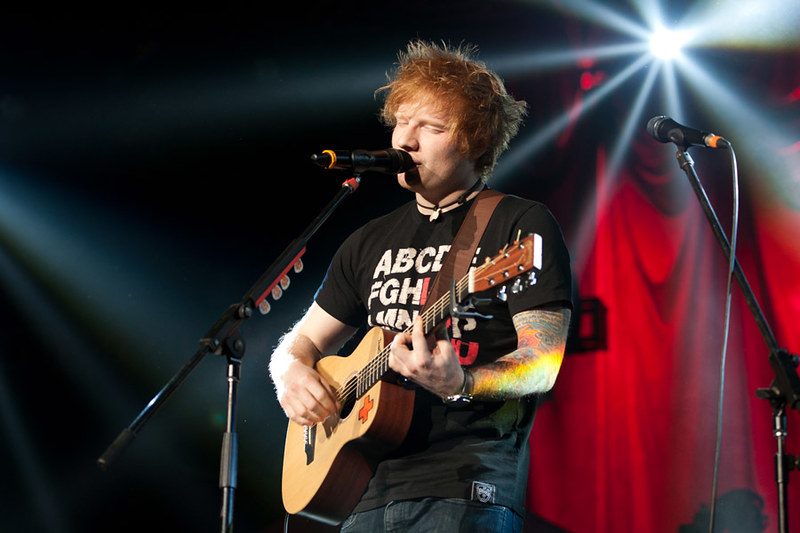
Red hair, charming accent and relatable music: This was Ed Sheeran’s reputation as of last week.
On Sept. 4, Macklemore opened for Ed Sheeran’s “Loop Tour” in front of an audience of almost 90,000 people. Following his performance of “Hind’s Hall” and a call for a “free Palestine,” Macklemore faced criticism from advocacy groups, including the Israeli-American Council.
The group cited the use of “selective imagery, biased messaging and disputed claims,” and created a petition to have Macklemore removed from the tour. On Sept. 14, Macklemore was dropped from the tour following objections from multiple venues and a decision by Ed Sheeran’s promoter.
Now, some protesters are accusing Sheeran of supporting Zionism, chanting, “Ed Sheeran is a clown / Zionists get out of town,” according to The New York Times. Not only is this inaccurate, but it also sets a dangerous precedent for the role artists are expected to play in discussions on political issues and global conflict.
The blame Sheeran faces is not only disproportionate to what he deserves; it is also distracting.
While media outlets scramble to cover his public controversy, public attention is once again being drawn away from what actually matters: the growing power of billionaires, the ability of wealthy private actors to restrict expression in influential cultural spaces, like the aforementioned concert venue, and the deaths of more than 70,000 Palestinians since 2023 during Israel’s military campaign in Gaza.
Macklemore, like all public figures, has the rare and powerful tool of social influence. His decision to speak out and draw attention to one of the most dire humanitarian crises in the world is an exercise of that influence in support of Palestinian human rights, and more celebrities should consider doing the same. But it has to be a choice.
Before they are musicians, they are people. Artists should use their platforms, but choosing not to shouldn’t result in an inability to pursue their art. Part of free speech is the freedom to not speak.
In the past week, Sheeran has been pressured to treat his tour as a proclamation of his personal beliefs, despite having maintained a music-first public image and generally avoiding making his concerts forums for contested political causes.
His decision to proceed with the tour route as planned, despite venues barring Macklemore, is being interpreted as evidence that his compliance with those venues implies support for the Israeli government and its military operations in Gaza.
Following the controversy, several of Sheeran’s family and friends severed ties with him, while his band and scheduled opening acts withdrew from the remainder of the tour. FINNEAS, who was originally scheduled to open for Sheeran in South America, said in an Instagram post that “artists must not be silenced when they speak up for the oppressed.”
People forget that a celebrity’s public persona is not entirely reflective of their private life. In an Instagram post, Sheeran said “I am not complicit” and refuted the notion that not speaking publicly on a conflict means not caring about it.
But there are more people in this equation than just Sheeran. Robert Kraft, the billionaire who owns the New England Patriots and Gillette Stadium, gave Sheeran an ultimatum: he could drop Macklemore from the tour or lose the venue where thousands of fans had bought tickets to see him.
Kraft accused Macklemore of “hate speech,” yet Macklemore said, “to all my Jewish brothers and sisters: criticism of Israel, criticism of apartheid, being against genocide in no way is a criticism of you.”
By banning Macklemore from performing in his stadium and rallying other venue owners to do the same, Kraft demonstrated how concentrated private wealth can determine which political messages are permitted in major cultural venues. Macklemore noted at the end of his first Instagram post that Kraft’s decision was not directed toward him individually but rather at the potential for other artists to build wider support for Palestinian freedom and self-determination.
Macklemore has demonstrated a willingness to accept professional consequences for his advocacy amid recent controversies: He stood by his beliefs when it cost him a once-in-a-lifetime opportunity and donated $1 million to charities supporting Palestinian relief. He also launched a tour where 100% of the proceeds will support Palestinians.
But, perhaps more impressively, Macklemore has not taken advantage of the sudden spotlight he has garnered to promote his career. He acknowledged in an Instagram post that the fans defending him risk misdirecting their support and wrote, “I want to bring the conversation back to where it belongs: to the Palestinian people who are still being killed, still living under military occupation, and still fighting for their freedom.”
Artists should use their platforms to speak up for the oppressed, and it is fair to criticize those who don’t. But to cancel them, to try to end their careers and to equate them to the perpetrators of oppression, is a step too far. Audiences should remain free to question an artist’s silence, just as artists should remain free to decide whether and how they respond.
The issue at hand is much larger than the rise or fall of any one celebrity: It concerns the freedom of all public figures to retain control over how they present themselves to the world and the threat that wealthy institutions pose to that freedom.