FEMININOMENON
Lucy Dacus ushers in new era for classical music
The musician celebrated reclaiming her debut album’s masters at the Hollywood Bowl.

By FIONA FEINGOLD
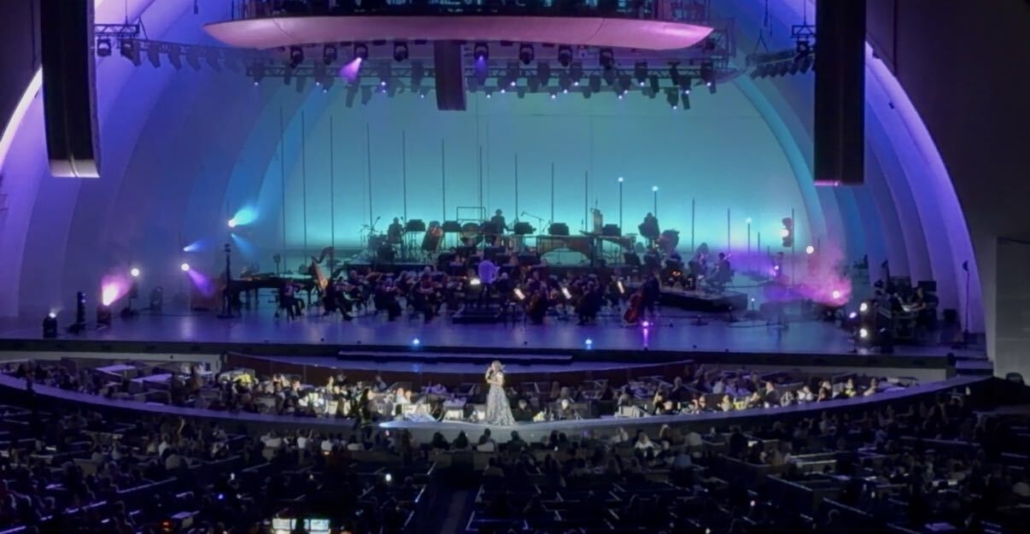

The musician celebrated reclaiming her debut album’s masters at the Hollywood Bowl.
The best concerts can transport you somewhere else. For 100 minutes or so, the anxieties of everyday life come to a screeching halt: It’s just you, the artist and whatever friend you forced to tag along.
On Sept. 13, I saw Lucy Dacus perform at the Hollywood Bowl with the venue’s orchestra. The concert was the final performance of her “Forever Is A Feeling” tour in the wake of her titular fourth album. I had previously seen Dacus perform as a part of indie supergroup boygenius — alongside Phoebe Bridgers and her now-girlfriend, Julien Baker — but hearing her solo, accompanied by a live orchestra, was a completely different experience.
That night, Dacus’s smooth vocals took center stage, coalescing with the symphony to command thousands of attendees into awed silence. If “forever is a feeling,” Dacus captured it at the Hollywood Bowl.
The performance was a fitting end to the “Forever Is A Feeling” era, which marked Dacus’ foray into a more classical sound — a genre within which women are typically underrepresented.
The album swaps out the moody electric guitars of “Historian” and the ambient synths of “Home Video” for arpeggiated harps and layered string arrangements. Lyrically, Dacus remains true to the endearing candor that she has become known for, unabashedly wearing her heart on her sleeve.
While many musicians have experimented with orchestral production, I can’t remember the last album I listened to that was so directly influenced by classical music. The record begins with an instrumental track, “Calliope Prelude,” which features crescendoing violins that symbolize the album’s overall progression, while the titular song uses an array of instruments to dramatically modulate between keys, underscoring Dacus’s contradictory hook: “This is bliss / This is hell.”
The album exposes Dacus’s fans to a genre they are likely unfamiliar with, which also happens to be where the work of women musicians is more essential than ever.
Despite women representing nearly 48% of classical performers, according to a 2023 report by the League of American Orchestras, they remain a stark minority of composers. Last year, approximately 23.8% of music performed by United States professional orchestras was written by women, according to Women’s Philharmonic Advocacy.
Dacus is credited as a composer on “Forever Is A Feeling,” meaning she played an active role in shaping the album’s instrumentation rather than merely signing off on the production. Knowing this, there is something particularly powerful about the way Dacus led the orchestra with her voice — acting as a secondary conductor of the music she penned herself. How many women composers are given that opportunity?
On an even more poignant note, Dacus performed music that she owned: Aside from marking the last stop of a yearlong tour, Dacus also celebrated the newly acquired ownership of her masters with concertgoers. While musicians own the rights to their original lyrics and compositions, the rights to their masters — the original sound recordings — are often owned by record labels.
Since Taylor Swift began rerecording her old catalogue, the conversation of musicians owning their masters has entered the zeitgeist. When Swift was unable to buy back the masters to her first six albums, she released her own editions of “Fearless,” “Speak Now,” “Red” and “1989,” affectionately dubbed “Taylor’s Version[s].” Swift has since been able to buy the original masters to all of her previously unowned albums.
A master recording is the culmination of all the blood, sweat and tears that went into bringing a project to release. While all artists should be entitled to own these rights, very few do. Dacus’s fight for her masters proves that ownership is no longer a privilege that only A-list pop stars like Swift are entitled to.
A few days prior to the concert, Dacus commemorated the milestone with the release of “No Thank You, I Love You, Goodbye,” an unreleased track from her debut album, “No Burden.” The title feels like a subtle dig at the executives she acquired her masters from; it’s a farewell to the era of not owning her music.
Although the song is a deep cut from an album originally released over a decade ago, “No Thank You, I Love You, Goodbye” feels deeply symbolic of Dacus’s artistic philosophy: Throughout her music, she expresses a seemingly radical care for the subjects she sings about — whether she’s singing about a friend, a lover or a burned ex. Even when heartbroken or angry, there’s always a layer of tenderness directed at the song’s muse.
Dacus’s sincerity is the thread extending across her vast discography, and it’s what made her concert such a joy to watch. She cares — not only about putting on the best possible show for fans, but also about the musicians with which she shares the stage.
Dacus serves as an inspiration to performers of all genres, in both her sound and the grace with which she carries herself. She represents a new future for the music industry, one in which women are not just more likely to compose, but are also empowered to own their music.
Fiona Feingold is a senior writing about women in the entertainment industry in her column, “Femininomenon,” which runs every other Friday.