WORD ON THE STREET
Dictionaries develop the 2020s lifestyle lexicon
Words added to Merriam-Webster are indicative of trends in food, beverage and health culture.

By MARINA YAZBEK
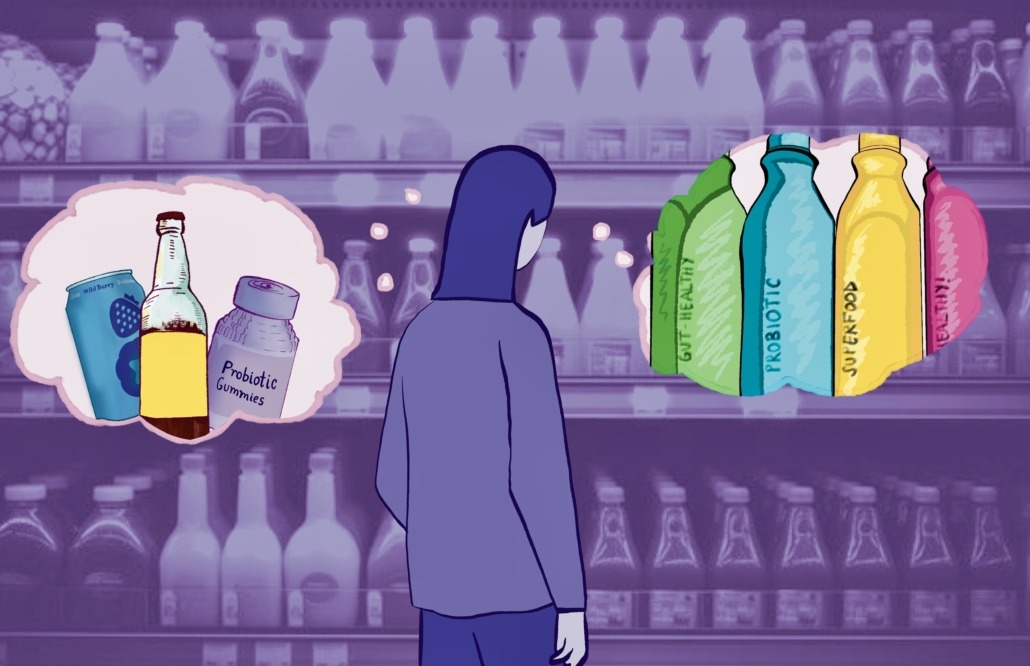

Words added to Merriam-Webster are indicative of trends in food, beverage and health culture.
On Sunday, four sailing teammates of mine and I embarked on a treacherous, gnarly, grimy journey known as the MUDGIRL Run — a fun, low-stakes and untimed 5K through muddy obstacle courses to raise money for breast cancer awareness.
Expecting free water bottles or Gatorade upon finishing the race, I instead crossed the finish line and immediately found myself faced with a stack of bottled protein milkshakes, a table full of nauseating Grüns ‘Superfood Gummies’ and buckets filled with sickly sweet Bloom Nutrition prebiotic sodas.
Despite my initial surprise, ultimately, none of this was earthshattering; it was just a face-to-face encounter with the latest buzzwords in the health, food and beverage industries.
I first heard about “superfoods” about seven years ago when watching videos on YouTube describing recipes for aesthetic smoothies, which drew their blue, pink and purple pastel colors from superfood powders like blue spirulina, lyophilized açai and dragonfruit.
I progressively started seeing the term used more and more in the health market as a whole, most recently in TikTok Shop ads for daily gummy supplements. The word ‘superfood’ is, literally, being shoved down my throat.
Seeing the gummies being offered as a freebie at a charity event seemed like the word’s final trickle-down in the market. That, and its recent addition to Merriam-Webster. On Sept. 15, the dictionary announced 1,400 new terms in its extensive vocabulary; among them were words and terms indicative of food and lifestyle trends, including “superfood” and “California sober.”
Their formal catalogue in the dictionary makes them the closest thing we have to a lifestyle lexicon for the 2020s so far.
Much like ‘superfoods,’ ‘California sober’ didn’t just grow out of thin air; the word is credited to journalist Michelle Lhooq, who coined the word in a 2019 VICE Magazine article about her choice to adopt the lifestyle. The term refers to abstinence from most substances, mainly alcohol, except the use of cannabis.
The term has also manifested in entertainment: In 2021, Demi Lovato released a song titled “California Sober” in their album “Dancing with the Devil…The Art of Starting Over” after announcing their departure from weed use just months prior. In 2023, country artists Willie Nelson and Billy Strings also released a song by the same name. The phrase’s frequent use in media — especially music — helps us track subcultures, as well as the issues and lifestyle changes people adopt.
‘California sober’ is also linked to a larger food and beverage trend: Generation Z’s shift to more health-conscious consumption. Simultaneously, there’s a growing market for wellness-focused products, primarily geared towards young adult consumers.
That same Sunday after my run, walking through the beverage aisle at USC Village Target, I found shelves lined with vibrant cans of Poppi, Olipop and Bloom prebiotic sodas, Barebells’ Protein Soda, and an entire display dedicated to “protein water” … which is then, by definition, not water.
This isn’t the birth of wellness drinks we’re witnessing. Kombucha, which follows relatively similar health principles to drinks like Poppi, has been on the market for decades and has become mainstream over the last decade, with multiple brands available at grocery stores.
If you’re any bit of a rom-com fanatic like me, you might remember Peter Kavinsky (Noah Centineo) swapping a beer for kombucha at a house party in “To All the Boys I’ve Loved Before” back in 2018. Similarly, if you watched any “Love Island” this summer, you may have spotted a couple of Poppis in the villa. Even on screen, both beverages are a regular part of young adult lifestyles.
Nevertheless, while kombucha’s success has been massive and long-standing, some people are averse to it because of the sour, vinegary taste from fermentation. So, in come brands like Poppi in 2020, which promote themselves as a healthier alternative to soda, swapping the probiotics from fermentation in kombucha for more subtle-tasting prebiotics and using one key phrase to find success in the market: “gut-healthy.”
In 2025, market leaders like PepsiCo and Coca-Cola both launched their own prebiotic sodas, and Poppi was bought by the former.
But sodas aren’t the only time we’ve seen “gut-healthy” trends in the last decade. Homemade sourdough, for instance — which also includes prebiotics — gained massive praise online since the pandemic and had everyone becoming their own private chef. The rise in frozen yogurt shops can also be seen as a beneficiary of the gut-healthy buzz. Now, we see this buzz dominating our Target aisles.
Will pounding back cans of prebiotic soda and stunning swirls of yogurt bedazzled with all the toppings of your heart’s desire make you healthy? It certainly can in the heart and in happiness, although studies point out that it’s all very conditional on the volume and form of consumption.
Regardless, all of these products share one thing in common with their success: buzzword marketing. Whether we as consumers truly understand what those buzzwords mean, the phrases ‘gut-healthy’ and ‘gut-friendly’ carry — more than any ingredient list — the power to influence our spending habits.
If predecessors like ‘superfood’ and ‘California sober’ are any indication, I wouldn’t be surprised to see ‘gut-healthy’ or ‘gut-friendly’ added to Merriam-Webster’s dictionary — and to our lifestyle lexicon — in the next few years.
Marina Yazbek is a sophomore writing about language and its role in popular culture and entertainment in her column, “Word on the Street,” which runs every other Tuesday. She is also an Arts & Entertainment Editor at the Daily Trojan.